







Farmland Property Tax Protest: Ag Appraisal, Rollback Taxes and Appeals

Cropland can be taxed on what it produces instead of what it would sell for. Here is how that works in Texas, what triggers rollback taxes and how to protest.
Get Started Now

⏰

Never Miss Another Filing Deadline

🏘️

Now in All Texas & California Counties

💵

Pay Only $129 A Year
No Savings No Fee
Farmland
As Seen On

Property Taxes Too High? Fight It.

Protect yourself from excesesive and inaccurate property taxes. Start with a free consult to find out how much you may be able to save.

Property Taxes Too High? Fight It.

Protect yourself from excesesive and inaccurate property taxes. Start with a free consult to find out how much you may be able to save.

Property Taxes Too High? Fight It.

Protect yourself from excesesive and inaccurate property taxes. Start with a free consult to find out how much you may be able to save.

Thank you! Your submission has been received and we will be in touch soon.
Oops! Something went wrong while submitting the form.

Never Overpay Again.

Property taxes are one of the biggest expenses for any owner. Miss a single exemption or let the county over-value your property, and it could cost you thousands every year.

‍
The appeal process is complex and time-consuming by design. That's exactly why we handle it for you.

‍
Our state-licensed consultants know how to file for every exemption and build a case that gets results. With data on 158M+ properties, we know what your home should actually be assessed at—and we'll prove it.

‍

You've got enough expenses. Your property tax bill shouldn't be higher than it needs to be - and with our "no savings, no fee guarantee" we only get paid if you see a reduction.

Key Property Tax Stats

Last updated: October 9, 2026

Farmland in Texas is often appraised on its productivity value instead of market value, which is usually lower. This page explains how that special appraisal works, how rollback taxes are calculated, what you can protest and how the Texas process works. It is about cropland and general agricultural use. For grazing land, wildlife management and timber, see the sibling pages below and our agricultural property tax protests guide. TaxDrop does not guarantee a result.

How ag appraisal works

  • Two values: for 1-d land, the chief appraiser records both the market value and the value based on capacity to produce (Tax Code §23.46). For 1-d-1 open-space land, the appraised value is set by land category using income capitalization applied to average net to land, and it may not exceed market value (Tax Code §23.52). You can ask the district for each value. Productivity value is usually lower than market value (Texas Comptroller).
  • Qualifying use: cultivating the soil, producing crops, raising livestock, poultry or fish, and planting cover crops are agricultural uses. Land can also qualify while idle in a government program or for normal crop rotation (Texas Comptroller).
  • Five of seven: the land must have been devoted to agricultural or timber production for at least five of the past seven years (Texas Comptroller).
  • Applications: Form 50-129 for 1-d-1 open-space appraisal and Form 50-165 for 1-d appraisal (Texas Comptroller).
  • The circuit breaker does not apply to land appraised under these special-appraisal subchapters (Tax Code §23.231).

Rollback taxes: three years, not five

You may see other year counts in older material. The current rule is three. The Comptroller says the rollback tax is due for each of the previous three years in which the land got the lower appraisal, and Tax Code §23.55(a) imposes the difference between the taxes imposed on the land for each of the three preceding years and the tax that would have been imposed at market value (Texas Comptroller; Tax Code §23.55). Land taxed under the 1-d subchapter also owes interest on sale or discontinuance (Texas Comptroller). Claiming part of the land as your residence homestead does not by itself change the use (Tax Code §23.55).

A hypothetical example (made-up numbers, for illustration only)

These round numbers are invented to show the math. They are not data from any real parcel, county or TaxDrop client.

  • Taxes paid each year on the agricultural value: $1,000.
  • Taxes that would have been due each year at market value: $10,000.
  • Change of use in the current year: rollback is the difference for each of the three preceding years, so 3 × ($10,000 − $1,000) = $27,000.

Biggest Pain Points

Special appraisal depends on an application

Texas land can be appraised on its capacity to produce agricultural products instead of market value, but you must apply. For open-space (1-d-1) agricultural appraisal, the application must be filed before May 1, and the chief appraiser can extend that for good cause by up to 60 days. Land that misses the deadline is ineligible for that year (Tax Code §23.54; Texas Comptroller). The form is Form 50-129.

A change-of-use notice can trigger rollback taxes

If land that received agricultural appraisal changes to a non-agricultural use, the owner owes a rollback tax for each of the previous three years in which the land got the lower appraisal (Texas Comptroller; Tax Code §23.55). The chief appraiser makes that determination and must send you a notice explaining your right to protest. You have 30 days from delivery of the notice to file (Tax Code §41.44).

Eligibility, value and acreage can all be wrong

Land generally must be devoted principally to agricultural use at the intensity typical for the area, and must have been used for agriculture or timber for at least five of the past seven years (Texas Comptroller). An owner can protest a denial of special appraisal, a change-of-use determination, and the appraised or market value of ag land (Tax Code §41.41). Check acreage, land classification and the productivity value on your notice.

How it Works

Evidence checklist for a farmland protest

Evidence works best when it ties to the specific action you are protesting (Texas Comptroller; Texas Comptroller):

  • Your notice showing the market value, the productivity value and the acreage by land type.
  • A copy of your Form 50-129 or 50-165 and the district's approval or denial letter.
  • Proof of qualifying use for the past seven years: crop records, sales receipts, lease agreements, program enrollment and dated photos.
  • Acreage and land-type support: a survey, soil information and a map of what is planted or grazed, to test the district's acreage and classification.
  • For a change-of-use notice: what changed, when, and which acres, since the rollback applies to the part of the parcel that changed (Tax Code §23.55).
  • The district's own evidence for the value it set, requested ahead of the hearing (Tax Code §41.461).

What you can protest

  • Denial of special appraisal, or a determination that land does not qualify.
  • A determination that a change of use has occurred, within 30 days of delivery of the notice.
  • The appraised or market value of agricultural land (Tax Code §41.41).

The Texas protest process and deadline

  • Deadline: file a written notice of protest with the appraisal review board (ARB) by May 15 or the 30th day after the appraisal notice was delivered, whichever is later (Tax Code §41.44). The Comptroller says the 30 days run from the date the district mails the notice (Texas Comptroller), so to be safe use the earlier date and check the dates on your own notice. A late protest can still be heard if you show good cause before the ARB approves the appraisal records.
  • Filing: use Form 50-132, or any written notice that identifies you, the property and your disagreement. A district cannot charge a fee for a protest (Tax Code §41.41). An agent needs Form 50-162.
  • Informal conference: you can ask the district for an informal conference before the hearing (Tax Code §41.445).
  • Before the hearing: the ARB must give you at least 15 days' written notice (Tax Code §41.46). You can ask the chief appraiser for the data, schedules and formulas it will use, which it must deliver at least 14 days before the hearing (Tax Code §41.461). Material you requested but did not receive in time generally cannot be used against you (Tax Code §41.67).
  • Hearing: on a market value or unequal appraisal protest, the district has the burden of establishing value by a preponderance of the evidence (Tax Code §41.43). Bring your own evidence anyway. Hearings are informal, and you may offer an affidavit, or appear by phone or videoconference (Tax Code §41.45).
  • After the ARB: you can appeal to district court within 60 days of receiving the written order. Depending on the property, State Office of Administrative Hearings (SOAH) appeals or regular binding arbitration may also be available (Texas Comptroller).

Our deadlines-by-state guide and Texas protest overview have more. For other states, see California, Georgia, Florida, New Jersey and Maryland.

Which TaxDrop product applies

TaxDrop One is our self-guided platform: $129 per property, per tax year, refunded if the filing yields no reduction. TaxDrop Pro is full service at 1% of the assessment reduction, with no fee unless we reduce your assessment. Pro is limited to select Texas counties, so check your property address for availability (see pricing). Pro is offered in these 17 counties: Harris County, Dallas County, Tarrant County, Bexar County, Travis County, Collin County, Denton County, Fort Bend County, Williamson County, Montgomery County, Brazoria County, Galveston County, Hays County, Comal County, El Paso County, Grayson County, McLennan County. In any other Texas county, TaxDrop One is the option. The pricing page does not say whether TaxDrop One or Pro covers ag-qualification or rollback disputes, so check your property when you sign up.

Avoid these Common Mistakes

  • Missing the May 1 application date for 1-d-1 appraisal, which can make the land ineligible for that year (Tax Code §23.54).
  • Not keeping use records. You may need to show agricultural use for five of the past seven years.
  • Ignoring a change-of-use notice. The protest window is 30 days from delivery of that notice (Tax Code §41.44).
  • Not checking the notice's acreage and land types. Errors there flow into the productivity value.
  • Using the wrong rollback period. It is three years (Texas Comptroller).
  • Changing use before talking to the district. A sale or change of use can start the rollback.

Related reading: agricultural property tax protests, and sibling property types ranch land, recreational land and timberland.

Frequently asked questions

How many years of rollback tax can I owe on farmland?

Three. The rollback tax is due for each of the previous three years in which the land got the lower appraisal (Texas Comptroller; Tax Code §23.55).

When must I apply for 1-d-1 appraisal?

Before May 1, though the chief appraiser can extend the date for good cause by up to 60 days (Tax Code §23.54).

Can I protest the value of ag land?

Yes. You can protest the appraised or market value of land appraised under the special-appraisal subchapters, a denial of special appraisal, and a change-of-use determination (Tax Code §41.41).

Does the 20% circuit breaker apply to farmland?

No. It does not apply to property appraised under the special-appraisal subchapters (Tax Code §23.231).

Does my farmhouse affect the ag appraisal?

The use of land does not change for rollback purposes solely because the owner claims part of it as a residence homestead (Tax Code §23.55).

What is the Texas protest deadline?

For a regular value protest, May 15 or 30 days after the appraisal notice, whichever is later. A change-of-use protest is due 30 days after delivery of that notice. Check your notice.

Sources

Ready to check your assessment? Start your protest with TaxDrop.
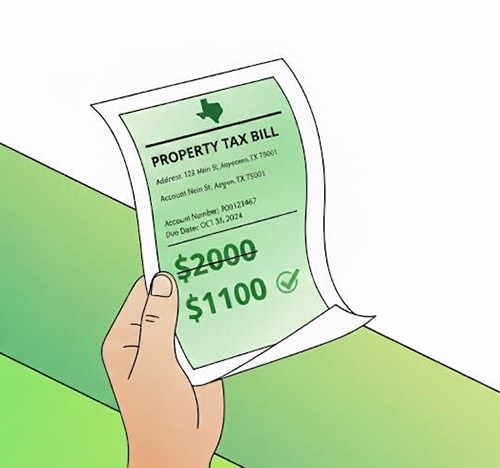
Hand holding Texas property tax bill showing reduced amount from $2000 to $1100 with checkmark.

End Unnecessarily High Property Taxes this Year

TaxDrop makes it easy to never pay more than you should by securing all exemptions and protesting high assessments annually. Book a call now to see if you're overpaying and how to get it back.

Talk to a Tax Expert