
⏰
🏘️
💵








Protect yourself from excesesive and inaccurate property taxes. Start with a free consult to find out how much you may be able to save.
Property taxes are one of the biggest expenses for any owner. Miss a single exemption or let the county over-value your property, and it could cost you thousands every year.
The appeal process is complex and time-consuming by design. That's exactly why we handle it for you.
Our state-licensed consultants know how to file for every exemption and build a case that gets results. With data on 158M+ properties, we know what your home should actually be assessed at—and we'll prove it.
You've got enough expenses. Your property tax bill shouldn't be higher than it needs to be - and with our "no savings, no fee guarantee" we only get paid if you see a reduction.
A hotel is far more than a piece of real estate—it is a dynamic operating business. County assessors frequently apply generic commercial property metrics to value hospitality properties, resulting in a significantly inflated property tax assessment that erodes your NOI and increases your overall tax burden. In both Texas and California, the law requires that your hotel be assessed at its fee-simple real estate value, excluding intangible assets like brand affiliation, franchise agreements, assembled workforce, and goodwill. When assessors ignore this distinction, they are effectively taxing your business enterprise—and you have the right to fight back.
Labor costs are up 30–50% since 2019. Insurance premiums have doubled or tripled. Energy costs have skyrocketed. Your NOI is likely down 40–60% from pre-pandemic levels—yet appraisal districts routinely use outdated, pre-decline income assumptions when calculating your property tax assessment. A lower NOI means a lower property value, which means a lower tax bill—but only if you can prove it. We document every expense increase and present a hospitality-specific income analysis that reflects the current reality of your hotel business.
Hotels are not valued like office buildings or apartment complexes. The primary method is the income approach, which requires analyzing RevPAR (Revenue Per Available Room), ADR, occupancy trends, and a hospitality-specific capitalization rate. Assessors who don't understand hospitality use generic commercial cap rates, dramatically overstating your property's value. Beyond that, they often fail to deduct the value of FF&E (Furniture, Fixtures & Equipment) and other tangible personal property that must be excluded from the real estate assessment. Our consultants understand hospitality and know exactly how to present unique valuation challenges that force a fair assessment.
Provide your property address and room count. Our experts conduct a deep analysis of your current assessment against market data, RevPAR trends, and operating expenses versus pre-COVID benchmarks. We identify the gap between what you're being taxed on and what your property should actually be worth.
We use your actual hotel financials—STR reports, P&Ls, and operating statements—along with our database of 158M+ properties to build a powerful, evidence-based case file. We document occupancy and RevPAR declines, prove operating expense increases (labor, insurance, energy), quantify intangible value that must be deducted (brand, FF&E, franchise), and apply the correct hospitality-specific valuation methods. This is not a generic commercial property tax appeal; it is a hotel-specific strategy designed for maximum tax savings.
Our state-licensed consultants handle the entire protest and appeal process. We present hotel-specific income analysis to appraisal boards and assessment appeals boards, often engaging specialized hospitality appraisers for larger properties. We negotiate aggressively on your behalf and are prepared to escalate to higher-level appeals if needed.
You see the reduction reflected on your property tax bill. With our "no savings, no fee" guarantee, you pay us only $129/year. If we don't win a reduction, you pay nothing. Average tax savings for a 100-room hotel are $45,000 per year; larger properties regularly save $150,000 to $300,000 or more annually. Check your estimated savings or learn more about how TaxDrop works. Read our guide on who pays the most in property taxes.
Read our guide on commercial property tax protests.
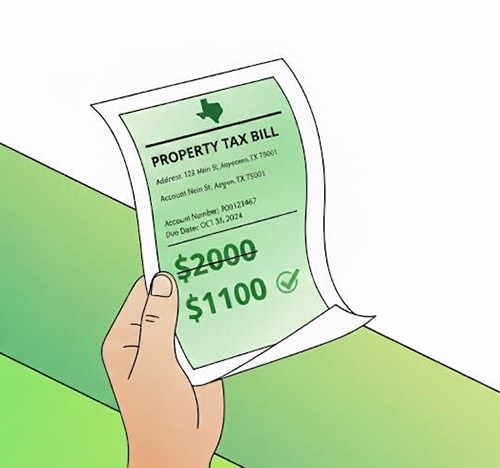
TaxDrop makes it easy to never pay more than you should by securing all exemptions and protesting high assessments annually. Book a call now to see if you're overpaying and how to get it back.
Everything hotel owners need to know about protesting and appealing property tax assessments in Texas and California.
Hotel properties are primarily valued using the income approach, which determines value based on the property's ability to generate income. Unlike standard commercial properties, this requires specialized adjustments to separate the hotel's non-taxable business value—including brand affiliation, management expertise, and goodwill—from the taxable real estate value.
Assessors may also use the sales comparison approach and the cost approach for newer properties. The challenge is that many assessors apply these methods incorrectly, leading to inflated property tax assessments for hotel owners.
In Texas, the property tax protest process begins when you receive your Notice of Appraised Value from the county appraisal district. You must file a protest with the Appraisal Review Board (ARB) by the deadline—typically May 15.
The process involves an informal meeting with the appraisal district to present your evidence, followed by a formal ARB hearing if no agreement is reached. If you are still unsatisfied, you can appeal to the State Office of Administrative Hearings (SOAH) or file a lawsuit in district court. TaxDrop manages this entire process for hotel owners across Texas.
In California, hotel owners can challenge their property's assessed value by filing an Assessment Appeal Application with the county Assessment Appeals Board (AAB). The standard filing window is July 2 through November 30.
California's Proposition 13 governs the base year value, but "Decline in Value" (Prop 8) claims can be filed when market value falls below the assessed value—a common situation for hotels in markets that have seen softening demand.
Non-taxable intangible assets that must be excluded include: the hotel's brand or flag, franchise agreements, management contracts and expertise, assembled workforce, goodwill, and FF&E (Furniture, Fixtures, and Equipment).
Both Texas and California law require that property be assessed at its fee-simple real estate value, excluding these business enterprise components. A 2025 California Supreme Court ruling reaffirmed this principle.
RevPAR (Revenue Per Available Room) is the primary performance metric for the hotel industry, calculated by multiplying a hotel's average daily rate (ADR) by its occupancy rate. A lower RevPAR indicates weaker market performance and serves as powerful evidence in a property tax appeal.
It demonstrates that the hotel's income-generating capacity—and therefore its real estate value—is lower than the assessor's figures suggest. STR reports are the gold-standard source for RevPAR data.
What is the income approach to hotel property valuation?
The income approach determines a property's value based on the net income it is expected to generate. For hotels, this involves projecting gross revenue, deducting all operating expenses (including management fees, franchise fees, and FF&E reserves), and capitalizing the resulting NOI using an appropriate capitalization rate.
The key challenge is ensuring that all non-taxable business value is properly deducted before the income stream is capitalized. When assessors skip this step, they systematically overstate hotel values—and your tax bill.
What is an Equal and Uniform appeal for Texas hotels?
An Equal and Uniform (E&U) appeal under Section 42.26 of the Texas Tax Code allows property owners to argue their property is assessed inequitably compared to similar properties. For hotels, this involves comparing per-room assessed values or revenue multiples across comparable properties.
If your hotel is assessed at a higher ratio than its peers, you may be entitled to a reduction based on inequitable treatment—even if a market value argument alone might not succeed. TaxDrop pursues both tracks simultaneously.
What is FF&E and how does it affect my hotel's property tax assessment?
FF&E (Furniture, Fixtures, and Equipment) includes all movable items required to operate a hotel—beds, linens, televisions, kitchen equipment, and so on. FF&E is considered tangible personal property, not real property, and its value must be deducted from the overall hotel asset valuation.
Assessors who fail to make this deduction are overstating your taxable base—and you are overpaying as a result.
How much can hotel owners typically save by protesting their property taxes?
Savings vary based on property size, location, and the degree of overassessment. TaxDrop clients with 100-room hotels see average annual tax savings of $45,000. Larger properties—full-service hotels, resorts, and conference centers—regularly achieve savings of $150,000 to $300,000 or more per year.
TaxDrop charges only $129/year, with no fee guarantee if no reduction is secured. There is zero financial risk to starting the process.
Do I need a specialist for hotel property tax appeals?
Yes. Due to the unique nature of hotel valuation, the complexity of separating real and personal property from intangible business value, and significant differences in tax law between jurisdictions, using a specialist in hospitality property tax consulting is essential.
A generalist may miss critical deductions for intangibles, apply the wrong valuation methods, or fail to leverage state-specific strategies like Texas's Equal and Uniform appeal. The stakes are often tens or hundreds of thousands of dollars annually.
Ready to lower your hotel's property tax bill?