







Small Multifamily Property Tax Protest: Duplexes, Triplexes and Fourplexes

Two-to-four-unit properties sit between homes and apartments, and districts can value them either way. Here is how to check the value and protest it.
Get Started Now

⏰

Never Miss Another Filing Deadline

🏘️

Now in All Texas & California Counties

💵

Pay Only $129 A Year
No Savings No Fee
Small Multifamily (2-4 Units)
As Seen On

Property Taxes Too High? Fight It.

Check if you're overpaying on property taxes. 92% of Texas protests we closed in 2026 got a reduction—enrollment takes less than 3 minutes.

⏰

Don't Miss Your Filing Deadline

🏠

For All Properties in Texas & California

💵

Self-Serve or Full-Service Pricing
Thank you! Your submission has been received!
Oops! Something went wrong while submitting the form.

Never Overpay Again.

Property taxes are one of the biggest expenses for any owner. Miss a single exemption or let the county over-value your property, and it could cost you thousands every year.

‍
The appeal process is complex and time-consuming by design. That's exactly why we handle it for you.

‍
Our state-licensed consultants know how to file for every exemption and build a case that gets results. With data on 158M+ properties, we know what your home should actually be assessed at—and we'll prove it.

‍

You've got enough expenses. Your property tax bill shouldn't be higher than it needs to be - and with our "no savings, no fee guarantee" we only get paid if you see a reduction.

Key Property Tax Stats

Last updated: October 9, 2026

If you own a duplex, triplex or fourplex in Texas, you can protest the appraisal district's value to the ARB. This page explains how small multifamily properties are valued, what evidence helps and how the Texas process works. Larger buildings are covered on our apartment complex page. TaxDrop does not guarantee a result, and not every property is over-assessed.

How districts value small multifamily

  • Market value as of January 1 is the standard for appraisal (Texas Comptroller).
  • Sales comparison uses adjusted sales of similar properties, and comparable sales generally must be within 24 months of the valuation date (Tax Code §23.013).
  • Income approach estimates what an investor would pay for the income stream. Our glossary entry on the income approach covers the basics.
  • Circuit breaker: for 2026, appraised-value increases on non-homestead real property valued at $5,320,000 or less are limited to 20%, and the limit expires December 31, 2026 (Texas Comptroller).

A hypothetical example (made-up numbers, for illustration only)

These round numbers are invented to show the math. They are not data from any real property, market or TaxDrop client.

  • Assumed income by the district: NOI of $60,000 at a 7.0% cap rate gives $60,000 ÷ 0.07 ≈ $857,000.
  • Actual NOI after vacancy and real expenses is $52,000 at the same cap rate: $52,000 ÷ 0.07 ≈ $743,000.

Whether any real property's inputs are wrong is a question for its own rent roll and market evidence.

Biggest Pain Points

Valued like a house when it earns like an investment

Districts often use sales comparisons for homes, while the Comptroller says the income approach suits properties held to produce income, such as apartments (Texas Comptroller). A duplex, triplex or fourplex can be valued either way, so ask the district which approach it used and what data supports it (Tax Code §41.461).

Rents, vacancy and expenses that do not match your records

When the income method is used, the chief appraiser must analyze comparable rental data, operating expenses and capitalization rates, and base projections on reasonably clear and appropriate evidence, considering historical information and trends (Tax Code §23.012). Your rent roll, leases and expense records are the best test of those assumptions.

Classification and homestead details

In the Comptroller's classification guide, residential properties with two or more units under single ownership are generally multifamily (Category B), while an owner-occupied duplex with a residence homestead exemption on the owner's portion is Category A (Property Classification Guide). If you live in one unit, ask the district how it treated your portion and whether the exemption was applied.

How it Works

Evidence checklist for a small multifamily protest

Gather what the ARB can weigh (Texas Comptroller; Tax Code §23.012):

  • Rent roll and leases by unit, showing what tenants actually pay and any concessions.
  • Vacancy history by unit and month.
  • Operating expenses for taxes, insurance, repairs, management and utilities.
  • Unit details: bedrooms, baths and square footage by unit, checked against the property record card.
  • Condition proof: photos, inspection reports and repair bids.
  • Market evidence: comparable sales and comparable rents for similar 2-to-4-unit properties.
  • Unequal appraisal evidence, if useful: appraised values of comparable properties, adjusted for differences (Tax Code §41.43).

The Texas protest process and deadline

  • Deadline: file a written notice of protest with the appraisal review board (ARB) by May 15 or the 30th day after the appraisal notice was delivered, whichever is later (Tax Code §41.44). The Comptroller says the 30 days run from the date the district mails the notice (Texas Comptroller), so to be safe use the earlier date and check the dates on your own notice. A late protest can still be heard if you show good cause before the ARB approves the appraisal records.
  • Filing: use Form 50-132, or any written notice that identifies you, the property and your disagreement. A district cannot charge a fee for a protest (Tax Code §41.41). An agent needs Form 50-162.
  • Informal conference: you can ask the district for an informal conference before the hearing (Tax Code §41.445).
  • Before the hearing: the ARB must give you at least 15 days' written notice (Tax Code §41.46). You can ask the chief appraiser for the data, schedules and formulas it will use, which it must deliver at least 14 days before the hearing (Tax Code §41.461). Material you requested but did not receive in time generally cannot be used against you (Tax Code §41.67).
  • Hearing: on a market value or unequal appraisal protest, the district has the burden of establishing value by a preponderance of the evidence (Tax Code §41.43). Bring your own evidence anyway. Hearings are informal, and you may offer an affidavit, or appear by phone or videoconference (Tax Code §41.45).
  • After the ARB: you can appeal to district court within 60 days of receiving the written order. Depending on the property, State Office of Administrative Hearings (SOAH) appeals or regular binding arbitration may also be available (Texas Comptroller).

Our deadlines-by-state guide and Texas protest overview have more. For other states, see California, Georgia, Florida, New Jersey and Maryland.
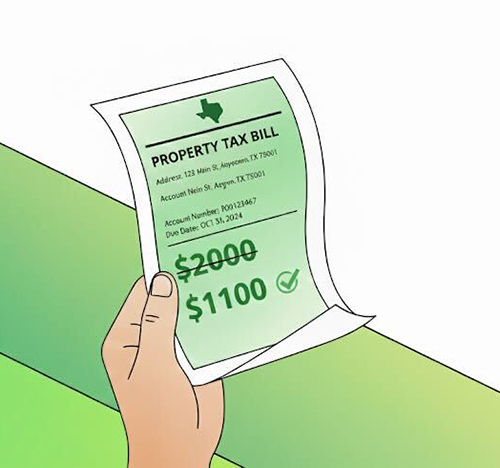
Hand holding Texas property tax bill showing reduced amount from $2000 to $1100 with checkmark.

End Unnecessarily High Property Taxes this Year

TaxDrop makes it easy to never pay more than you should by securing all exemptions and protesting high assessments annually. Book a call now to see if you're overpaying and how to get it back.

Talk to a Tax Expert