
Key Takeaways:
- 162,060 Dallas County accounts protested in 2023
- $93M+ recovered by homeowners through formal and informal protest
- Less than 5% of eligible owners protest each year
- 80–90% informal protest success rate at DCAD
- 1.74% average effective tax rate — among Texas's highest
- May 15, 2026 protest deadline for most Dallas County properties
Executive Summary
Dallas County homeowners carry some of the highest property tax bills in America. Texas has no state income tax. That means local governments fund schools, roads, and services almost entirely through property taxes.
The Dallas Central Appraisal District (DCAD) assesses nearly one million properties every year. This report uses public data from the Texas Comptroller's Office and DCAD to show where assessments stand in 2026, how protests performed in recent years, and what you can do before the May 15 deadline.
Key Findings at a Glance
- 162,060 Dallas County properties were protested in 2023
- $93M+ recovered by homeowners through the protest process in 2023
- Less than 5% of eligible owners file a protest each year
- 80–90% of informal DCAD protests result in a reduction
- 1.74% effective property tax rate — one of the highest in Texas
- $4,000–$12,000 typical annual tax bill for Dallas County homeowners
- 10–15% typical reduction for successful protests
- 30–60% of Texas residential properties are estimated to be over-assessed each year
How DCAD Assesses Your Property
DCAD appraises all real and personal property in Dallas County. It works on behalf of 61 local taxing entities — including the City of Dallas, Dallas ISD, and Dallas County itself.
DCAD uses computer-assisted mass appraisal (CAMA) models. These models group properties by neighborhood. They adjust for size, age, condition, and recent sales. The goal is 100% of market value as of January 1 each year.
The problem: automated models are broad by design. They cannot account for individual conditions — a cracked foundation, a location backing to a freeway, or an outdated floor plan. They rely on sales data that may not reflect your specific street. Errors compound year over year when unchallenged.
The Mass Appraisal Problem in Practice
A single DCAD appraiser may handle 10,000+ accounts. That scale makes individual property nuance nearly impossible to capture.
Research suggests 30–60% of residential properties carry assessments above true market value each year. Yet fewer than 5% of owners file a protest.
2023 Dallas County Protest Statistics
The Texas Comptroller publishes annual protest data by appraisal district. The most recent complete data is from 2023.
Total Protests Filed
162,060 accounts were protested in Dallas County in 2023. That is roughly 16–18% of total taxable accounts — higher than the Texas average, driven by rising assessments across North Texas.
Dollars Recovered
- $59 million recovered through formal ARB hearings
- $34 million recovered through informal review settlements
- $93 million total returned to Dallas County property owners in 2023
Informal vs. Formal Resolution
Most successful protests settle at the informal review stage. This is a meeting between you (or your representative) and a DCAD appraiser. It is faster and less formal than an ARB hearing.
The informal success rate across Texas runs 80–90%. That makes it the highest-value step in the process. Owners with professional representation consistently win higher reductions at ARB hearings than those who go alone.
Dallas Neighborhoods with the Highest Overassessment Risk
Not all Dallas County properties carry equal risk. DCAD's mass appraisal models struggle most in areas where values changed rapidly, housing stock is mixed, or soil conditions damage properties.
Based on DCAD assessment trends and Texas Comptroller protest data, these neighborhoods and ZIP codes show the highest overassessment risk in 2026:
| Neighborhood | ZIP Codes | Key Risk Factor | Most Common Protest Ground |
|---|---|---|---|
| Lake Highlands | 75238, 75218 | 25–35% assessment growth 2020–2023 | Market value overshoot |
| Lakewood / East Dallas | 75214, 75223 | Mixed housing stock, rapid appreciation | Unequal appraisal |
| Oak Cliff / Kessler Park | 75208, 75211 | Gentrification-driven reassessment | Market value + unequal appraisal |
| Preston Hollow | 75229, 75230 | High-value estates, unique properties hard to comp | Unequal appraisal |
| Casa View / East Dallas | 75217, 75228 | Older housing stock reassessed broadly | Unequal appraisal |
| South Dallas | 75215, 75216 | Recent reassessment after years of lag | Market value |
| Garland | 75040, 75041, 75042 | High protest volume, aging housing stock | Market value + condition |
| Irving | 75061, 75062 | Mixed residential / commercial proximity | Unequal appraisal |
| Mesquite | 75149, 75150 | 1970s–1990s homes, deferred maintenance | Condition-based |
| DeSoto / Lancaster | 75115, 75134 | Sharp 2021–2023 appreciation, model lag | Market value overshoot |
Source: DCAD public assessment records, Texas Comptroller protest statistics 2023. Assessment growth ranges reflect typical patterns; individual properties vary.
If your property is in one of these neighborhoods, the case for protesting is strong — even without specific evidence yet. Looking up your DCAD record takes five minutes and often reveals straightforward errors.
Dallas County Tax Rate Breakdown
Your property tax bill is the sum of rates from every taxing entity whose boundaries include your property. Most Dallas County homeowners pay five or more entities at once.
Common taxing entities include:
- City of Dallas (or your municipality — Garland, Irving, Grand Prairie, Richardson, etc.)
- Dallas ISD (or local district — Garland ISD, Irving ISD, Richardson ISD, etc.)
- Dallas County
- Dallas County Community College District
- Parkland Hospital District
- Municipal Utility Districts (MUDs) in some areas
The combined effective rate averages approximately 1.74% for properties within Dallas city limits. Rates vary by location — Highland Park has its own city and school district, so its rate differs from Mesquite or Garland.
Here is why every dollar of assessed value reduction matters: a $50,000 reduction does not lower just one bill. It lowers every bill from every taxing entity at once — saving approximately $870 per year at the 1.74% combined rate.
Who Benefits Most from Protesting
Homeowners in Rapidly Appreciating Neighborhoods
DCAD assessments lag the market. They reflect January 1 values based on prior-year sales. In neighborhoods where values rose fast, assessments often overshoot. Homeowners in Lakewood, Preston Hollow, Oak Cliff, and Lake Highlands have seen increases of 20–40% in recent cycles.
Properties with Condition Issues
Dallas's expansive clay soil is hard on foundations. Properties with foundation movement, drainage problems, or deferred maintenance are often assessed at full-condition value. DCAD's models cannot see these issues. Owners with condition problems have strong grounds to protest.
First-Time Homeowners
Texas Tax Code Section 23.23 caps annual assessment increases for homestead properties at 10% over the prior year's value. New homeowners who buy at or above appraised value often see their first assessment jump sharply — because the cap resets. This first year is usually the best protest opportunity.
Investment Property Owners
Homestead protections do not apply to rental or investment properties. These can see uncapped annual increases. Landlords who skip protests pay above-market assessments that compound over years.
Your Rights as a Dallas County Property Owner
Texas law gives property owners broad rights to challenge their assessments. Key rights include:
- Right to protest — any owner may file a Notice of Protest (Form 50-132) each year
- Two protest grounds — market value (value exceeds market) and unequal appraisal (value exceeds similar properties), under Section 41.43 of the Texas Property Tax Code
- Right to see DCAD's evidence — request the evidence package at least 14 days before your ARB hearing
- Right to representation — a licensed property tax consultant or attorney may represent you at any stage
- Right to appeal beyond the ARB — District Court (within 60 days), binding arbitration (properties $5M or less, within 60 days), or SOAH (within 30 days, $1,500 fee)
- Homestead exemption — primary residences qualify for $100,000+ reduction in taxable value; file with DCAD if you have not already
2026 Dallas County Property Tax Protest Timeline
- January 1, 2026 — Assessment date. DCAD values all properties as of this date.
- April 15, 2026 — DCAD mails Notice of Appraised Value to all property owners.
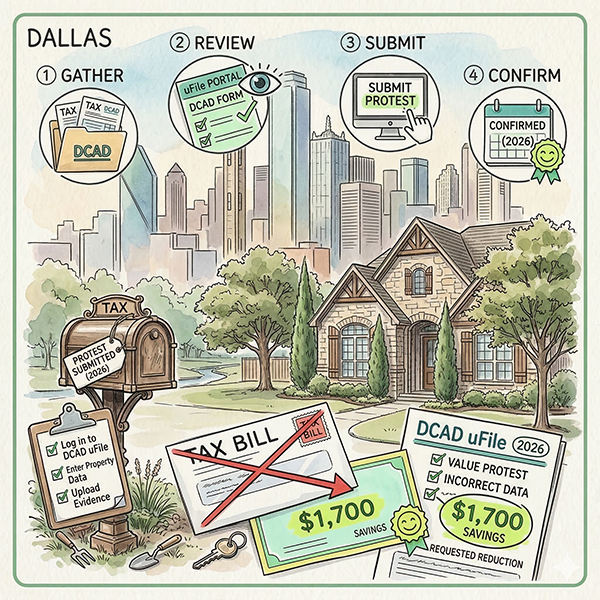
- May 15, 2026 — Protest deadline. File Form 50-132 via uFile at dallascad.org, by mail, or in person at 2949 N Stemmons Fwy, Dallas, TX 75247. (Or within 30 days of receiving your notice, whichever is later.)
- May–July 2026 — Informal review and ARB hearing period. Most cases settle informally. DCAD's uFile Online Settlement Offer Program lets eligible homeowners settle entirely online.
- August–October 2026 — Tax bills mailed reflecting any assessment changes.
- January 31, 2027 — Property tax payment deadline.
Five Steps Every Dallas County Homeowner Should Take Before May 15
- Look up your DCAD record — visit dallascad.org and search your address. Check every field: square footage, bedroom count, year built, condition grade. Errors here inflate your bill and are easy wins.
- Compare to recent sales — find sales of similar homes within a half-mile. If comparable homes sold below your assessed value, you have a market value protest case.
- Check your neighbors' assessments — look up 5–10 nearby similar properties on dallascad.org. If your assessed value per square foot is higher than theirs, you have an unequal appraisal case under Section 41.43.
- File your homestead exemption if you have not — if this is your primary residence, file now. The savings are immediate and repeat every year.
- File your protest by May 15 — even if you are unsure. It costs nothing and preserves your rights. You can always withdraw if your evidence does not support a reduction.
About This Report
This report was prepared by TaxDrop using public data from the Texas Comptroller's Property Tax Assistance Division, DCAD public records, and industry research on mass appraisal methodology. Protest statistics reflect tax year 2023 — the most recent complete year of public data. Tax rates reflect published 2025–2026 figures and are subject to annual change.
TaxDrop is a licensed property tax protest service in Texas and California. We help homeowners and investors challenge overassessments through the formal protest process. Our fee is 25% of first-year savings — no savings, no fee.
Questions? Visit our Dallas County protest guide or start a free analysis at app.taxdrop.com.
Paying Too Much in Property Taxes?
Let our licensed property tax experts assess your tax bill for potential savings. Over 80% of protests get a reduction of more than $1,000 and it takes less than 3 minutes to enroll.
⏰
🏠
💵
FAQs
How many Dallas County properties were protested in 2023?
162,060 accounts were protested in Dallas County in 2023 — roughly 16–18% of total taxable accounts. That's higher than the Texas average, driven by rising assessments across North Texas.
How much money did Dallas County homeowners recover through protests?
$93 million total in 2023 — $59 million through formal ARB hearings and $34 million through informal review settlements.
What is the property tax protest success rate in Dallas County?
80–90% of informal DCAD protests result in a reduction. Owners with professional representation consistently win higher reductions at ARB hearings than those who go alone.
What is the effective property tax rate in Dallas County?
The combined effective rate averages approximately 1.74% for properties within Dallas city limits. Rates vary by location based on which taxing entities overlap your property.
Which Dallas neighborhoods have the highest overassessment risk?
Lake Highlands, Lakewood/East Dallas, Oak Cliff/Kessler Park, Preston Hollow, and South Dallas show the highest overassessment risk in 2026 — driven by rapid appreciation, mixed housing stock, and gentrification-driven reassessment.
What is the 2026 deadline to protest property taxes in Dallas County?
May 15, 2026. DCAD mails Notices of Appraised Value on April 15. File online through uFile at dallascad.org, by mail, or in person at 2949 N. Stemmons Freeway.
Who benefits most from protesting property taxes in Dallas?
Homeowners in rapidly appreciating neighborhoods, properties with condition issues (foundation, roof, deferred maintenance), first-time homeowners whose 10% cap just reset, and investment property owners facing uncapped annual increases.
How does DCAD assess property values?
DCAD uses computer-assisted mass appraisal (CAMA) models that group properties by neighborhood and adjust for size, age, condition, and recent sales. A single appraiser may handle 10,000+ accounts, making individual property nuance nearly impossible to capture.