
DCAD Protest Deadline 2026: When to File, How to File, and What Happens If You Don't
The DCAD property tax protest deadline for 2026 is May 15, or 30 days after your Notice of Appraised Value is mailed, whichever is later. This guide covers exactly how to file through DCAD's uFile system and what happens if you miss it.
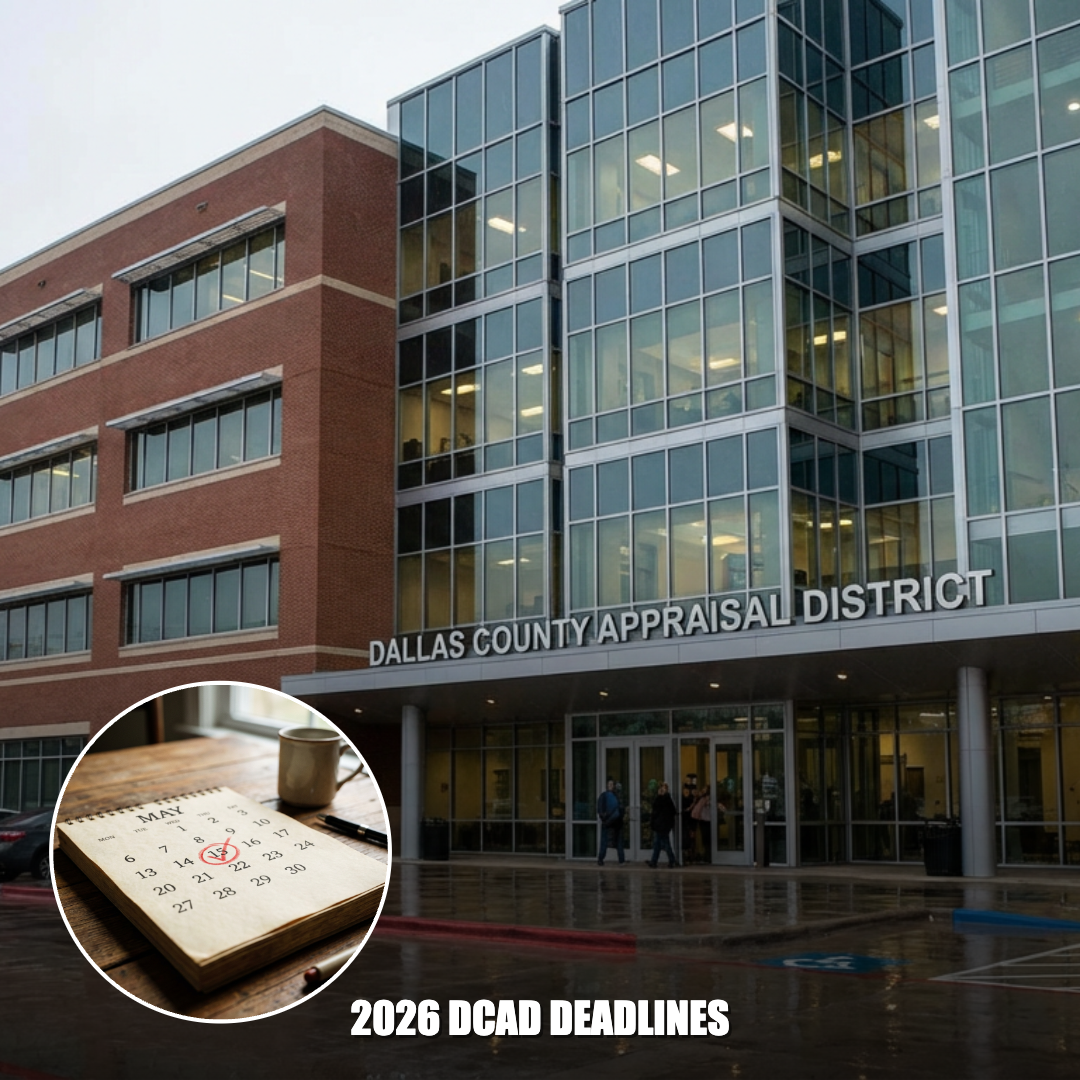
Key Takeaways:
- The DCAD protest deadline for 2026 is May 15, or 30 days after your notice is mailed, whichever is later
- 80-90% of Dallas protests resolve successfully at the informal review stage (Gill Denson, 2024)
- File online through DCAD's uFile system in under 10 minutes, and you don't need evidence to file
- Miss the deadline and your assessed value is locked for the entire year with almost no exceptions
Now that you know the deadline, be sure not to miss it or you're locked in for 12 months and your assessment baseline for future years is set higher.
Here's how it works:
DCAD will mail Notices of Appraised Value in April 2026. That gives most homeowners roughly 30 days to act. According to the National Taxpayers Union, 30-60% of properties nationwide are over-assessed. Yet only about 5% of homeowners actually file a protest.
This post is your deadline checklist. When to file, how to file online, what happens after you file, and what happens if you don't.
For a deep dive on winning strategies and evidence, see our full DCAD protest guide for 2026.
Here's the simple math. Notice mailed April 10? Your deadline is May 15. Notice mailed April 20? Your deadline is May 20.
But don't play calendar games. File as soon as you get your notice. You don't need evidence to file. You just need to get into the system before the clock runs out.
How Do You File Your DCAD Protest Online?
About 80-90% of Dallas County protests resolve at the informal review stage, according to property tax consultant Gill Denson (2024). But you can't get to that stage without filing first. The fastest way to file is through DCAD's uFile system at dallascad.org.
Here's a step-by-step walkthrough.
Step 1: Go to dallascad.org and Log In
Visit dallascad.org and look for the uFile portal link. You'll need your property account number. It's printed on your Notice of Appraised Value. If you don't have your notice yet, you can search by address.
Step 2: Select Your Reason for Protest
You'll see checkboxes for your protest reason. Most homeowners choose "Value is over market value" or "Value is unequal compared with other properties." You can select both. Selecting unequal appraisal gives you a second angle if market value alone doesn't win your case.
Step 3: Enter Your Opinion of Value
This is what you believe your home is actually worth. Don't stress over this number. It's a starting point for negotiation, not a binding commitment. Look at recent sales of similar homes in your neighborhood for a reasonable estimate.
Step 4: Submit and Save Your Confirmation
After you submit, save or screenshot your confirmation number. That's your proof of filing. You'll receive a hearing date by mail, typically scheduled for June or July 2026.
The entire process takes under 10 minutes. You can also file by mail or in person at DCAD's office at 2949 N. Stemmons Freeway, Dallas, TX 75247. But online is faster, and you get instant confirmation.
What Happens After You File Your DCAD Protest?
Once you file, 80-91% of protests that present evidence resolve at the informal review stage without needing a formal hearing, according to property tax consultant Gill Denson (2024). The process has two main stages, and most homeowners never need the second one.
The Informal Review
DCAD will schedule an informal meeting with a staff appraiser. This usually happens in June or July. You'll sit down (in person or by phone) and present your case. Comparable sales, condition issues, square footage errors, anything that shows your assessed value is too high.
Under HB 1533, appraisal districts in Texas must now share their evidence with you at least 14 days before your hearing. This is a big deal. You get to see exactly what data DCAD is using to justify your value before you walk in. For more on what HB 1533 changed, see our Texas property tax law changes guide.
If you and the appraiser agree on a lower number, you're done. Your value gets reduced and your tax bill drops accordingly.
The Appraisal Review Board (ARB) Hearing
If the informal review doesn't produce a settlement, your case goes to the ARB. This is a formal hearing with a panel of appointed members. You present your evidence, DCAD presents theirs, and the board makes a binding decision.
Most homeowners won't need this step. But knowing it exists gives you more room to hold firm during the informal review. You have nothing to lose by letting it go to the ARB.
What Happens If You Miss the DCAD Protest Deadline?
If you miss May 15 (or your 30-day window), your 2026 assessed value is locked. No Appraisal District appraiser can lower it. No ARB panel can review it. Dallas County property values rose 8-12% in many neighborhoods in 2025. If your home was over-assessed, you'll pay taxes on that inflated number for the full year.
There are no second chances, no grace periods, and no "I didn't know" exceptions.
Here's what makes this sting: you don't just lose the 2026 reduction. You lose the compounding effect. A successful protest lowers your baseline value. That lower baseline carries forward into future years. Missing one deadline can cost you thousands over a five-year period, not just one year.
The One Narrow Exception
Texas Tax Code Section 41.411 allows a late protest once every five years for homestead properties. You must prove you never received your notice. This is rarely granted and requires documentation. Treat it as a legal footnote, not a safety net.
What Should You Do Right Now?
Only about 5% of homeowners actually protest their property taxes, even though the National Taxpayers Union estimates 30-60% of properties are over-assessed. Don't be in the 95% who do nothing. Here are three things to do today.
1. Check Your Notice of Appraised Value
If you've received your 2026 notice, look at the assessed value. Compare it to what your home would actually sell for right now. Not what you hope it's worth. What a buyer would realistically pay. If DCAD's number is higher, you likely have grounds to protest.
Haven't received your notice yet? Search your property at dallascad.org to see your current assessed value.
2. File Your Protest Today
Don't wait until May 14. File now. It takes under 10 minutes through uFile, and you don't need evidence to submit. Filing just reserves your right to a hearing. You can build your case after you file.
We've seen homeowners lose thousands simply because they planned to "do it this weekend" and then forgot. The deadline doesn't move. Your calendar gets busier. File first, prepare second.
3. Gather Evidence Before Your Hearing
After you file, start pulling together your evidence. Comparable home sales within half a mile, photos of condition issues, documentation of any errors in DCAD's property description. The Texas homestead exemption is now $140,000 for school district taxes in 2026 (Texas Comptroller, 2025). Make sure yours is applied. If it's missing, that alone could be costing you hundreds.
Don't Let the Deadline Pass You By
The DCAD protest deadline is May 15, 2026. Notices arrive in April. You have roughly 30 days to act.
Filing takes 10 minutes. You don't need evidence to file. And the odds are in your favor: 80-90% of protests resolve successfully at the informal review. The only homeowners who definitely lose are the ones who don't file.
If you want to handle it yourself, go to dallascad.org and use the uFile portal. If you want someone to handle the entire process for you, from filing to evidence to representation, start your protest with TaxDrop. No upfront cost. No fee unless we win.
Your deadline is May 15. Don't wait.
Paying Too Much in Property Taxes?
Let our licensed property tax experts assess your tax bill for potential savings. 92% of Texas protests we closed in 2026 got a reduction. It takes less than 3 minutes to enroll.
⏰
🏠
💵
No Savings No Fee
FAQs
What is the DCAD protest deadline for 2026?
The standard deadline is May 15, 2026. If your Notice of Appraised Value was mailed after April 15, your personal deadline is 30 days from the mailing date. Check the top of your notice for the exact mail date. For most Dallas County homeowners, May 15 is the date that matters.
Can I file a DCAD protest after May 15?
In almost all cases, no. Texas Tax Code Section 41.411 allows a late protest once every five years for homestead properties if you can prove you never received proper notice. This is rarely granted. Don't rely on it as a backup plan.
Do I need evidence to file my DCAD protest?
No. You can file your protest with zero evidence attached. The filing itself just reserves your right to a hearing. You'll have time to gather comparable sales, photos, and other documentation before your informal review, which typically happens in June or July 2026.
How long does the DCAD protest process take?
Filing takes under 10 minutes through DCAD's uFile portal. After filing, most homeowners get an informal review within 4-8 weeks. According to Gill Denson, 80-91% of protests that show up with evidence resolve at this stage without needing a formal ARB hearing.

Ryder Meehan
Ryder Meehan is the Co-Founder of TaxDrop and a Licensed Property Tax Protest Consultant