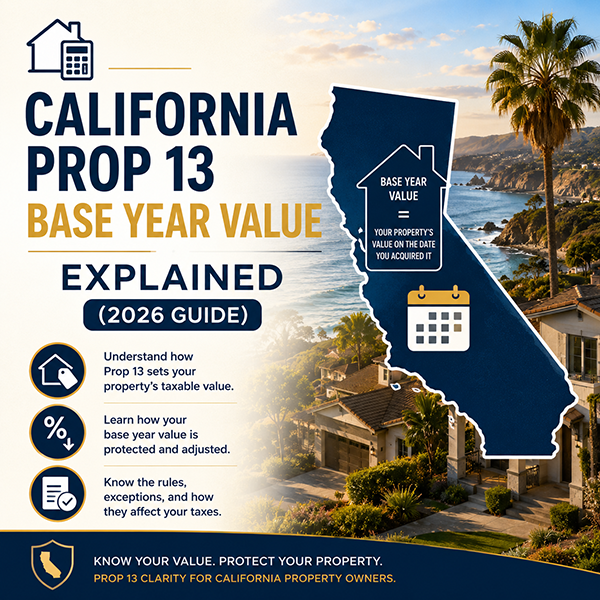
California Prop 13 Base Year Value Explained (2026 Guide)
The Prop 13 base year value is the single most important number on your California property tax bill. This guide explains how it is set, how the 2% cap works, when it resets, and how to fix errors.
Key Takeaways:
- Prop 13 base year value is the fair market value of your California home at the time you bought it (RTC §51)
- Once set, it can only increase by an inflation factor capped at 2% per year — even if market values double
- The current assessed value with the inflation factor applied is called the factored base year value
- When market value drops below your factored base year value, you qualify for a Proposition 8 temporary reduction
- You have 4 years from a sale or construction event to challenge an incorrect base year value (RTC §51.5)
Every California homeowner has a Proposition 13 base year value — the single most important number on your property tax bill. It determines what you pay in property taxes today and what you will pay for as long as you own the home. Get it wrong, and you overpay every year you live there.
This guide explains what the base year value is, how the county sets it, how the 2% annual cap works, when it can be reset, and how to read it on your assessor's website.
What Is a Proposition 13 Base Year Value?
Under Proposition 13 (passed by California voters in 1978), real property is assessed at its fair market value at the time of acquisition. That market value becomes your "base year value." From that point forward, the assessed value can only increase by an inflation factor capped at 2% per year (California Revenue & Taxation Code §51).
Two events create a new base year value:
- Change of ownership — the property is sold or transferred to a new owner (with some exceptions like spouse transfers)
- New construction — you build an addition, ADU, swimming pool, or do a major remodel that adds value (§70, §71)
Between those events, your base year value drifts up by no more than 2% per year — even if your neighborhood values double.
How the 2% Annual Cap Works (Factored Base Year Value)
Each year on January 1 (the "lien date"), the county Assessor applies an inflation factor — capped at 2% — to your base year value. The result is called the factored base year value, and it becomes your assessed value for that tax year.
Example: You bought your home in 2018 for $800,000. That is your Prop 13 base year value.
- 2019: $800,000 × 1.02 = $816,000
- 2020: $816,000 × 1.02 = $832,320
- 2021: $832,320 × 1.02 = $848,966
- 2022: $848,966 × 1.02 = $865,946
- 2023 onward: continues compounding at up to 2% per year
By 2026, your factored base year value would be approximately $901,142. If your home's actual market value is $1.4 million, you are still only taxed on the $901,142 factored value. That is the Prop 13 protection in action.
What Happens If Market Value Drops Below the Factored Base Year Value
When the current market value of your property falls below your factored base year value, you become eligible for a Proposition 8 temporary reduction. This is sometimes called a "decline-in-value" reassessment.
Under Proposition 8 (RTC §51(a)(2)), the county Assessor temporarily reduces your assessed value to current market value for that tax year. When the market recovers, the assessed value rises back up — but only as far as your factored base year value, never higher.
Prop 8 reductions are reviewed annually. They do not change your underlying Prop 13 base year value — that number stays fixed in the county's records until a qualifying event triggers a new one.
How to Find Your Base Year Value
Every California county Assessor publishes property records online. To look up yours:
- Find your county Assessor's parcel search tool (Google "[your county] county assessor parcel search")
- Search by your property address or Assessor's Parcel Number (APN)
- Look for "base year value," "factored base year value," or "Prop 13 value" on your property's record
- You will also see the current year's assessed value, which is what your tax bill is based on
If your factored base year value is lower than the current market value, your Prop 13 protection is working. If they are roughly equal, ask about a Prop 8 review.
When Your Base Year Value Can Be Reset (and When You Want to Avoid That)
Most California homeowners want their base year value to stay low. Resetting it usually means a higher tax bill. Common triggers:
- Sale to a new owner — the new owner gets a new base year value equal to the sale price (the most common reset)
- Major new construction or addition — only the new portion gets a new base year value; the original home retains its old base (§70, §71)
- Change of ownership through transfer or gift — most transfers create a new base year value unless an exclusion applies
- Death of the homeowner + transfer to heirs — historically protected under Prop 58/Prop 193, but Proposition 19 (effective Feb 16, 2021) significantly tightened these rules
There are several exclusions where a transfer does NOT create a new base year value:
- Transfers between spouses (RTC §63)
- Transfers between registered domestic partners
- Transfers to or from a revocable trust (§62(d))
- The parent-child exclusion under Prop 19, if the heir uses the property as their primary residence within 1 year
- Property tax base transfers for homeowners over 55 (Prop 19, up to 3 times)
Why the Base Year Value Matters for Appeals
When you file a California property tax appeal, the Assessment Appeals Board does not change your Prop 13 base year value (except in narrow circumstances like change-of-ownership errors or appeals filed within the four-year statute of limitations after a base-year event).
What an appeal can do:
- Trigger a Prop 8 temporary reduction when current market value is below your factored base year value
- Correct a clerical error in your base year value (wrong square footage, wrong sale price recorded, etc.)
- Challenge a base year value if filed within 4 years of the change in ownership or new construction (RTC §51.5)
- Appeal a supplemental assessment after a recent sale or remodel
If your factored base year value looks wrong — for example, if the Assessor recorded a sale price higher than what you actually paid — you have a 4-year window to challenge it. After that, the base year value is locked.
Common Base Year Value Mistakes
- Wrong purchase price recorded — Assessors sometimes pick up the gross sale price including seller credits or concessions, when the true net purchase price was lower
- Wrong square footage — if the Assessor's records show your home is larger than it actually is, your base year value (and every year going forward) is inflated
- New construction over-valued — additions and ADUs sometimes get base year values higher than the cost of construction
- Missed Prop 8 reductions — when market value drops below factored base year value, the county does not automatically reduce your assessment in most counties — you have to request it
Each of these is correctable through the appeals process if caught within statutory deadlines.
How TaxDrop Helps
TaxDrop helps with California property tax appeals. We review your Prop 13 base year value for errors, compare it to current market value to identify Prop 8 opportunities, and build a self-serve evidence packet you file with the Assessment Appeals Board. TaxDrop does not represent you at the hearing in California. TaxDrop One is $129 per property per year, refunded if there's no reduction. See current pricing.
Check your California property tax savings in under 2 minutes →
Paying Too Much in Property Taxes?
Let our licensed property tax experts assess your tax bill for potential savings. Over 80% of protests get a reduction of more than $1,000 and it takes less than 3 minutes to enroll.
⏰
🏠
💵
No Savings No Fee
FAQs
What is my Prop 13 base year value?
Your Prop 13 base year value is the fair market value of your home on the date you bought it (or the date of the most recent qualifying change of ownership). You can look it up on your county Assessor's parcel search tool, or it will be listed on your annual assessment notice.
Can my Prop 13 base year value go up by more than 2% in a year?
No. Under California Revenue & Taxation Code §51, the factored base year value can only increase by an inflation factor capped at 2% per year. The only exceptions are if a change of ownership occurs or you do new construction that triggers a partial reassessment.
How is the factored base year value different from market value?
The factored base year value is your Prop 13 protected value, which has been adjusted upward by up to 2% per year. The market value is what your home would sell for today. The Assessor uses the lower of these two numbers as your assessed value (per Prop 8).
How do I challenge an incorrect base year value?
You have 4 years from the date of the change of ownership or new construction to file a base-year-value appeal under RTC §51.5. The application is BOE-305-AH (Application for Changed Assessment), filed with your county's Clerk of the Assessment Appeals Board.

Ryder Meehan
Ryder Meehan is the Co-Founder of TaxDrop and a Licensed Property Tax Protest Consultant