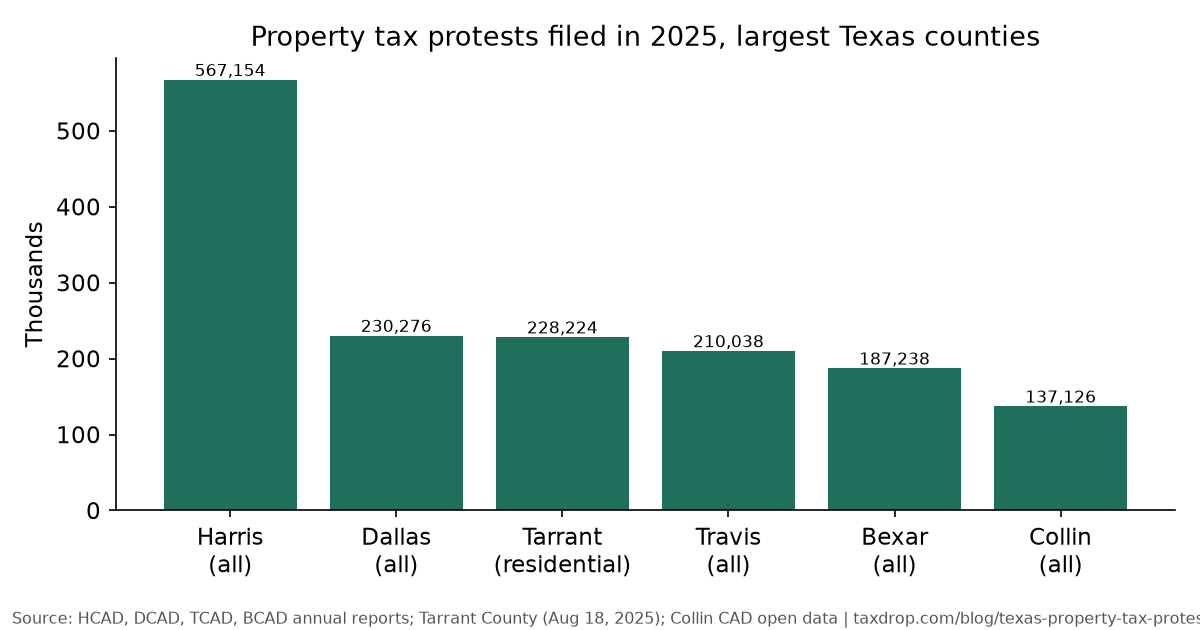
Shocking Chart: US Property Taxes are Surging Even Faster than Inflation
Three numbers moved in 2025 that were never supposed to move apart: tax bills up 3%, inflation up 2.6%, home values down 1.7%. Nobody voted for a rate increase and the rate rose anyway — to its highest point since 2020. Inside: the budget arithmetic that did it, why a falling market is the strongest appeal evidence a homeowner ever gets, and the three states where it changes nothing at all.
Key Takeaways:
- $4,427 – average U.S. single-family property tax bill in 2025, up 3% year over year
- −1.7% – change in the average U.S. home value over the same year, to $494,231
- 2.6% – 2025 annual average CPI inflation, four tenths below the tax increase
- $396.8 billion – total levied on 89.6 million single-family homes, up 3.7%
- 0.90% – national effective tax rate, up from 0.86% and the highest since 2020
- 5.6x – gap between the highest state rate (Illinois, 1.84%) and the lowest (Hawaii, 0.33%)
- 30–60% – share of U.S. property estimated to be over-assessed
- Under 5% – share of owners who ever challenge their assessment
The average American homeowner paid $4,427 in property tax last year. The average American home was worth less than it had been the year before.
Both of those facts come out of the same dataset. ATTOM's 2025 property tax analysis put the average single-family bill at $4,427 across 89.6 million homes — up 3% over 2024. The same report put the average home value at $494,231, down 1.7%. Over the same twelve months, consumer prices rose 2.6%.
Taxes up. Inflation up less. Home values down. Three lines that are supposed to travel together went three separate directions.
This is a national picture, so one note before the numbers: the word for challenging your assessment is "protest" in Texas and "appeal" almost everywhere else. We use "appeal" as the general term below and switch to "protest" when the example is a Texas one.
| Key takeaways |
|---|
| The average 2025 single-family property tax bill was $4,427, up 3% — while the average home value fell 1.7% to $494,231. |
| Total taxes levied hit $396.8 billion, up 3.7%. That total is set by local budgets, not by your house. |
| The national effective tax rate rose from 0.86% to 0.90% — the highest since 2020 — mostly without any public vote on a rate increase. |
| Effective rates range from 1.84% in Illinois to 0.33% in Hawaii, a 5.6x spread. |
| A year when values fall and assessments don't is the strongest comparable-sales case a homeowner will ever be handed — except in capped states, where the drop may never reach your taxable value. |
| Between 30% and 60% of U.S. property is thought to be over-assessed. Fewer than 5% of owners ever challenge it. |

Three Numbers, Three Directions
The tax gap everyone reported was 0.4 points. The one nobody reported was 4.7.
"Property taxes are rising faster than inflation" is true, and it undersells what happened. Against inflation, tax bills won by four tenths of a percentage point — real, but not dramatic.
Against home values, tax bills won by 4.7 points. That is the number that matters, because your assessment is supposed to be an estimate of what your house is worth. When the estimate goes up in a year the market goes down, the estimate is describing something other than your house.
Notice which bar is biggest. It is not the average bill — it is the total levied, up 3.7% to $396.8 billion. That bar is the cause. The other three are the effect.
Your Tax Bill Was Never a Percentage of Your Home's Value
Local governments decide what to spend first. Your assessment only decides your share of the bill — which is why a falling market can't rescue you on its own.
The sequence runs backwards from how it feels:
- The school district, county and city each adopt a budget. That is the levy — the dollars they intend to collect.
- The assessor totals up the value of every taxable property in the jurisdiction. That is the tax base.
- The rate is whatever number divides the base into the levy. Levy ÷ base = rate.
- Your bill is your assessed value × that rate.
Read step three again. The rate is a result, not a decision. If the levy holds steady and the tax base shrinks, the rate has to rise to raise the same money.
So 2025 was the arithmetic doing exactly what it does. Budgets grew 3.7%. The base got smaller. The rate rose to cover the difference. Nobody had to vote for a tax increase for taxes to increase.
Which kills the most common reason people skip an appeal: "my assessment didn't go up much, so there's nothing to fight." Your assessment is not competing against last year's assessment. It is competing against every other property in the jurisdiction. If your neighbors' values came down and yours didn't, you did not hold steady. You picked up their share.
That is why your share moved. It is not, on its own, a legal argument. Only Texas and Georgia let you challenge an assessment on the grounds that comparable properties are assessed lower; everywhere else the case has to be built on sales, and New Jersey rules comparable assessments inadmissible outright.
The Effective Rate Did the Work — and It Varies 5.6x by State
0.86% to 0.90% sounds like rounding. It is the highest rate since 2020, and nobody had to vote for it.
The effective tax rate — your bill divided by what your home is actually worth — is the only property tax number that survives a state line. Headline millage rates don't compare. Assessment ratios don't compare. This does.
Nationally it went from 0.86% to 0.90%. Four hundredths of a point sounds like nothing. It is applied to every house in the country at once, in a year the houses got cheaper.
An Illinois homeowner pays 5.6 times the rate a Hawaii homeowner pays on the same dollar of home value. In bill terms: New Jersey averages $10,499 a year and West Virginia averages $1,081. That gap is rate and price together. Hold the house constant and New Jersey still charges 3.3 times what West Virginia does.
| State | Average 2025 bill | Effective rate |
|---|---|---|
| New Jersey | $10,499 | 1.58% |
| Connecticut | $8,901 | 1.36% |
| New Hampshire | $8,174 | 1.29% |
| Massachusetts | $7,904 | — |
| New York | $7,732 | 1.23% |
| United States | $4,427 | 0.90% |
| Louisiana | $1,639 | — |
| Mississippi | $1,563 | — |
| Arkansas | $1,387 | — |
| Alabama | $1,284 | 0.43% |
| West Virginia | $1,081 | 0.48% |
Effective rate shown where ATTOM published it — its rate rankings cover only the ten highest and ten lowest states.
We break the geography down further in who pays the most in property taxes.
One important exception, because getting this wrong costs people money. New Jersey sits second on both lists, and it is the one state where filing an appeal can legally make your assessment go up. New Jersey decides appeals on the Chapter 123 ratio test rather than on market value alone: above the common level range your assessment comes down, inside the range nothing moves no matter how over-assessed the property looks, and below the range the county board is required by statute to raise it. New Jersey also charges you to file — $5 to $150 up front, scaled to assessed value and non-refundable. Run the ratio test before you file there, not after.
A Falling Market Is the Best Appeal Evidence You'll Ever Be Handed
The lag that made your assessment look cheap in 2022 is what makes it beatable in 2026 — unless your state caps it.
Assessments are backward-looking by construction. In a rising market that lag works in your favor — the roll trails the market and your assessment is low. In a falling market the same lag works against you, and the roll is at its most stale exactly when the market has moved furthest from it.
An appeal is not a complaint about the size of your bill. It is a factual claim: this specific number is wrong, and here are the sales that prove it. The evidence is comparable sales near the assessment date. In a year when the average home lost 1.7% of its value, more of those sales close below the assessor's number than they did in the years the market was climbing. That is not sentiment. That is the arithmetic of a down market meeting a lagging roll. Our walkthrough on how to find comps for a property tax appeal covers what makes one usable.
Now the caveat, because a filed case that cannot win still costs you a season. A falling market does not help everyone, and in three of the states we serve it often helps nobody:
- California. Proposition 13 caps increases to your base year value at 2% a year. After a long boom, most owners' assessed value sits far below market. A market dip that never crosses that line changes nothing. The remedy when it does cross is a Proposition 8 decline-in-value review — a real and useful tool, but only for people actually underwater against their base year value.
- Florida. Save Our Homes caps annual increases in assessed value on a homesteaded property at 3% or CPI, whichever is lower. You appeal just value; your bill is built on taxable value. A cut that never crosses the gap between them is a trophy, not a saving.
- Texas. The 10% homestead cap does the same job. If your appraised value is well above your capped value, winning a reduction down to somewhere still above the cap moves your bill by nothing.
The check is the same in all three: compare your taxable value — not the headline market value — against what your home would realistically have sold for on the assessment date. If taxable value is comfortably below it, there is no case, and anyone who tells you otherwise is selling you one. Go audit your exemptions instead. If it is at or above it, you have a live one.
What a Reduction Is Actually Worth at 0.90%
Every $100,000 off an assessment is roughly $900 a year at the national rate — and it compounds, because next year's value starts from this year's.
At 0.90%, the math is unglamorous and easy: knock $50,000 off and you save about $450 a year. In Illinois at 1.84%, the same $50,000 is worth about $920. In Hawaii at 0.33%, about $165. The reduction is the same; the payoff is entirely local.
What people consistently underprice is the second half. An assessment is not a one-year charge. It is next year's starting line. Every unchallenged increase is a floor the following year's increase is measured from, which is how a value quietly runs away over three seasons.
One of our 2026 Texas protests shows it plainly. A Denton County home was assessed at $1,963,000 in 2024, $2,430,424 in 2025, then $2,579,024 in 2026 — a 31% climb in two years on a house that had not changed. The 2025 increase went unchallenged, so the 2026 notice started from it. That is how $616,024 of value gets added to a house that never changed.
Here is what a handful of our 2026 Texas protests actually settled at. These are real files and real reductions. The savings figures are estimates at local rates, on properties where the reduction cleared the homestead cap — which is exactly the test in the section above:
| County | District's value | Settled at | Reduction | Est. annual saving |
|---|---|---|---|---|
| Tarrant | $280,688 | $139,600 | $141,088 (50.3%) | ~$3,100 |
| Dallas | $1,957,110 | $1,743,700 | $213,410 (10.9%) | ~$4,650 |
| Denton | $2,579,024 | $2,419,000 | $160,024 (6.2%) | ~$3,500 |
| Galveston | $275,280 | $205,000 | $70,280 (25.5%) | ~$1,500 |
| Fort Bend | $702,473 | $633,800 | $68,673 (9.8%) | ~$1,500 |
The Tarrant County file is the one worth staring at. A $280,688 assessment settled at $139,600 — the district's number was more than double the defensible value. That is not a market disagreement. The same number had been on the roll in 2024, 2025 and 2026 — identical three years running. A value that never moves does not look like an error, which is exactly why nobody checked it. Full write-ups are in our Tarrant County case study and the rest of our 2026 results.
30% to 60% of U.S. Property Is Over-Assessed. Fewer Than 5% of Owners Say So.
Six times more homeowners are over-assessed than ever say a word about it.
Those figures come from the National Taxpayers Union Foundation. The Foundation also notes that most owners who do file, and who prepare properly, win at least a partial reduction.
It is not apathy. It is a set of small frictions that each look surmountable and add up to a wall:
- The notice arrives on the state's schedule, not yours — April in Texas, August in Florida, the dead of winter in New Jersey — looks like junk mail, and is written in valuation language.
- The window is short — 25 days from a Florida TRIM notice, roughly 45 days from a Georgia annual notice, a hard May 15 in Texas.
- Nothing tells you what evidence counts, and the wrong evidence loses politely.
- The downside feels vague and official; the upside feels speculative.
The upside is not speculative. It is your bill times the percentage you were wrong by, every year until somebody fixes it. We put actual numbers on the cost of not filing in what happens if you never protest your property taxes, and the mechanics of why assessments go wrong in the first place in how property tax assessments work.
Four Checks to Run Before Your Next Notice Arrives
The first two take ten minutes and cost nothing. The other two decide whether you have a case or just a grievance.
- Read the value, not the amount. Almost everyone reads the dollar figure at the bottom and files the notice. The number that decides everything is the assessed value near the top. Write down last year's and this year's.
- Confirm your exemptions are actually on the roll. Homestead, senior, veteran, disability. Exemptions silently drop off after a refinance, a title change, a death or a move, and this is the single most common way people overpay for years without an error ever appearing in the valuation. It costs nothing to check and nothing to fix.
- Check the physical facts. Square footage, bedroom and bathroom count, year built, lot size, and whether the county thinks you have a pool or a finished basement you don't. An assessment built on the wrong house is the easiest case there is.
- Pull three to five comparable sales near the assessment date. Similar size, similar age, same neighborhood, closed close to the valuation date. If the middle of that range sits below your assessed value, you have something — five signs your home is over-assessed is the faster version of this check. If it sits above, you have a bill you dislike — which is a real feeling and not a case.
Where This Leaves You
The 2025 numbers didn't create a problem. They exposed one that was already on your roll.
A tax bill that rises while your home's value falls is not evidence of a conspiracy. It is evidence that the two numbers were never as tightly connected as everyone assumed, and that the one you can actually influence is the assessment.
TaxDrop does that work, in two places:
- TaxDrop One — self-serve, $129 per property per tax year. Available in 43 Texas counties, 6 California counties and 4 Georgia counties, and statewide in Florida, New Jersey and Maryland. You get the comparable-sales analysis, the cap test for your state, and a filled, ready-to-file form. A licensed consultant reviews every case before it goes out — including the ones we tell you not to file.
- Full-service — we handle the protest end to end in 17 Texas counties. Our fee is 1% of the assessment reduction we win. No fee unless we reduce your assessment.
The part we will not do is tell you that you have a case when you don't. The cap test above is the first thing we run on a capped-state property, and it returns "no case" often. That is the answer that saves you a season of chasing a reduction your cap would have swallowed.
Check your property and see where yours actually stands, or read the full pricing breakdown first.
Keep Reading
Tax and value figures are from ATTOM's 2025 Property Tax Analysis, released April 2026, covering 89.6 million U.S. single-family homes. Inflation is the 2025 annual average CPI from the U.S. Bureau of Labor Statistics. Over-assessment and appeal-rate estimates are from the National Taxpayers Union Foundation. TaxDrop case study savings are estimates based on local tax rates; individual results vary. This article is general information, not tax or legal advice.
Paying Too Much in Property Taxes?
Let our licensed property tax experts assess your tax bill for potential savings. Over 80% of protests get a reduction of more than $1,000 and it takes less than 3 minutes to enroll.
⏰
🏠
💵
No Savings No Fee
FAQs
What is the average property tax bill in the United States?
The average single-family property tax bill was $4,427 in 2025, up 3% from 2024, according to ATTOM's 2025 Property Tax Analysis of 89.6 million homes. In total, $396.8 billion was levied, up 3.7%. The averages hide an enormous spread: New Jersey averages $10,499 a year and West Virginia averages $1,081.
Are property taxes rising faster than inflation?
Yes, but narrowly. The average tax bill rose 3.0% in 2025 while consumer prices rose 2.6% — a gap of four tenths of a percentage point. The larger gap is against home values, which fell 1.7% over the same period. Tax bills outran home values by 4.7 points.
Why did my property tax bill go up when my home lost value?
Because the bill starts with the budget, not with your house. Local governments adopt a levy first, the assessor totals the value of all taxable property, and the tax rate is whatever divides that base into that levy. When the base shrinks and the levy grows, the rate rises to cover the gap — with no vote on a rate increase required. That is why the national effective rate rose from 0.86% to 0.90% in 2025.
What is an effective property tax rate?
Your annual tax bill divided by your home's estimated market value. It is the only property tax figure that compares meaningfully across state lines, because it accounts for assessment ratios, exemptions and caps all at once. The 2025 U.S. average was 0.90%, ranging from 1.84% in Illinois to 0.33% in Hawaii.
Can appealing my property taxes ever backfire?
In one state we serve, yes. New Jersey decides appeals on the Chapter 123 ratio test rather than on market value alone, and if your assessment falls below the common level range the county board is required by statute to increase it. New Jersey also charges to file — $5 to $150 up front, scaled to assessed value and non-refundable — which is unique among the states we serve. Everywhere else we operate, the realistic downside is your time and any county filing fee, not a higher assessment.
How much can a property tax appeal actually save?
At the national effective rate of 0.90%, roughly $900 a year for every $100,000 removed from your assessment — more in a high-rate state, less in a low-rate one. It also compounds, because your current assessed value is the starting point for next year's. Recent TaxDrop results in Texas range from about $1,500 to about $4,650 a year.
When should I not appeal my property taxes?
When your taxable value already sits comfortably below what your home would sell for. In California, Proposition 13 holds assessed value below market for most long-term owners; in Florida, Save Our Homes does the same for homesteaded property; in Texas, the 10% homestead cap does. In those cases a reduction in market value that never crosses your capped value changes your bill by nothing. Check your exemptions instead.

Ryder Meehan
Ryder Meehan is the Co-Founder of TaxDrop and a Licensed Property Tax Protest Consultant