
Texas Property Tax History: Why Your Bill Works This Way
Why does Texas have local property taxes, county appraisal districts and so many different exemptions? Follow the major changes, then use a practical checklist to review your own assessment.

Key Takeaways:
- Texas has no state property tax; local jurisdictions set the rates on your bill.
- The modern appraisal system grew out of 1979 reforms; state property taxation ended in 1982.
- The current general school homestead exemption is $140,000. An appraisal cap is a different protection.
Researched October 30, 2026 · Texas property tax history and the rules owners use today
Texas has taxed property since its earliest years, but the system behind your current bill is much newer. County appraisal districts grew out of 1979 reforms. State property taxation ended in 1982. Later changes expanded homestead exemptions, limited appraisal growth and compressed school tax rates.
That history explains a familiar frustration: lawmakers can announce tax relief while your own bill still changes. Your appraisal, exemptions and local tax rates each affect the result. Understanding which part moved gives you a better starting point for protecting your money.
Use this guide to follow the major changes, understand what survived them, and check the parts of your assessment you can act on.
Texas property tax history in under two minutes: from the 1876 equal-and-uniform rule to today’s $140,000 homestead exemption. Savings example is illustrative; your rates vary.
Texas property tax levies have grown over time.
Local governments levied $22.6 billion in 2000 and $81.4 billion in 2023.
Selected years · nominal dollars · all property types. Statewide totals reflect population, new construction, property values and local tax policy. They do not measure the change in the same homeowner’s bill.
Source: Texas Comptroller, Biennial Property Tax Report 2022–2023, Appendix 5.
How your Texas tax bill got here
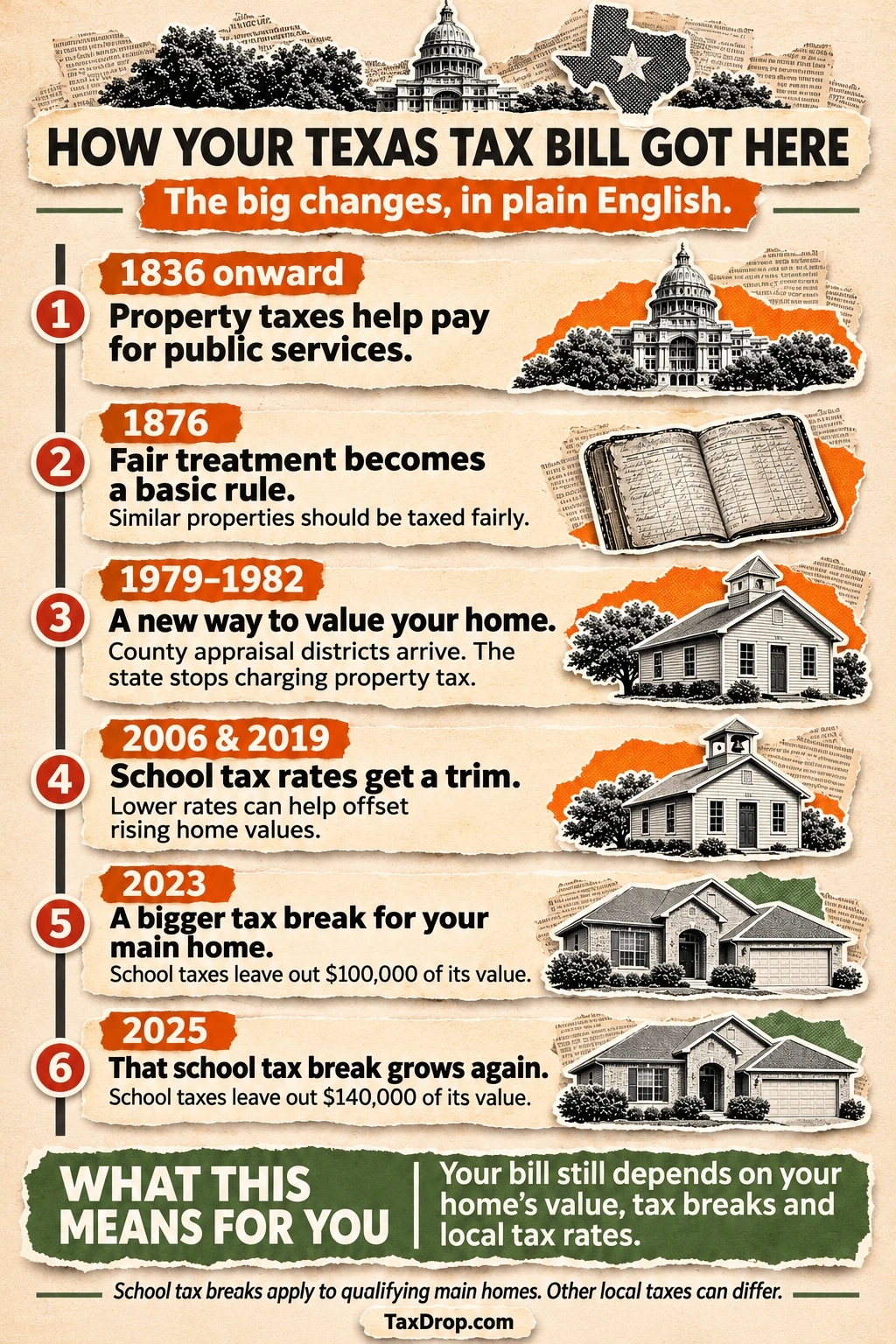
Read the timeline as text
Property taxes help pay for public services.
Fair treatment becomes a basic rule.
Similar properties should be taxed fairly.
A new way to value your home.
County appraisal districts arrive. The state stops charging property tax.
School tax rates get a trim.
Lower rates can help offset rising home values.
A bigger tax break for your main home.
School taxes leave out $100,000 of its value.
That school tax break grows again.
School taxes leave out $140,000 of its value.
What this means for you: Your bill still depends on your home’s value, tax breaks and local tax rates.
School tax breaks apply to qualifying main homes. Other local taxes can differ.
Historical sources are linked in the sections below.
Early Texas: a valuable tax with inconsistent assessments
For roughly the first century after independence, property taxes supplied between half and three-quarters of Texas state tax receipts. Administration was uneven. Local officials valued and collected taxes with limited oversight, and reported values often missed much of the property's actual worth.
The Great Depression added a collection problem: more than 20% of the state property tax levy was delinquent in 1933. These were different failures, but both made the system less dependable. One owner could be undervalued while another struggled to pay an assessment.
Texas gradually repealed its state property taxes and abolished all forms of state property taxation in 1982. Local property taxes continued. Source: Texas Comptroller's history of the property tax.
1876: equal treatment became a constitutional foundation
Article VIII of the Texas Constitution requires equal and uniform taxation and generally ties property taxation to value, subject to authorized exemptions. That principle still matters when you compare your appraisal with similar properties.
A fair tax system needs more than an accurate estimate for one house. Comparable properties also need consistent treatment. A property owner reviewing an assessment should therefore ask two questions: does the value reflect the property, and is the treatment consistent with comparable properties?
Different exemptions, taxing boundaries and property characteristics can explain different bills. Your neighbor's tax payment alone does not establish that your appraisal is wrong. Source: Texas Constitution, Article VIII.
1979: the Peveto reforms changed who appraises your property
Before the modern system, different taxing authorities could produce inconsistent appraisals for the same property. Senate Bill 621, passed in 1979 and associated with Representative Wayne Peveto and Senator Grant Jones, established the countywide appraisal approach.
The goal was a single appraisal for the governments taxing a property. Montgomery Central Appraisal District's own history describes organizing in 1980 and preparing its first appraisal rolls for the 1982 tax year. Source: Montgomery CAD board manual.
For an owner today: challenging an appraisal and objecting to a tax rate are separate actions. An Appraisal Review Board hears disputes about value and other protestable matters. It does not rewrite a city's budget.
Who controls your Texas property tax bill today?
The Comptroller describes three different responsibilities in the local system:
- Appraisal district: estimates property values and processes exemption applications.
- Local taxing units: school districts, cities, counties and special districts adopt their tax rates.
- Tax collection office: bills and collects for the jurisdictions it serves.
Texas has no state property tax. State law shapes the process, but a county appraisal district does not levy your local property taxes. Your address determines the combination of local jurisdictions on your bill. Source: Texas Comptroller, Property Tax System Basics.
2006 and 2019: why school tax rates became central to relief
School finance is a major part of Texas property tax policy. The 2006 reforms compressed school maintenance-and-operations rates, with a one-third reduction from the earlier rate level over two years and state aid helping replace lost local revenue. Source: Texas Education Agency budgeting guidance.
House Bill 3 in 2019 required another round of school tax-rate compression. In plain language, compression lowers the rate applied to taxable value. It can reduce what a district would otherwise collect from rising values. It does not guarantee that every owner's total bill falls. Source: TEA's 2019 implementation letter.
The 2019 Senate Bill 2 also changed tax-rate election rules. For many cities and counties, the voter-approval calculation allows roughly 3.5% additional operating revenue, with separate treatment for debt, unused increments and other adjustments. Special taxing units follow different rules.
The 3.5% figure is not a cap on your personal tax bill. Your value, exemptions and combination of taxing units can change independently. Source: Texas Comptroller, Truth-in-Taxation.
2023–2025: larger school homestead exemptions
The 2023 relief package increased the school district residence homestead exemption from $40,000 to $100,000 and provided additional school tax-rate compression. Those are different tools: the exemption reduces taxable value, while compression reduces a tax rate. Source: Texas Comptroller's 2023 relief analysis.
Voters adopted Proposition 13 on November 4, 2025, raising the general school homestead exemption to $140,000. That increase is already reflected in current Comptroller guidance. It is not a proposal still awaiting a future vote. Source: Texas Legislative Reference Library election record.
Qualifying homeowners age 65 or older or with a disability receive an additional $60,000 school exemption, bringing those two school exemptions to $200,000 combined. These amounts do not automatically apply to every city, county or special-district tax. Eligibility and local exemptions matter. Check the Comptroller's current exemption guidance.
The school homestead exemption has grown.
Exemption amount, not a cash payment. Applies to qualifying residence homesteads for school district taxes. Sources: Texas Comptroller, 2023 relief and current exemption guidance.
Same home. Same rate. A larger exemption.
$100,000 exemption: $300,000 × 1% = $3,000. $140,000 exemption: $260,000 × 1% = $2,600. School taxes only; actual rates, exemptions and tax ceilings vary.
Know what the protections cover
A qualifying residence homestead's appraised value is generally limited to the prior year's appraised value plus 10%, plus new improvements, subject to the statutory rules. The cap limits appraised-value growth. It does not cap your bill at 10%, prove the market value is correct, or replace an exemption. Source: Texas Comptroller, Valuing Property.
Homestead protections also do not erase unpaid property taxes. Tax debt can lead to foreclosure. Treat an exemption application, a value protest and payment arrangements as separate matters. Source: Texas State Law Library.
Your next appraisal notice: a five-step check
- Confirm the property record. Check size, condition, improvements and exemptions against the actual property.
- Separate the values. Identify market value, capped appraised value and each taxing unit's taxable value.
- Build relevant evidence. Use comparable sales, comparable assessments and documented condition issues rather than a general complaint about taxes.
- Watch your deadline. The general protest deadline is May 15 or 30 days after the appraisal notice was delivered, whichever is later. Read your notice for the applicable date.
- Review the final bill. Check each jurisdiction's rate and exemptions, even if you received a value reduction.
The Comptroller explains the protest process and appeal options on its Appraisal Protests and Appeals page. Your protest addresses the matters raised in that process; it does not automatically change an adopted tax rate.
Put the history to work on your own property
The recurring problem in Texas property tax history is fair treatment. Modern appraisal rules give owners a way to challenge an assessment, but the evidence still has to fit the property.
Start with TaxDrop's free Texas property tax check. If your assessment deserves a closer look, review how TaxDrop works and the options for your address. For examples of how property-specific evidence can change an assessment, read TaxDrop's property tax protest case studies.
Research note: Historical milestones are distinguished from rules checked in October 2026. Examples are illustrative. A lower market appraisal may not immediately reduce taxable value when a cap or tax ceiling already controls the calculation.
Paying Too Much in Property Taxes?
Let our licensed property tax experts assess your tax bill for potential savings. 92% of Texas protests we closed in 2026 got a reduction. It takes less than 3 minutes to enroll.
⏰
🏠
💵
No Savings No Fee
FAQs
When did property taxes start in Texas?
Property taxation dates to the Republic era and earlier tax arrangements. The county appraisal district system used today developed from reforms passed in 1979.
Does Texas have a state property tax?
No. Local school districts, counties, cities and special districts levy property taxes. Texas abolished all forms of state property taxation in 1982.
What were the Peveto reforms?
The 1979 reforms established a countywide appraisal approach intended to give taxing authorities a consistent appraisal for each property, instead of multiple inconsistent assessments.
What is the Texas school homestead exemption now?
The general school residence homestead exemption is $140,000. Qualifying owners age 65 or older or with a disability receive an additional $60,000 school exemption. Other taxing units may have different exemptions.
Does the 10% homestead cap limit my tax bill?
No. It generally limits annual growth in a qualifying homestead’s appraised value, plus new improvements, under the applicable rules. Tax rates and exemptions also affect the final bill.
Can I protest even if I have a homestead exemption?
Yes. An exemption does not establish that the appraisal is correct. Review the assessment and the protest deadline shown on your notice. A reduction may not immediately change taxable value when a cap or tax ceiling already controls it.

Ryder Meehan
Ryder Meehan is the Co-Founder of TaxDrop and a Licensed Property Tax Protest Consultant