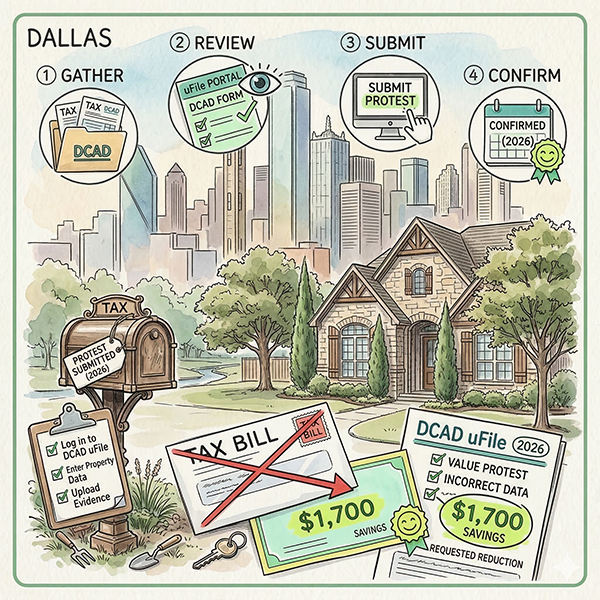
Property tax bills are based on assessed values determined by appraisal districts, not necessarily the true market value of a home. Differences in valuation methods, property data, and market timing can cause tax values to differ from actual home prices.
Key Takeaways:
- Property tax bills are based on assessed value, not market value.
- Appraisal districts use mass appraisal systems to value many homes at once.
- Property records play a major role in determining assessed value.
- Incorrect property data can influence assessments.
- Neighborhood sales impact appraisal estimates.
- Assessment data may lag behind current housing market trends.
- Property condition differences may not be reflected in valuation models.
- Mass appraisal systems prioritize consistency over individual precision.
- Differences between assessed and market value are common.
- Understanding valuation methods helps homeowners interpret tax bills.
Why Your Property Tax Bill Doesn’t Always Reflect Your Home’s True Value
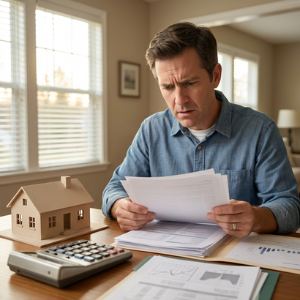
Opening your property tax bill and seeing a higher value than expected can be frustrating. Many homeowners assume that the number listed on their tax statement perfectly reflects what their home is worth in the current housing market.
But in reality, property tax bills don’t always match a home’s true market value. This happens because the way homes are assessed for tax purposes is different from how they are valued when buying or selling.
Understanding why these differences occur can help homeowners make better sense of their property tax bills.
The Difference Between Assessed Value and Market Value
One of the main reasons for confusion is the difference between assessed value and market value.
Market value represents what a buyer would realistically pay for your home in the current real estate market. It reflects supply, demand, location, and property condition.
Assessed value, on the other hand, is the value assigned by an appraisal district or tax assessor for the purpose of calculating property taxes.
These two values can be similar, but they often differ.
Mass Appraisal Systems Don’t Evaluate Each Home Individually
Appraisal districts typically value thousands — sometimes millions — of properties at once. To make this possible, they use mass appraisal models.
These systems rely on:
- Recent neighborhood sales
- Property records
- Automated valuation models
- Statistical estimates
While efficient, mass appraisal systems cannot perfectly account for the unique characteristics of every individual home.
Property Records May Not Always Be Accurate
Another reason tax bills may not reflect true home value is that they depend heavily on property records.
If those records contain incorrect information, the assigned value may also be inaccurate.
Common data issues include:
- Incorrect square footage
- Outdated property features
- Misclassified property types
- Missing depreciation factors
Even small differences in property data can influence valuations.
Neighborhood Averages Can Affect Your Value
Many appraisal systems rely on neighborhood comparisons when determining property values.
If nearby homes sell at higher prices, those sales may influence valuations across the area. However, not every home in the same neighborhood is identical.
Differences in condition, upgrades, or lot features may not always be reflected in automated valuation models.
Market Timing Can Create Gaps
Housing markets move quickly, but property assessments typically follow an annual schedule.
This means the data used to determine your tax value may reflect market conditions from several months earlier.
If the market shifts after assessments are completed, the assessed value may not align with current market trends.
Condition Differences Aren’t Always Visible in Data
Appraisal models generally assume homes are in average condition unless information suggests otherwise.
However, many homes have condition differences that are difficult to capture in large-scale valuation models.
Examples include:
- Aging roofs
- Foundation wear
- Interior updates that never occurred
- Drainage or landscaping issues
These factors may influence actual market value but may not be reflected in property tax assessments.
Why This Matters for Homeowners
Understanding that property tax bills are based on estimated values rather than perfect market comparisons can help homeowners interpret their tax statements more clearly.
A property tax value isn’t necessarily a reflection of what your home would sell for today. Instead, it’s a standardized estimate used to calculate taxes across large groups of properties.
Recognizing this distinction can make property tax bills easier to understand.
The Bottom Line
Property tax assessments are built using large datasets, statistical models, and standardized assumptions. While these systems help counties evaluate large numbers of homes efficiently, they don’t always capture every detail of an individual property.
As a result, the value shown on a property tax bill may not always reflect a home’s true market value.
By understanding how assessments work and why differences occur, homeowners can approach their property tax bills with greater awareness and confidence.
Paying Too Much in Property Taxes?
Let our licensed property tax experts assess your tax bill for potential savings. Over 80% of protests get a reduction of more than $1,000 and it takes less than 3 minutes to enroll.
⏰
🏠
💵
FAQs
Why is my property tax value different from my home’s market value?
Property tax values are based on assessed values determined by appraisal districts using mass appraisal models, which may differ from actual market conditions.
What determines my property’s assessed value?
Assessed values are calculated using property records, neighborhood sales data, and statistical valuation models.
Can property records affect my tax value?
Yes. Incorrect details like square footage or property features can influence the assessed value used for taxation.
Are property tax assessments updated every year?
Most appraisal districts update property assessments annually using available sales data and market trends.
Should my property tax value match what my home would sell for?
Not necessarily. Market value and assessed value serve different purposes and may differ.