
The Chatham County Board of Assessors mails a Notice of Assessment every year. You have 45 days from the date on it.
✔ Sales-Led Cases – recent comparable sales from Savannah, Pooler, Garden City and Tybee Island
✔ Coastal Conditions Counted – flood zone, wind exposure and storm damage are value evidence, and we document them
✔ Form PT-311A, Filled In – built for the Chatham County Board of Assessors
✔ $129 Per Property – flat, per tax year. Georgia charges no filing fee.
⏰
🏠
💵
The Chatham County Board of Assessors mails a Notice of Assessment every year. You have 45 days from the date on it.
✔ Sales-Led Cases – recent comparable sales from Savannah, Pooler, Garden City and Tybee Island
✔ Coastal Conditions Counted – flood zone, wind exposure and storm damage are value evidence, and we document them
✔ Form PT-311A, Filled In – built for the Chatham County Board of Assessors
✔ $129 Per Property – flat, per tax year. Georgia charges no filing fee.
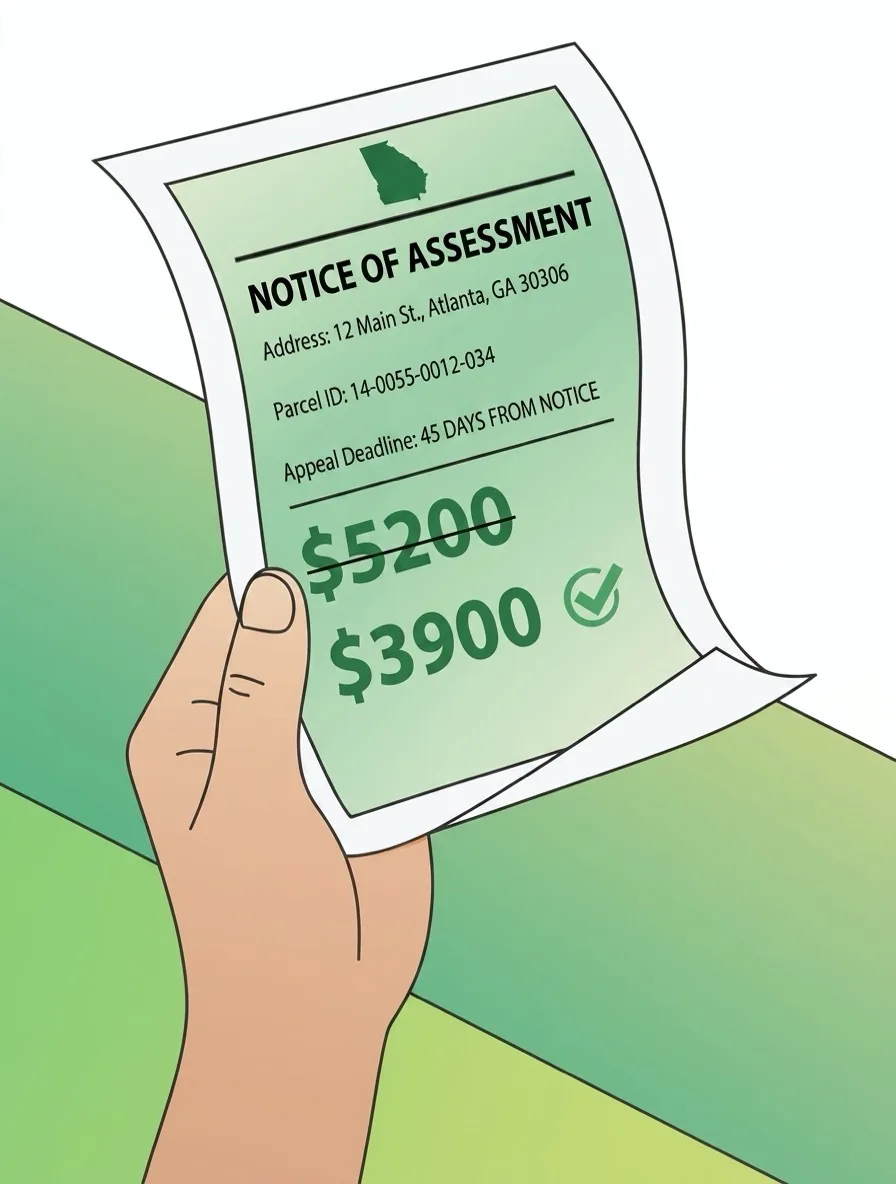







The Chatham County Board of Assessors values everything from Victorian District row houses to Pooler new builds to Tybee Island cottages, and it does it with mass appraisal models. Those models handle square footage and build year well. They handle a coastal market badly.
Georgia assesses at 40% of fair market value (O.C.G.A. § 48-5-7). The ratio is fixed statewide, so a Chatham County appeal is an argument about the fair market value the county assigned.
You have 45 days from the date on your Notice of Assessment to appeal in writing (O.C.G.A. § 48-5-311). Chatham mails in June — in the 2026 cycle notices went out June 16 and the county set the appeal and exemption deadline at July 31, 2026. Read your own notice for the operative date.
Coastal value is not a smooth surface. Two houses a block apart can sit in different flood zones, and the one with the worse zone carries higher insurance, a smaller buyer pool and a lower sale price — none of which an automated model necessarily sees. Storm and wind damage that has not been repaired rarely makes it into county records. Elevation, drainage and proximity to the marsh all move price in ways square footage does not capture.
Savannah's historic districts add another layer. A landmark-district property carries renovation restrictions that constrain what a buyer can do with it, and a model comparing it to an unrestricted house of the same size is comparing two different products.
Roughly 30% to 60% of properties nationally are over-assessed. About 5% of owners appeal.
Georgia allows market value and uniformity appeals. Sales are the strongest evidence a Board of Equalization sees, so we lead with sales and hold uniformity in reserve.
Under O.C.G.A. § 48-5-299(c), a value changed through appeal is generally frozen for the following two tax years — worth watching in a market where coastal values have moved hard in short stretches.
We pull recent sales from MLS and public records, compare them against the fair market value on your Chatham notice, and show you the gap and the annual savings. You get the comparable sales, your completed Form PT-311A, an assessor negotiation script, Board of Equalization talking points, and a tax consultant review. $129 per property, per tax year. You file it yourself, and Georgia charges nothing to file.
Sign up and TaxDrop handles the paperwork, the evidence, and the filing. It takes less than 3 minutes to enroll.
Step 1: Read the notice date.
Your Notice of Assessment arrives from the Chatham County Board of Assessors, typically in June. The 45 days run from the date on it.
Step 2: Check the fair market value.
The notice shows a fair market value and the 40% assessed value derived from it. Your appeal targets the fair market value.
Step 3: Document the coastal facts.
Flood zone, elevation, unrepaired storm or wind damage, historic-district restrictions. In Chatham this is often the difference between a denial and a reduction.
Step 4: Build the sales case.
Recent sales of comparable properties in the same zone and the same submarket. TaxDrop One assembles them from MLS and public records.
Step 5: File Form PT-311A in writing
with the Board of Assessors before the 45 days run out.
Step 6: Settlement conference, then the board.
Georgia requires the assessors to offer a conference. If it does not resolve, the Chatham County Board of Equalization hears the case.
Step 7: The freeze.
A value reduced on appeal is generally held for the following two tax years under O.C.G.A. § 48-5-299(c).
Key Dates
Filing Fee
What You File
Where It Goes
Assessment Basis
Official resources:
A: 45 days from the date on your Notice of Assessment, filed in writing (O.C.G.A. § 48-5-311). Chatham typically mails in June — in the 2026 cycle notices went out June 16 and the county set the deadline at July 31, 2026. Your own notice carries the governing date.
A: No. There is no filing fee for a Chatham County appeal to the Board of Assessors or the Board of Equalization. TaxDrop One is $129 per property, per tax year.
A: It affects your property's fair market value, which is what the assessment is supposed to reflect. A worse flood zone means higher insurance and a smaller buyer pool, and both show up in sale prices. Chatham's mass appraisal models do not always capture it, which is exactly the kind of gap an appeal is for.
A: Unrepaired damage lowers market value and frequently is not reflected in county records. Photograph it, get repair estimates, and put both in the appeal.
A: Georgia's statewide assessment ratio (O.C.G.A. § 48-5-7). Property is assessed at 40% of fair market value and taxed at the local millage rate. An appeal challenges the fair market value, not the 40%.
A: Usually market value. Both grounds exist in Georgia, but recent comparable sales are what a Board of Equalization weighs most heavily.
A: Generally yes. O.C.G.A. § 48-5-299(c) freezes a value set through appeal for the following two tax years, with limited exceptions such as substantial improvements to the property.
A: An appeal reopens the fair market value, so a board can move it either way. It is uncommon when the case rests on solid comparable sales, and TaxDrop One tells you before you file whether the sales support a reduction at all.
A: No — TaxDrop One is self-guided. You file your own PT-311A. We provide the comparable sales, the completed form, the negotiation script, the Board of Equalization talking points, and a tax consultant review.
A: Yes. TaxDrop One covers rental and investment property across Chatham, including short-term rentals in Savannah's historic districts and on Tybee Island. Non-homestead property has no floating homestead protection, so an inflated value hits the return in full.
A: Enter your Chatham County address at TaxDrop.com and you will see the gap between your notice value and what recent sales support before you pay anything.