

Key Takeaways:
The average homestead exemption isn't one number. It ranges from $7,000 in California to $100,000 in Texas, and two of the six states TaxDrop works in — New Jersey and Maryland — don't use a dollar exemption at all.
TL;DR
- Texas leads with a $100,000 homestead exemption for school taxes; California's $7,000 exemption is the smallest of the six states TaxDrop serves.
- Florida cuts up to $50,000 off assessed value; Georgia's state floor is just $2,000 before counties add local exemptions.
- New Jersey and Maryland skip a dollar exemption entirely — NJ runs the ANCHOR rebate, Maryland caps assessment growth instead.
- A homestead exemption lowers your taxable value automatically. It does not fix an over-assessment — only an appeal or protest does that.
- File your exemption first in 2026, then check your assessment against the 30-60% over-assessment rate typical across these states.
Why this matters
A homestead exemption is a flat amount subtracted from your home's assessed value — the dollar figure your county or state uses to calculate your tax bill — before the tax rate is applied. It's not the same as an appeal. An appeal or protest challenges whether the assessed value itself is too high in the first place.
Most homeowners file the exemption once and never touch it again. Fewer than 5% of eligible owners ever appeal their assessment, even though 30-60% of properties nationally are over-assessed in any given year. The exemption and the appeal stack — one lowers your baseline, the other corrects an inflated starting number.
Start with TaxDrop to see whether your homestead exemption is on file and whether your assessed value looks out of line for 2026.
Average homestead exemption by state (2026)
The table below shows the statewide homestead benefit in each state TaxDrop serves. Four states use a flat-dollar exemption. Two use a different mechanism entirely, which is why a single blended "average" across all six doesn't tell you anything useful.
Texas
- Type of relief: Flat-dollar homestead exemption
- Statewide amount: $100,000 off assessed value for school district taxes
- Who administers it: County Appraisal District (CAD)
Florida
- Type of relief: Flat-dollar homestead exemption
- Statewide amount: Up to $50,000 off assessed value ($25,000 applies to all taxes; a second $25,000 applies to non-school taxes on value between $50,000-$75,000)
- Who administers it: County Property Appraiser
Georgia
- Type of relief: Flat-dollar homestead exemption
- Statewide amount: $2,000 off assessed value (state floor; most counties add a larger local exemption)
- Who administers it: County Board of Tax Assessors
California
- Type of relief: Flat-dollar homestead exemption
- Statewide amount: $7,000 off assessed value
- Who administers it: County Assessor's Office
Maryland
- Type of relief: Assessment-growth credit, not a dollar exemption
- Statewide amount: Caps the annual increase in taxable assessment at up to 10% statewide; many counties set the cap lower
- Who administers it: SDAT / Supervisor of Assessments
New Jersey
- Type of relief: Rebate program, not an assessed-value exemption
- Statewide amount: Amount set annually by the state through the ANCHOR program
- Who administers it: State Division of Taxation
Texas has the largest flat-dollar homestead exemption of the six states at $100,000 — roughly 14 times Georgia's $2,000 state floor and more than 14 times California's $7,000. Florida sits in the middle at up to $50,000. Maryland and New Jersey don't rank on this list at all because their relief isn't a dollar subtraction from assessed value.
Georgia's $2,000 figure looks low next to Texas because it's a statutory floor, not a ceiling. Counties like Fulton and DeKalb layer local homestead exemptions on top that push the real number far higher than the state minimum — you have to check your specific county to know what you're actually getting.
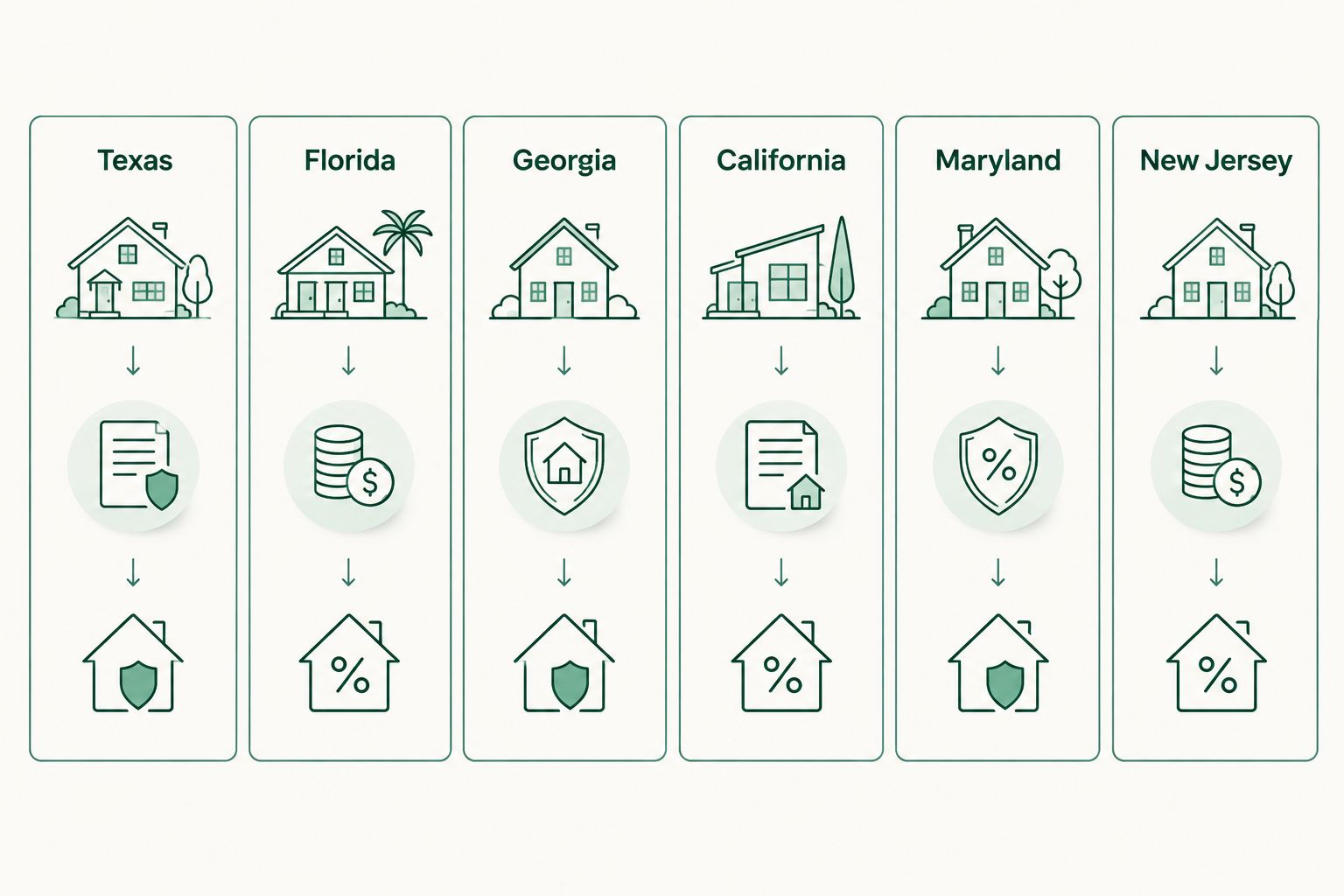
Four states cut a flat dollar amount off assessed value; Maryland and New Jersey use a different mechanism entirely.
Methodology and limitation: figures reflect statewide homestead exemption and credit rules published by each state's tax authority for the 2026 tax year. What this table can't tell you is your local add-on — county and municipal governments in Georgia, Texas, and elsewhere can layer additional exemptions on top of the state figures shown here, so your actual reduction may run higher than the statewide baseline.
How to use these benchmarks
- If you're in Texas or Florida, file the exemption before you do anything else. These are the two largest flat-dollar exemptions on this list, and missing the filing deadline means paying full freight for a year you didn't have to.
- If you're in Georgia, call your county assessor's office and ask what local exemptions exist. The $2,000 state floor almost never reflects what long-time homeowners in that county actually pay.
- If you're in California, don't expect the $7,000 exemption to move the needle much — go after the assessed value instead. Filing an appeal on an inflated assessment does far more for your bill than the exemption itself.
- If you're in New Jersey, treat ANCHOR and an assessment appeal as two separate tracks. Filing an appeal in New Jersey can raise your assessment under the Chapter 123 ratio test if your value is already below the county's common level range, so don't file generically hoping for a reduction.
Check your exemption and assessment
See if your homestead exemption is filed and whether your 2026 assessment looks accurate.
FAQ
What is the average homestead exemption amount by state in 2026?
There's no single blended average because states use different mechanisms. Texas offers the largest flat-dollar exemption at $100,000 for school taxes, California the smallest at $7,000, and Maryland and New Jersey don't use a dollar exemption at all.
Is California's homestead exemption really only $7,000?
Yes. California's Homeowners' Exemption reduces assessed value by $7,000, a figure that has stayed flat for decades. In California, the bigger lever for lowering your bill is appealing an inflated assessed value, not the exemption.
Does Texas have the highest homestead exemption in the country?
Among the six states TaxDrop serves, yes — Texas's $100,000 school-tax exemption is the largest flat-dollar homestead exemption on this list. Additional local exemptions from your county appraisal district can add more on top.
Why doesn't New Jersey have a homestead exemption?
New Jersey handles property tax relief through the ANCHOR rebate program instead of an assessed-value exemption. The amount is set annually by the state and paid as a rebate rather than subtracted from your assessment.
How is Maryland's Homestead Tax Credit different from an exemption?
Maryland's Homestead Tax Credit caps how much your taxable assessment can increase each year, up to 10% statewide, with many counties setting a lower cap. It limits growth in your taxable value instead of subtracting a flat dollar amount.
Does a homestead exemption replace the need to appeal my assessment?
No. The exemption lowers your taxable value by a fixed amount, but it does nothing if your underlying assessed value is inflated. An appeal or protest is the only way to correct an over-assessment.
Do Georgia counties offer more than the $2,000 state exemption?
Most do. The $2,000 figure is a statutory floor for state and county taxes, and many Georgia counties layer local homestead exemptions on top that are worth far more to homeowners.
How much does a homestead exemption actually save on my tax bill?
It depends on your local tax rate and which exemption applies, since the exemption reduces taxable value, not the bill directly. A $50,000 reduction at a 2.5% rate saves roughly $1,250 a year, for example.
One last thing
California's $7,000 Homeowners' Exemption hasn't been raised since 1974. Adjusted for what a dollar bought back then, it covers a fraction of what it once did, which is exactly why appealing the assessed value matters more in California than filing the exemption paperwork. The exemption is a formality; the appeal is where the money is.
Related guides
Paying Too Much in Property Taxes?
Let our licensed property tax experts assess your tax bill for potential savings. Over 80% of protests get a reduction of more than $1,000 and it takes less than 3 minutes to enroll.
⏰
🏠
💵
No Savings No Fee