
Serving Homeowners & Real Estate Investors in All 21 New Jersey Counties
Why New Jersey Homeowners Choose Us
✅ Know Before You Pay – being over-assessed isn't enough to win here, and filing can backfire. We check first.
✅ Every County, Every Deadline – including the January 15 date in Burlington, Gloucester and Monmouth
✅ Sales-Only Evidence – the only kind New Jersey accepts
✅ Your Filing Fee, Up Front – we show your $5–$150 county fee before you commit
✅ $129 Per Property – flat, per tax year
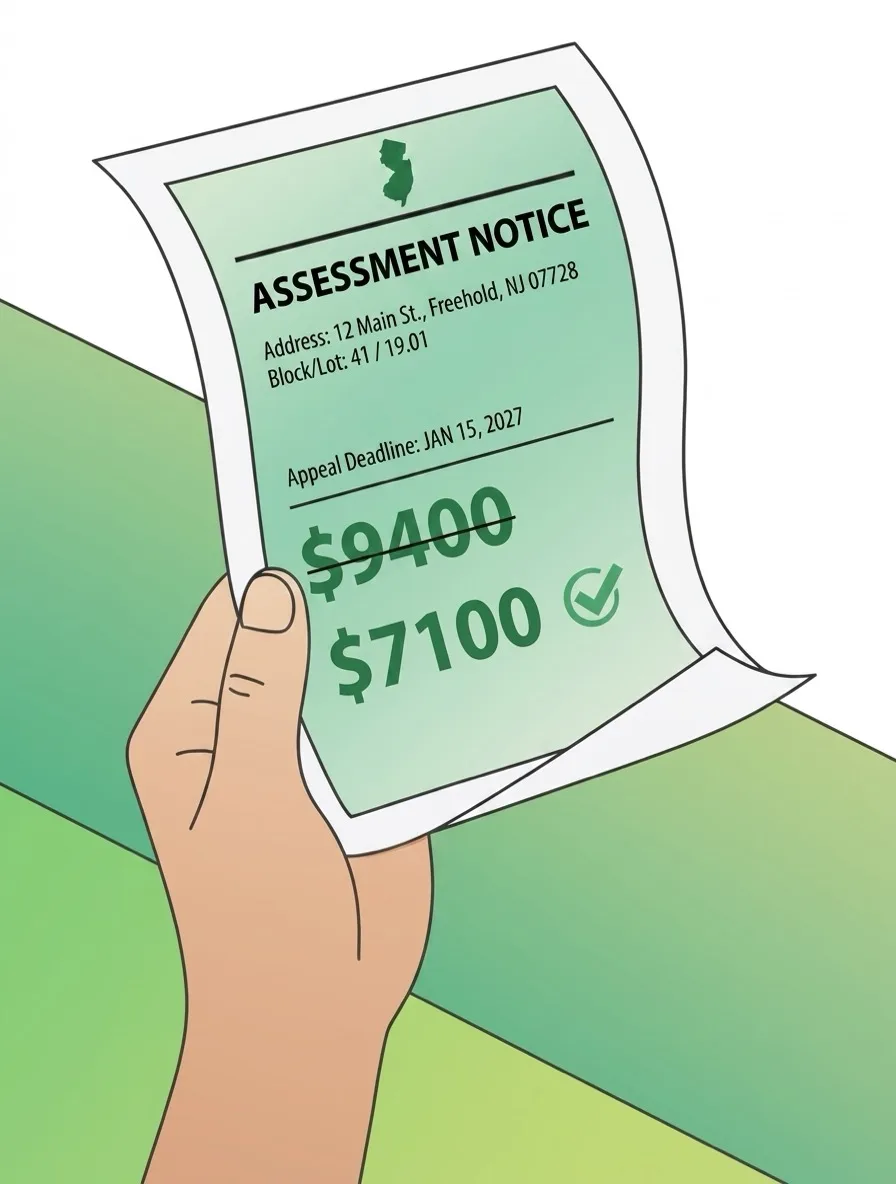







New Jersey homeowners pay some of the highest property taxes in the country. The appeal that lowers them does not work the way it does anywhere else.
Your town's assessor sets the value. Your County Board of Taxation hears the appeal. And the decision turns on a ratio rather than on market value alone.
Every municipality has a common level range — a band around the average assessment-to-value ratio for that town.
If your assessment sits above the band, the board reduces you to the common level. If it sits inside the band, nothing changes, however over-assessed the property looks. And if it sits below the band, the board is required by law to raise your assessment (N.J.S.A. 54:3-22).
That last outcome is the reason we check before you file. If your property is already assessed for less than its share, we tell you not to file and we explain why. You keep the report, and we re-check next season in case the ratio moves. Read the full rule in our Chapter 123 explainer.
Most of the state files by April 1.
Burlington, Gloucester and Monmouth counties file by January 15 — two and a half months earlier than everyone else. If your municipality ran a district-wide revaluation or reassessment, the date moves to May 1 instead. In every case you get at least 45 days from the day your town finishes mailing assessment notices.
Appeals must be received by the deadline, not postmarked. One day late is dismissed.
We pull recent sales from MLS and public records, compare them against your assessed value, and run your municipality's Chapter 123 numbers. You get a report showing the value we can support, the assessment the board would land on if you win, and an honest read on whether it is worth filing.
New Jersey accepts comparable sales only — comparable assessments are not evidence of value here. Five sales, filed with the petition or delivered at least seven days before your hearing.
TaxDrop One is $129 per property, per tax year.
New Jersey also charges its own filing fee, from $5 to $150 depending on your assessed value, payable to the County Tax Administrator when you file. It is the only state we serve that charges up front, and it is non-refundable — so we show you your tier before you commit.
We cover all 21 New Jersey counties.
New Jersey decides on the Chapter 123 ratio test (N.J.S.A. 54:51A-6), not on market value alone. Comparable sales are the only admissible evidence of value here — comparable assessments are not.
Three arm's-length sales support a true market value of $395,000:
At a $413,500 assessment against a $395,000 proven value, the ratio is 104.7% — above the 103.50% upper limit. The board must reduce the assessment to the common level: $395,000 × 90.00%.
The request is $355,500, not $395,000. New Jersey reduces a winning appeal to the municipality's common level — not to the sale price of the comparables. Had the ratio come in below 76.50%, the board would have been required to raise this assessment, and we would not have filed.
April 1 in most of the state. January 15 in Burlington, Gloucester and Monmouth counties, which run on an alternate assessment calendar. May 1 if your municipality completed a district-wide revaluation or reassessment. In all cases you get at least 45 days from the day assessment notices finish going out.
Yes — and New Jersey is the only state where that is a statutory requirement rather than a risk. If your assessment-to-value ratio falls below your municipality's common level range, the county board must increase the assessment (N.J.S.A. 54:3-22). We test for this first and refuse those cases. A report that tells you not to file is doing its job.
Because New Jersey reduces a winning appeal to the common level — the value you prove multiplied by your municipality's average ratio — not to the sale price of your comparables. That figure is the assessment we ask the board for. It is not our opinion of your home's market value.
$129 per property, per tax year for TaxDrop One. Separately, the county charges a filing fee of $5 to $150 based on your assessed value, paid when you file and non-refundable. See our pricing page.
Comparable sales — up to five. Comparable assessments are not acceptable evidence of value in New Jersey, which is the opposite of how Texas works. Value is argued as of October 1 of the year before the tax year, not today's market.
Yes. N.J.S.A. 54:3-27 requires at least the first quarter of the year's taxes and municipal charges to be paid before the board will hear you.