
Appraisal Higher Than Purchase Price? Cut Your Texas Tax Bill

Key Takeaways:
When your lender’s appraisal comes in higher than your purchase price, nothing bad happens. Your loan and your cash to close stay the same. The part that matters comes later: the county appraisal district may value your home above what you paid, and you can protest that.
I’m Ryder Meehan, Founder and Licensed Property Tax Consultant at TaxDrop. I’ve been a landlord since 2012, with rentals in Dallas and Grayson counties. I’ve seen this exact situation from both sides of the table, as a buyer and as a protester.
TL;DR
- A lender’s appraisal at or above your price lets closing go ahead without changing your financing or upfront cash, according to Fannie Mae.
- The higher appraisal doesn’t lower your property taxes. It also doesn’t raise the price you agreed to pay.
- The county values your home on its own schedule, as of January 1, and you can protest if that number is too high.
- Your signed contract price is stronger protest evidence than the lender’s appraisal. I’d lead with it.
- A TaxDrop protest costs nothing unless we cut your bill, because of our no savings, no fee guarantee.
Table of Contents
- What a higher appraisal means at closing
- Why the lender’s number and the county’s number are different
- The trap: a high appraisal can lead to a high county value
- Why I’d use your price, not the appraisal
- What the county can and can’t do with a sale price
- How to protest, step by step
- A worked example with a homestead cap
- If you’re a landlord or investor
- Denton, Tarrant and Grayson owners
- What I’d skip
- Our approach
- Let us handle your protest
- FAQ
- Sources
What a higher appraisal means at closing
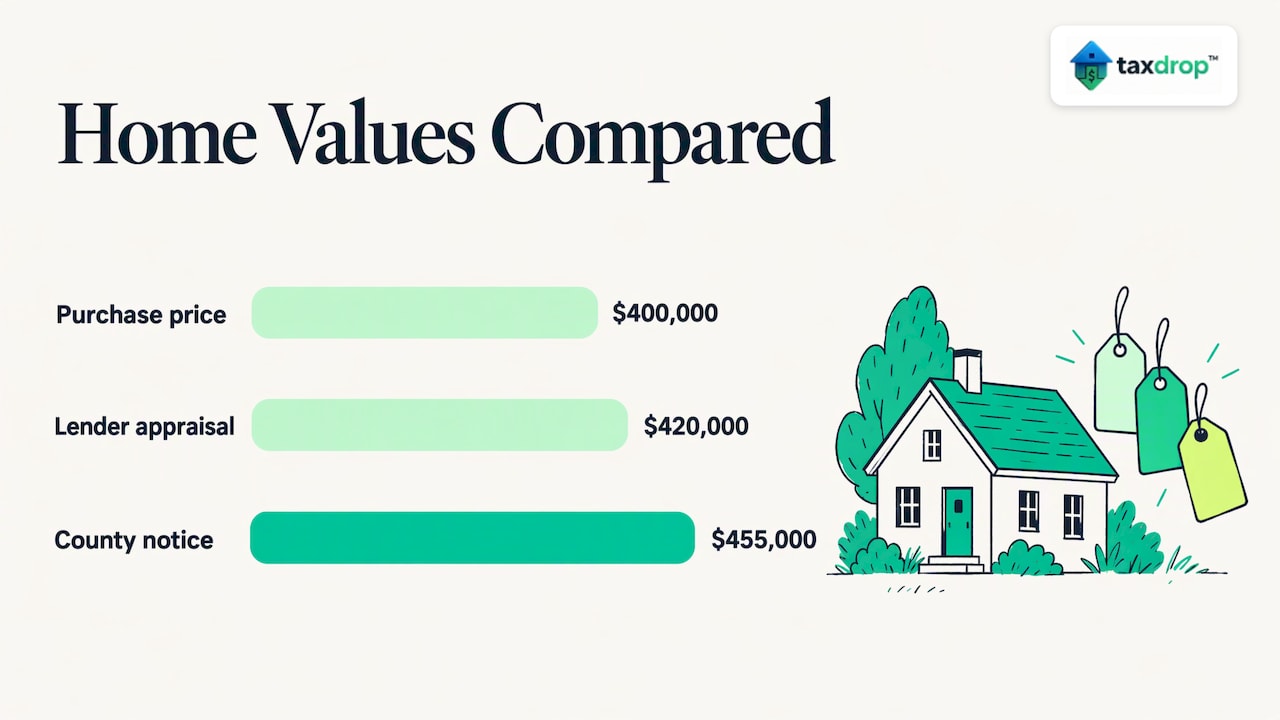
You agreed to pay $400,000. The lender’s appraiser says the home is worth $420,000. Good news, and mostly a quiet kind.
A lender’s appraisal is an independent opinion from a trained professional. It looks at the home’s condition, its features, its location and market trends. Fannie Mae explains that a value at or above the purchase price should let closing move forward. Your financing and your upfront cash don’t change.
The lender uses the appraised value to underwrite the loan. If the value is higher than the price, the lender is comfortable. That’s all it does for you.
Here’s what it doesn’t do:
- It doesn’t hand you cash at closing.
- It doesn’t change the contract price. The seller can’t ask for more after signing.
- It doesn’t lower your loan balance.
- It doesn’t set your property tax value.
The buyer-side flip of this is the appraisal gap, where the appraisal lands under the price and the buyer covers the difference. You don’t have that problem. You bought below the lender’s number.
You do have a built-in cushion. You may have instant equity on paper. Keep that in mind, because the county might see the same thing, and it could cost you every year.
Why the lender’s number and the county’s number are different
Two different people value your home for two different reasons.
The lender’s appraiser answers one question: is this home worth enough to back the loan? That’s a one-time opinion tied to your sale.
The county appraisal district answers another: what was your home worth on January 1? Texas law says all taxable property is appraised at its market value as of January 1. The district runs mass appraisals across thousands of homes. It then sends you a notice of appraised value each spring.
That gap in timing and method is why the two numbers rarely match. Market value is what a willing buyer would pay a willing seller. Your price is the best proof of that, and the appraisal district doesn’t always have it.
There’s one more term to know. Appraised value is the county’s estimate of market value. Taxable value is what’s left after limits and exemptions. A homestead exemption (a break on your primary residence) lowers the taxable value. So does the appraisal cap, which limits how much a homestead’s value can rise per year. Grayson Central Appraisal District’s 2025 information booklet says the value you protest is market value, while the taxable amount can reflect those limits and exemptions.
The trap: a high appraisal can lead to a high county value
Say you bought in 2026 for $400,000. The lender appraised at $420,000. In spring 2027, the county sends a notice. It says $455,000.
That’s $55,000 above what you paid. If you don’t protest, you pay tax on $455,000 for the year.
The math, using a sample combined tax rate of 2.2%. Your rate will differ, since each school district, city and county sets its own:
| Value | Tax at 2.2% | |
|---|---|---|
| County notice | $455,000 | $10,010 |
| Your contract price | $400,000 | $8,800 |
| Difference | $55,000 | $1,210 |
That’s $1,210 a year on the sample rate. A homestead exemption would trim the taxable amount a bit further, so check your own notice for the exact figures.
The lender’s $420,000 would still beat the county’s $455,000. But I’d rather argue from $400,000, and I’ll explain why below.
Why I’d use your price, not the appraisal
Most online advice says to bring everything you have. I disagree on one point. Leave the lender’s appraisal in the folder.
Here’s why. At the review hearing, a county appraiser or a board member (the appraisal review board, or ARB, is the panel that hears protests) may see a lender’s appraisal as a number built to support a loan. It’s also higher than your price, so it hurts your case. If you hand it over, you’ve given them a figure above your own contract.
Your closing disclosure and signed purchase contract are plain. They show what a real buyer and a real seller agreed to, close to January 1. That’s market value at work.
A few notes on that:
- A sale close to January 1 is the strongest. An older sale needs help from other evidence.
- A price that included odd terms (a seller credit, a relative sale, a rush sale) needs an explanation.
- Nearby sales of similar homes back up your price. So do photos of condition problems.
I’d skip the lender’s appraisal unless it’s lower than the county’s number and fits your story. Even then, it’s a side note, not the lead.
What the county can and can’t do with a sale price
A recent purchase price is strong evidence. It isn’t a hard cap on the county’s number. Texas law doesn’t tell the district to adopt your price as the value. It says to use recognized methods and techniques. The statute on appraisals says adjustments must be based on recognized methods to produce a credible opinion.
So a sale price gets weighed alongside comparable sales and condition. That’s why I like to build a full set of evidence, not a single paper.
Two things work in your favor:
- The county may not know what you paid. Don’t assume it does.
- You can also protest on unequal appraisal, which means your home is valued higher than similar homes nearby. Tax Code §41.41 grounds, as Grayson CAD’s booklet lists them, include excessive value and unequal appraisal.
Two market-value arguments give you two shots at the same reduction.
How to protest, step by step
Here’s the routine I’d follow after a purchase.
Step 1: Watch for the notice
The district mails a notice of appraised value in spring. Open it the day it comes. Check the market value, the exemptions listed, and the protest deadline.
Step 2: Know your deadline
The Texas Comptroller says most appraisal review board protests are due May 15, or 30 days after the notice is delivered, whichever is later. Mark it. Don’t wait until the last week. Our Texas protest deadline guide lays it out.
Step 3: Gather your evidence
Pull these together:
- Your signed contract and closing disclosure.
- Sales of similar homes near yours, close to January 1.
- Photos and repair bids for anything that cuts value.
- The district’s own record for your home. Look for wrong square footage, wrong bedroom counts or a missing flaw.
This is where a lot of people stall. Sorting comparable sales takes time, and public listing sites give asking prices, not always what homes sold for. Our system runs AI-driven market data analysis, and a licensed consultant reviews every case, so the evidence package is built for you.
Step 4: File the protest
File with the appraisal district by the deadline. Most districts take online filings. Choose “excessive value” and, if it fits, “unequal appraisal.”
Step 5: Try the informal review
Many districts offer an informal meeting first. A staff appraiser looks at your evidence and may offer a lower number on the spot. It’s often the quickest path. We explain how it compares to a hearing in informal review vs. ARB hearing.
Step 6: Go to the ARB hearing if needed
If the informal offer is too high, you go to the ARB. Grayson CAD’s booklet says boards give at least 15 days’ notice of the hearing date, time and place. Qualifying owners may ask for a postponement. Our guide on how protests actually work walks through the hearing.
Step 7: Look at your options after the hearing
The Comptroller’s July 2025 update says you can pursue binding arbitration for property valued at $5 million or less, or for a residence homestead of any value. Owners can also appeal ARB orders to the State Office of Administrative Hearings for property valued above $1 million. Our arbitration guide covers cost and timing.
If you’d rather skip steps 3 through 7, we handle them for you. More on that below.
A worked example with a homestead cap
The appraisal cap trips people up, so here’s a number-by-number case.
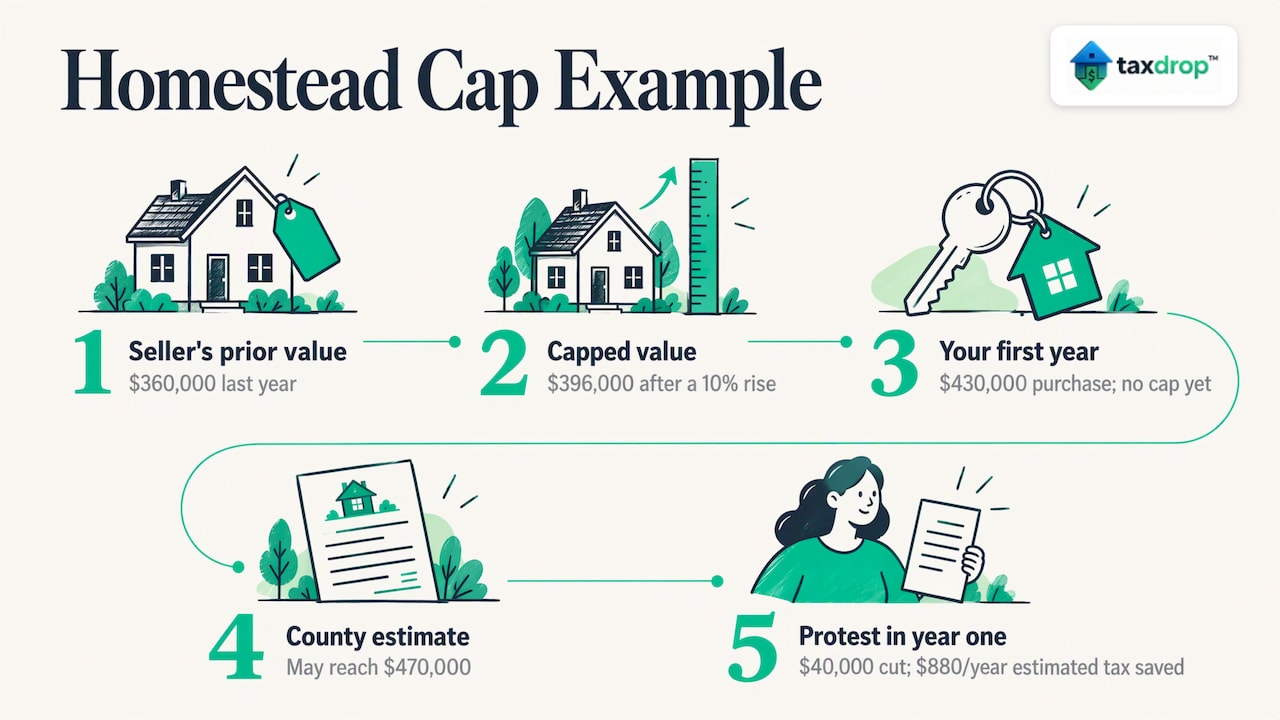
The cap limits the yearly rise in a homestead’s value. Grayson CAD’s booklet gives the limit as 10% per year for a qualifying homestead. It takes effect on January 1 of the tax year after the first full year the home qualifies.
Say a seller’s homestead was valued at $360,000 last year. The cap lets it rise to $396,000. The market value can sit far above that, and the cap just holds the taxable amount down.
Now you buy it for $430,000. You don’t have a capped value in your first year. The county can value it at full market. You may see $470,000.
A protest backed by your $430,000 contract aims for a $40,000 cut. At the 2.2% sample rate, that’s $880 a year in estimated tax saved.
The cap then starts for you in a later year. Every dollar you cut off market value in year one also lowers the base the cap grows from. That’s why I’d protest in year one, not wait.
If you’re a landlord or investor
I own rentals, so I’ll say this plainly. Your purchase price matters just as much on a rental. Rentals don’t get the homestead cap, so the county can move your value with the market. Protest each year. Our Texas landlord protest guide covers the details.
Buy three rentals, and that’s three notices and three deadlines. Our commercial and residential protest services cover both kinds, and we track deadlines for you.
Denton, Tarrant and Grayson owners
The rules above are statewide. The process is local. Each appraisal district sets its own online filing portal, its own informal review style and its own hearing calendar. Denton and Tarrant homeowners should read the notice from their own district. Grayson owners can read the GCAD booklet. If you’re in the Dallas–Fort Worth area, our Texas property tax consultant page shows how we work there.
What I’d skip
Some moves look smart and aren’t.
- Skipping the protest because your appraisal was high. The lender’s number has no effect on your tax bill.
- Waiting until next year. Your value this year sets the base for later ones.
- Arguing from the lender’s appraisal. Use your contract instead.
- Missing the deadline. After it passes, your protest rights for that year are mostly gone.
Our approach
After buying a home, I see the same pattern. People relax once the loan closes. Then the notice arrives, and the number is higher than their price.
We built TaxDrop for that moment. You tell us about your purchase. Our proprietary AI technology and market data build the case, and a licensed consultant reviews every file. We track your deadline, file on time and tell you where things stand in your dashboard.
We charge only when we cut your bill. That’s our no savings, no fee guarantee. I’d want the same deal if I were protesting my own rentals, and I do.
Your price is proof. We put it to work.
Ryder Meehan, Founder and Licensed Property Tax Consultant at TaxDrop
Let us handle your protest
If you’d rather not collect comparables and sit in a hearing, we’ll do it. Our full-service protest means we file, negotiate and attend the hearing, and we re-file each year. You pay only if your tax bill drops.
Prefer to present your own case? TaxDrop One is a self-service evidence package built by licensed consultants. It costs $129 per year per property. See TaxDrop One and Pro for the details, or start with our residential protest service.

Want to see real numbers first? Our case studies show results from past protests.
FAQ
Is it good if my appraisal is higher than the purchase price?
Yes. It means the lender sees the home as worth at least what you’re paying, so your loan and upfront cash stay on track. Fannie Mae says an appraisal at or above the price should let closing proceed. It doesn’t change your price or your tax value.
Can the seller ask for more money if the appraisal is higher?
No. The contract is signed at the agreed price. A higher lender appraisal doesn’t reopen it. You pay what you agreed to pay.
Does a higher appraisal raise my property taxes?
The lender’s appraisal doesn’t set your tax value. The county appraisal district does, using market value as of January 1. Still, a strong market can lead the county to a number above your price. If it does, protest by the deadline and bring your contract.
Should I use my lender’s appraisal in a Texas protest?
I wouldn’t lead with it. A number above your price works against you. Your signed contract and nearby comparable sales make a cleaner case. If you want help picking the right evidence, we do that as part of every protest.
Sources
- Understanding Home Appraisals, Fannie Mae
- Tex. Tax Code Section 23.01, Appraisals Generally
- Grayson Central Appraisal District 2025 Information Booklet
- Property Tax Today, Texas Comptroller, April 2025
- Property Tax Today, Texas Comptroller, July 2025
- Appraisal Gap Meaning, HouseGoodbye Blog
Recommended
Paying Too Much in Property Taxes?
Let our licensed property tax experts assess your tax bill for potential savings. 92% of Texas protests we closed in 2026 got a reduction. It takes less than 3 minutes to enroll.
⏰
🏠
💵
No Savings No Fee
FAQs

Ryder Meehan
Ryder Meehan is the Co-Founder of TaxDrop and a Licensed Property Tax Protest Consultant