
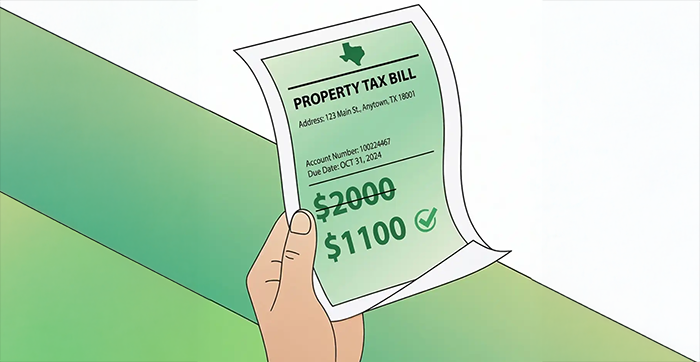
Williamson County property taxes are protested with the Williamson Central Appraisal District in Georgetown. File by May 15 or 30 days after your notice of appraised value is delivered, whichever is later. TaxDrop One is a self-guided evidence package at $129 per property per tax year, refunded if there is no reduction. TaxDrop Pro is full service in Williamson County at 1% of the assessment reduction, paid only if we win.
✔ Free to file yourself - the district cannot charge a filing fee
✔ TaxDrop One - $129 per property per tax year, refunded if no reduction
✔ TaxDrop Pro - full service, 1% of the assessment reduction, pay only if we win
🏠
Williamson County property taxes are protested with the Williamson Central Appraisal District in Georgetown. File by May 15 or 30 days after your notice of appraised value is delivered, whichever is later. TaxDrop One is a self-guided evidence package at $129 per property per tax year, refunded if there is no reduction. TaxDrop Pro is full service in Williamson County at 1% of the assessment reduction, paid only if we win.
✔ Free to file yourself - the district cannot charge a filing fee
✔ TaxDrop One - $129 per property per tax year, refunded if no reduction
✔ TaxDrop Pro - full service, 1% of the assessment reduction, pay only if we win
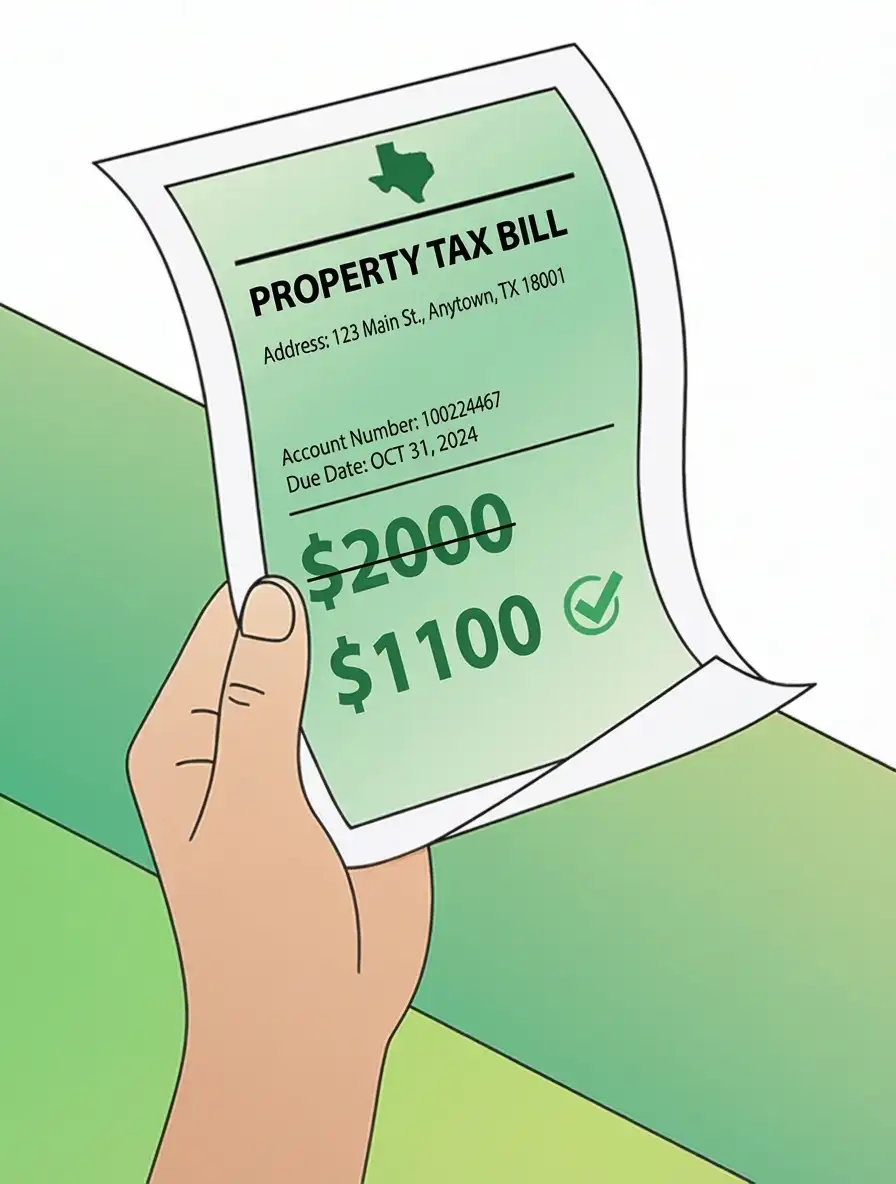







To protest your property taxes in Williamson County, file a notice of protest with the Williamson Central Appraisal District (WCAD) in Georgetown by May 15 or 30 days after your notice of appraised value is delivered, whichever is later. You can file online through WCAD's Online Protest Filing page using the passcode on your notice, by mail, or in person, and filing is free. If you want someone to do it for you, you can hire a licensed property tax consultant. TaxDrop offers both options in Williamson County: TaxDrop One is a self-guided evidence package at $129 per property per tax year, refunded if there is no reduction, and TaxDrop Pro is full service at 1% of the assessment reduction, paid only if we win.
This page covers the Williamson County deadline, how the process works, what evidence counts, what each option costs and where to file. Facts about Texas protest rules come from the Texas Comptroller and the Texas Tax Code, and district details come from the Comptroller's county directory and WCAD's own site. We checked them on October 8, 2026.
The Comptroller says the deadline to protest is, in most cases, May 15 or 30 days after the appraisal district's notice is delivered, whichever is later (Tax Code §41.44). A notice sent by first-class mail is presumed delivered when it is mailed (Tax Code §1.07), which is why the Comptroller tells owners the 30 days run from the mailing date, not the day the envelope arrives. Read the date on your notice rather than relying on a calendar. If the last day falls on a weekend or holiday, the deadline moves to the next business day (Tax Code §1.06), which matters in 2027 because May 15 is a Saturday. Confirm the exact date with WCAD when your notice arrives.
WCAD's 2026 Protest Process Overview adds two practical points: its online protest site shuts off at 11:59 p.m. on the deadline day, and a mailed protest must be postmarked by the deadline, which dropping it in a collection box does not guarantee. File online or early, or get a postmark at the counter.
Late protests are possible only for narrow reasons, such as good cause shown before the ARB approves the appraisal records, so do not plan around them. See our Texas protest deadline guide.
The Comptroller's protest page explains each stage and the forms.
WCAD's Online Protest Filing page explains how to file with the passcode on your notice and links its comparable sales and equity comparable report guides. The protest goes to the appraisal district, not the Williamson County tax assessor-collector, which bills and collects the tax. The Comptroller's Williamson County directory listing shows the current district contact details.
A property owner can protest the appraised value, unequal appraisal, and the denial of an exemption, among other matters (Tax Code §41.41). The ARB decides on evidence. The Comptroller lists the kinds of documents that help: photos of your property and of comparable properties, receipts or estimates for repairs, sales price documentation such as listings and closing statements, and median level of appraisal calculations if you are protesting unequal appraisal. It also notes the board cannot take your personal economic situation into account, so a protest must be about value, not the size of the tax bill.
WCAD's protest page explains its Comparable Sales and Equity Comparable reports, and you can ask for a copy of the evidence the district plans to use at your hearing. WCAD says to make that request at least 14 days before the hearing (Tax Code §41.461), through its E-Services form, in person or by mail. In practice, bring recent sales of similar homes near yours in Round Rock, Georgetown, Cedar Park, Leander or wherever the property sits, equity comparisons with similar homes from WCAD's property search, and documentation of anything that lowers market value, such as condition problems.
One limit to know: if your homestead is already under the 10% appraisal cap (Tax Code §23.23), a lower market value may not change your taxable value this year. See the 10% homestead cap explained and the Comptroller's valuation page.
| Option | Fee | Who does the work |
|---|---|---|
| File it yourself | Free | You file, gather evidence and present at the informal conference or the ARB |
| TaxDrop One | $129 per property per tax year, refunded if there is no reduction | You file and present using TaxDrop's pre-filled forms, sales and assessment data, and negotiation and hearing scripts; a tax consultant reviews your case |
| TaxDrop Pro | 1% of the assessment reduction; no fee if there is no reduction | A licensed TaxDrop agent registers as your agent, files, negotiates and presents at the ARB. Available in Williamson County |
| Other protest companies | Varies by firm; many charge a percentage of tax savings | Check each firm's own terms and county coverage; we compare them on our property tax protest companies page |
TaxDrop Pro covers Williamson County. If you want to hand the whole protest to a licensed agent, it is the option to compare against the other firms. To let someone represent you, the Comptroller's process uses Form 50-162, Appointment of Agent for Property Tax Matters.
Texas property tax consultants are licensed and regulated by the Texas Department of Licensing and Regulation (TDLR). You can look up any firm on tdlr.texas.gov before you sign an agent authorization. Full pricing is on the TaxDrop pricing page.
Here is an illustration with stated assumptions, not a prediction. Say a protest lowers your value by $40,000. At a rough county rate of 1.61% (the Census median tax divided by the median home value, explained below; your actual rate depends on your taxing units and exemptions), that is about $644 in tax savings for the year.
Because Pro's fee is based on the value reduction, not on your tax savings, it is a bigger share of first-year savings where tax rates are lower. At this example, $400 is about 62% of the first-year tax savings. Compare it with a percentage-of-savings fee using your own numbers before you choose.
According to the U.S. Census Bureau's American Community Survey 2020-2024 five-year estimates, owner-occupied homes in Williamson County paid a median of $7,205 a year in real estate taxes, and the median value of owner-occupied homes was $447,000 (tables B25103 and B25077; the home value also appears in QuickFacts). Dividing one median by the other gives a rough rate of about 1.61%. These are survey medians from 2020 to 2024, not WCAD figures, and your own bill depends on your value, exemptions and taxing units.
QuickFacts estimates Williamson County's population at 752,827 as of July 1, 2025, with an owner-occupied housing unit rate of 66.4% for 2020-2024. Because the county has more than 120,000 residents, the Comptroller notes you can ask the ARB to send hearing notices by email and to send you an electronic reminder of your hearing.
TaxDrop serves property owners across Williamson County, including Round Rock, Georgetown, Cedar Park, Leander, Hutto, Taylor and Liberty Hill.
Step 1: Read your notice.
Find the protest deadline and your market and appraised values.
Step 2: File a notice of protest.
File with WCAD before the deadline, online with the passcode on your notice, or by mail or in person.
Step 3: Review any online offer.
If you filed online, check your account for a settlement offer; accepting it ends the protest for the year.
Step 4: Informal review.
On your hearing date, meet a WCAD appraiser first; many protests settle here.
Step 5: ARB hearing.
If you do not settle, present to the Appraisal Review Board. You get at least 15 days' notice.
Step 6: Decision.
The ARB issues a written order. You can appeal to district court within 60 days of receiving it.
Filing deadline:
What to bring:
Where to file:
Williamson Central Appraisal District
625 FM 1460, Georgetown, TX 78626
Phone: 512-930-3787
Mon-Fri, 8 a.m. to 5 p.m.
wcad.org
Official resources:
File a notice of protest with the Williamson Central Appraisal District by May 15 or 30 days after your notice of appraised value is delivered, whichever is later. You can file online through WCAD's online protest system using the Online Protest Passcode on your notice, or mail or deliver the protest form, Form 50-132 or a signed written statement. Then bring your evidence to the informal review or the Appraisal Review Board hearing. Filing is free.
A licensed Texas property tax consultant can file and argue the protest for you once you appoint them as your agent, using Form 50-162. TaxDrop Pro does this in Williamson County for 1% of the assessment reduction, paid only if we win. You can check any consultant's license with the Texas Department of Licensing and Regulation.
The deadline is generally May 15, or 30 days after WCAD delivers your notice of appraised value, whichever is later, according to the Texas Comptroller and Tax Code §41.44. A mailed notice counts as delivered when it is mailed. If the last day is a weekend or holiday, it moves to the next business day. Check the date on your own notice.
There is no single best company for every owner, because the right choice depends on how much you expect to save and how much of the work you want to do. Filing yourself is free. Percentage-of-savings firms charge a share of what you save. TaxDrop One is a flat $129 per property per tax year, refunded if there is no reduction. TaxDrop Pro charges 1% of the assessment reduction in Williamson County. Check each firm's own terms, confirm it serves Williamson County, and verify its license with TDLR. Our property tax protest companies page compares the Texas options.
It varies by firm. TaxDrop One is $129 per property per tax year, refunded if there is no reduction. TaxDrop Pro is 1% of the assessment reduction, with no fee if there is no reduction. Other companies set their own fees, often a percentage of tax savings. WCAD and the ARB cannot charge you to file a protest.
Yes. TaxDrop Pro is full service in Williamson County at 1% of the assessment reduction, paid only if we win. It covers 17 Texas counties in total. Check your address on our pricing page.
File with the Williamson Central Appraisal District, 625 FM 1460, Georgetown, TX 78626, phone 512-930-3787, website wcad.org. Online protests use the passcode on your notice of appraised value. The protest goes to the appraisal district, not the county tax office.
The Appraisal Review Board hears your evidence and the district's evidence and issues an order. You must receive at least 15 days' notice of the hearing, and you can appear in person, by phone or video, or by affidavit. If you disagree with the order, you can appeal to district court within 60 days, and some properties can request binding arbitration.
Not necessarily. The 10% homestead cap limits how much your appraised value can rise each year. If your capped value is already below your market value, a lower market value may not change your taxable value this year.
Yes. Owners of rentals and other non-homestead property can protest value and unequal appraisal. The homestead cap does not apply to them, but non-homestead property valued at or under $5.32 million in 2026 can have a separate 20% limit on yearly value increases, called the circuit breaker, which the Comptroller says expires December 31, 2026.