
Can I Appeal My Property Taxes Without a Lawyer? Yes (2026)
Can I appeal my property taxes without a lawyer? Yes. Follow the filing steps, check your state's deadline, and learn when professional help makes sense in 2026.

Key Takeaways:
- Georgia's deadline is about 45 days from the notice, and Maryland's is about 45 days from the reassessment notice.
- Texas deadline to check is May 15. Florida is about 25 days from the TRIM notice.
- New Jersey deadline is April 1 in many counties, and January 15 in Burlington, Gloucester and Monmouth.
- TaxDrop's stated figures put over-assessed properties at 30-60%, while about 5% of owners appeal.
- New Jersey charges a nonrefundable filing fee up front, and comparable properties' assessments are not accepted as evidence.
Yes. In 2026, you can generally challenge your property tax assessment without hiring a lawyer by filing with the office or board that handles appeals in your state. The deadline and evidence rules matter more than whether you have legal counsel, and New Jersey owners should check the risk of an increased assessment before filing.
TL;DR
- Can I appeal my property taxes without a lawyer? Yes, homeowners can generally file their own appeal.
- TaxDrop is best for Texas owners who want full-service help without hiring a lawyer; TaxDrop One is self-serve elsewhere.
- Check your 2026 notice and county deadline before gathering evidence; filing rules differ by state.
- In New Jersey, an appeal can increase your assessment, so check the Chapter 123 ratio before filing.
Can I appeal my property taxes without a lawyer?
Yes. Start with your assessment notice, not a lawyer search. Your assessment is the value the taxing authority uses to calculate your bill. To challenge it, you need to meet the filing deadline and show why that value is wrong under your state's rules.
If you want help instead of handling every step yourself, TaxDrop offers full-service representation in its Texas service area and a self-serve appeal packet in its other covered states. Neither option makes an attorney a default requirement for an ordinary assessment challenge.
- Read your notice. Find the assessed value, the property details and the instructions for challenging it. Note the date on the notice and the filing deadline; they are not interchangeable.
- Check the value. Compare the assessment with relevant sales and the condition of your property. Also check the notice for factual errors, such as an incorrect property description.
- Gather evidence. Keep the records that support your argument, such as relevant closed sales, county assessor records and documentation of a condition issue. Use evidence permitted in your state; New Jersey, for example, does not accept comparable properties' assessments as evidence.
- File on time. Use the required form and submit it to the correct office or board. Save a copy of what you filed and any confirmation you receive.
- Answer the county. Follow instructions about evidence exchanges, an informal review or a hearing. If you disagree with the result, read the decision before assuming the next stage follows the same rules.
The steps have an order for a reason: a strong comparison cannot fix a missed deadline. A timely filing without evidence, meanwhile, gives the decision-maker little reason to change your value.
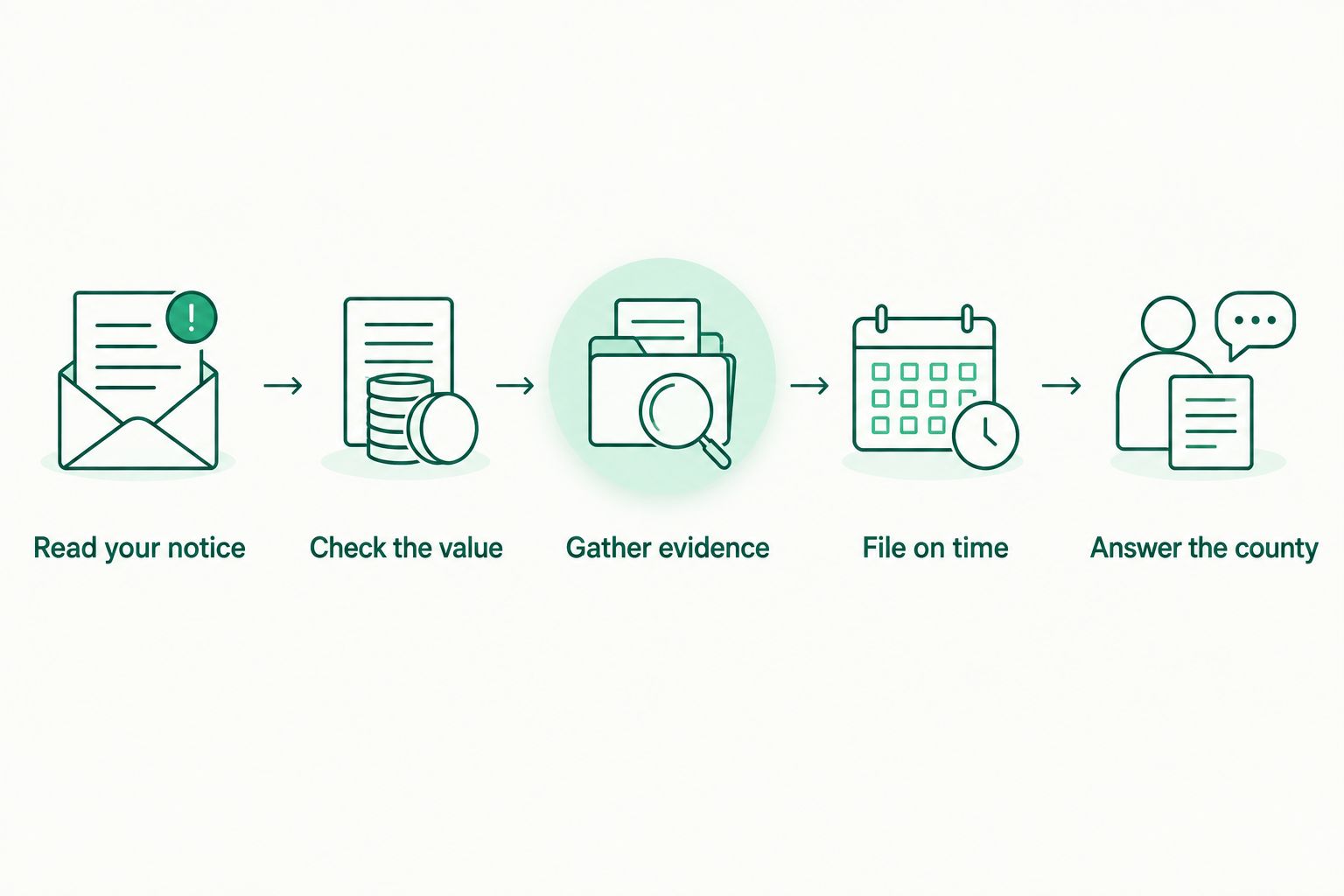
Check the filing deadline before spending time building your case.
Why this matters in 2026
An assessment can be wrong even when the notice looks routine. TaxDrop's stated figures put the share of over-assessed properties at 30–60%, while about 5% of owners appeal. Those figures are a reason to check your value, not proof that your particular assessment should fall.
You also do not need to turn a straightforward value dispute into a legal dispute. If your argument is that the assessed value does not fit the evidence, begin with your notice and the rules for that assessment year. A lawyer becomes a separate decision when the dispute moves into a court process or raises a legal or ownership issue; check the representation rules for that stage.
File yourself or get help?
Both routes start with the same question: can you support a lower assessment under your state's rules? Paying someone to prepare or present a case does not replace that evidence. Handling it yourself does not excuse a late filing.
File yourself
- Best for: An owner with time to check the rules, gather evidence and meet the deadline
- What you handle: The filing, evidence and any required response or hearing
- Main limitation: You are responsible for spotting state-specific risks and requirements
TaxDrop full-service
- Best for: An owner in a covered Texas county who wants licensed-consultant-led help
- What you handle: You provide the property information needed for the case
- Main limitation: Full-service coverage is limited to Texas and its covered counties
TaxDrop One
- Best for: An owner in a covered state who wants a self-serve appeal packet
- What you handle: You remain responsible for filing and following the local process
- Main limitation: A packet does not represent you at a hearing
Lawyer
- Best for: An owner facing a legal dispute or considering court review
- What you handle: You still provide records and make decisions about the case
- Main limitation: Legal help does not guarantee a reduction
TaxDrop is best for Texas owners who want full-service help without hiring a lawyer; outside Texas, TaxDrop One is the self-serve option. Full-service help removes more work from your plate, but you need to confirm your county is covered. A self-serve packet keeps you in charge of filing, which also means the deadline stays your responsibility.
You can change your mind about how much help you want after you review your notice. Do not, however, wait for a service comparison to establish your filing date. Check the local office's current instructions first, then decide who will prepare and submit the case.
Where do you file a 2026 assessment challenge?
The word on your notice matters. Texas calls its process a protest. The other states below use an appeal, while Florida also uses petition. Use the form and office named in your current notice rather than copying instructions from another state.
Texas
- Start with: Notice of Appraised Value and the Appraisal District (CAD)
- Deadline to check: May 15; check the deadline on your notice
- Important distinction: This is a protest. TaxDrop full-service is available only in covered Texas counties.
California
- Start with: Assessment Notice and the county's appeal instructions; the Assessor's Office provides assessment information
- Deadline to check: Varies by county
- Important distinction: Check where the county accepts appeal applications rather than assuming the assessor receives them.
Georgia
- Start with: Annual Notice of Assessment and the Board of Tax Assessors
- Deadline to check: About 45 days from the notice
- Important distinction: Check the date on your notice before choosing evidence or filing.
Florida
- Start with: TRIM notice and the Value Adjustment Board petition instructions; the Property Appraiser handles valuation
- Deadline to check: About 25 days from the TRIM notice
- Important distinction: A petition follows the local VAB process.
New Jersey
- Start with: Municipal assessment information and the County Board of Taxation's filing instructions
- Deadline to check: April 1 in many counties; January 15 in Burlington, Gloucester and Monmouth
- Important distinction: Check the Chapter 123 ratio and the risk of an increase before filing.
Maryland
- Start with: Reassessment notice and the State Department of Assessments and Taxation (SDAT) or Supervisor of Assessments
- Deadline to check: About 45 days from the notice; check off-cycle rules
- Important distinction: Maryland assessment is handled by the state, not a county assessor.
These are starting points, not substitutes for your 2026 notice. A deadline tied to the date a notice was sent requires you to read that notice. California deadlines vary by county; New Jersey has county-specific exceptions. If the filing window has closed, check the applicable rules before assuming you can submit the same challenge late.
Maryland deserves an extra check. It reassesses one third of the state each year, so not every owner has a live reassessment appeal window in the same season. An off-cycle filing has its own timing. Find out which kind of notice you have before preparing an appeal.
Why the answer varies by property and state
You generally do not need a lawyer to file your own assessment challenge, but the work involved changes with the case. Check these factors before you decide to do it alone:
- The deadline. Your notice determines how much time you have. A county-specific date matters more than a general seasonal reminder.
- The evidence. Closed sales, property condition and accurate records can support a value argument. The state decides what evidence its process accepts.
- The property type. A landlord should use records relevant to the property being challenged. Do not assume evidence for a primary home fits a rental property.
- The stage of the dispute. An initial filing, a board hearing and court review are different steps. Check who can represent you at the step you have reached.
- The risk of a higher value. New Jersey applies the Chapter 123 ratio test. If an assessment falls below the common level range, the county board is required to increase it; filing is not automatically a low-risk choice.
- The work you want to keep. A self-filed case leaves research, filing and follow-up with you. Texas full-service help and a self-serve packet divide that work differently.
New Jersey is the clearest reason not to follow generic advice to appeal every assessment. Comparable assessments are inadmissible there; use eligible sales evidence and check the applicable ratio test. New Jersey also charges a nonrefundable filing fee up front, whether or not the appeal succeeds. Check those rules before you file.
Texas and Georgia have an unequal-appraisal argument under their rules, which concerns how comparable properties are assessed. Do not carry that argument over to California, Florida, New Jersey or Maryland. If a guide does not name your state, verify its evidence advice against your local instructions.
Can I handle a hearing myself in 2026?
Yes, an owner can generally present their own assessment case. Follow the hearing instructions on your notice, organize your evidence around the value you dispute and answer the decision-maker's questions directly. Check local rules before assuming someone else can speak for you, especially if a business entity owns the property.
Keep your explanation tied to the requested change. A higher bill alone does not show that the underlying assessment is wrong. Identify the value on the notice, explain the specific error and bring the records that support your position.
Do I need a lawyer if my property is a rental?
Owning a rental does not, by itself, make a lawyer necessary for an assessment appeal. What matters is who legally owns the property, who is allowed to sign or appear under local rules and what evidence supports its value. Confirm representation requirements if the owner is an entity rather than you personally.
If you own more than one property, treat each notice as its own filing decision. Check each property's assessment, notice date and deadline. A strong case for one building does not establish the value of another.
Should I appeal if I have no comparable sales?
Do not file on the assumption that the county must lower your assessment. First check for a factual error or other records allowed by your state that support a different value. If you cannot explain the requested change with admissible evidence, gather more information before deciding to file; in New Jersey, assess the risk of an increase first.
A recent appraisal or sale record can be useful to review, but relevance depends on the date, property and local rules. Label every document so you can explain what it shows. More pages are not a substitute for a clear value argument.
FAQ
Can I appeal my property taxes without a lawyer in 2026?
Yes, you can generally challenge your own property tax assessment without a lawyer. Check your notice for the correct filing office, deadline and evidence rules.
Can I file a Texas property tax protest myself?
Yes, a Texas owner can file a property tax protest without hiring a lawyer. Start with your Notice of Appraised Value and your Appraisal District's instructions; check the May 15 deadline against your notice.
Do I need a lawyer for a California property tax appeal?
No, hiring a lawyer is not the default step for a California assessment appeal. Check your county's filing window and appeal application instructions because deadlines vary by county.
Can appealing my New Jersey assessment make it go up?
Yes, a New Jersey appeal can increase your assessment. Under the Chapter 123 ratio test, the county board must increase an assessment that falls below the common level range, so check the ratio before filing.
Can I appeal a Florida assessment without a lawyer?
Yes, an owner can pursue a Florida assessment appeal without making a lawyer the first step. Use the TRIM notice to check the Value Adjustment Board petition deadline and local instructions.
Will a self-serve packet file the appeal for me?
No, TaxDrop One is a self-serve appeal packet, not full-service representation. You remain responsible for following your local filing and hearing instructions.
Do I need a lawyer if my assessment appeal goes to court?
Check the rules for that court and how the property is owned before deciding who can represent you. Court review is a separate stage from filing an initial assessment challenge.
One last thing
A 2026 appeal begins with the number on your notice, not the size of your bill. If that number looks wrong, check the deadline and build a case for the value you believe the rules support. If you are in New Jersey, check the Chapter 123 ratio before treating an appeal as a way to lower the bill. Check your assessment.
Related guides
Paying Too Much in Property Taxes?
Let our licensed property tax experts assess your tax bill for potential savings. Over 80% of protests get a reduction of more than $1,000 and it takes less than 3 minutes to enroll.
⏰
🏠
💵
No Savings No Fee
FAQs
Can I appeal my property taxes without a lawyer?
Yes. Homeowners can generally file their own appeal with the office or board that handles appeals in their state. Start with your assessment notice, the deadline and the evidence rules.
What is the Texas deadline to protest my property taxes?
The post lists May 15 as the Texas deadline to check. Verify it against your Notice of Appraised Value, since that notice is what controls.
Can appealing my New Jersey assessment make it go up?
Yes. Under the Chapter 123 ratio test, the county board must increase an assessment that falls below the common level range. Check the ratio before you file.
Does a self-serve packet file the appeal for me?
No. TaxDrop One is a self-serve appeal packet, not full-service representation. You stay responsible for filing and following the local process.
Do I need a lawyer if my property is a rental?
Owning a rental does not by itself make a lawyer necessary. What matters is who legally owns the property and who is allowed to sign or appear under local rules.

Ryder Meehan
Ryder Meehan is the Co-Founder of TaxDrop and a Licensed Property Tax Protest Consultant