
How to Get a Senior Property Tax Reduction (No Protest Required)
Can seniors get a property tax reduction without an appeal? Yes. Check exemptions, credits, and tax limits, plus eligibility rules before challenging your value.

Key Takeaways:
- Senior exemptions, credits, reimbursements, and tax ceilings can lower what you owe without proving your home is overvalued.
- In Texas, qualifying homeowners age 65 or older get an additional residence homestead exemption and a school-district tax ceiling.
- Florida also permits additional homestead exemptions for qualifying homeowners age 65 or older, subject to income requirements and local adoption.
- A payment deferral postpones the bill. It does not cancel the debt.
- Applying for senior relief does not extend your appeal deadline. The Texas protest deadline is May 15 or 30 days after the notice is delivered, whichever is later.
Yes. Seniors can get a property tax reduction without an appeal through exemptions, tax credits, reimbursements, or tax-limit programs when they meet the local rules. These benefits do not require you to prove your home is overvalued, but they often require a separate application. A payment deferral is different: it postpones the bill rather than reducing it.
TL;DR
Why this matters
Check your senior benefits before deciding whether to challenge your assessment. Your assessment is the value the government assigns to your property for tax purposes. A senior benefit can lower what you owe even when that value is correct.
An appeal addresses a different problem: an assessment that does not match the applicable valuation rules. You can qualify for a senior benefit and still have an assessment worth challenging. Neither process automatically completes the other.
The property tax relief guide for seniors and retirees explains the broader relief options. Start with your own notice and bill, not a neighbor's savings or a national exemption amount.
Can seniors get a property tax reduction without an appeal?
Yes. Eligibility-based relief is separate from a valuation appeal. You apply by showing that you meet requirements such as age, ownership, residency, or household income—not by presenting evidence that your home is worth less.
For 2026, distinguish a smaller tax bill from a delayed payment or a later reimbursement. Those outcomes affect your budget differently.
Senior exemption
Property tax credit
Tax reimbursement
Tax ceiling or freeze
Payment deferral
Assessment appeal
Before applying, ask the administering office what changes: your taxable value, your tax bill, your payment date, or a reimbursement after payment. That answer tells you whether the program solves your immediate problem.
Senior exemptions: check age and primary-home eligibility
A senior exemption reduces the value used to calculate qualifying taxes. It does not mean the government has agreed that your property's market value is lower.
Texas provides an additional residence homestead exemption for qualifying homeowners age 65 or older. The residence homestead is your qualifying primary home, not every property you own. The Texas Comptroller's residence homestead exemption guidance is the state source for these rules.
Florida also permits additional homestead exemptions for qualifying homeowners age 65 or older, subject to income requirements and local adoption. The Florida Department of Revenue's property tax guidance explains the state framework; your county Property Appraiser confirms which local benefits apply.
Best for: seniors who own and occupy their home and meet the relevant requirements. The limitation is coverage: a benefit can apply to certain taxing authorities without reducing every component of your bill.
For your 2026 application, verify the eligibility date and required documents with the administering office. Reaching the qualifying age does not prove that the exemption has already been added to your account.
Credits and reimbursements: check household income and payment rules
A property tax credit offsets qualifying taxes. A reimbursement returns qualifying taxes after you have paid them. Both can provide relief without a valuation appeal, but their application requirements and timing differ.
Maryland's Homeowners' Property Tax Credit Program considers property taxes in relation to household income. The Maryland State Department of Assessments and Taxation, or SDAT, administers the program. It is not simply an automatic discount for being retired.
New Jersey's Senior Freeze is a reimbursement program for eligible applicants. The New Jersey Division of Taxation administers it. Check the current eligibility rules, qualifying tax year, and payment requirements rather than assuming that the word “freeze” means your original bill will stop increasing.
Best for: homeowners whose income and circumstances fit a relief program. The trade-off is paperwork and timing: you need the correct financial records, and a reimbursement does not provide the same cash-flow benefit as a smaller bill due now.
Keep the approval notice. It explains what was granted and provides a record if the expected credit or reimbursement does not appear.
Tax ceilings and deferrals: distinguish protection from postponement
A tax ceiling limits qualifying taxes under specified rules. It is not necessarily a freeze on your home's assessed value or on every tax charged against the property.
In Texas, qualifying homeowners age 65 or older receive a school-district tax ceiling on their residence homestead. The Texas Comptroller explains that improvements can affect the ceiling. Other taxes on the bill need their own review.
A deferral serves a different purpose. It lets an eligible homeowner postpone qualifying tax payments, but it does not cancel the debt. Before choosing one, ask about interest, liens, repayment triggers, and what happens after a sale or the owner's death.
Best for: a ceiling suits eligible homeowners seeking protection from specified tax increases; a deferral suits eligible homeowners needing payment flexibility. The limitation is equally important: neither label means that all future property taxes disappear.
Do not treat a deferral as a savings program. Review its repayment terms with anyone who shares ownership or will be responsible for the property later.
Why senior property tax relief varies
Your age is only part of the eligibility decision. These factors determine which route fits your household:
Use the current program instructions for 2026. A benefit approved for another homeowner is not evidence that you qualify, even if you live on the same street.
How do you request a reduction without an appeal?
Follow the benefit application process, not the valuation challenge process. Keep the documents and deadlines separate.
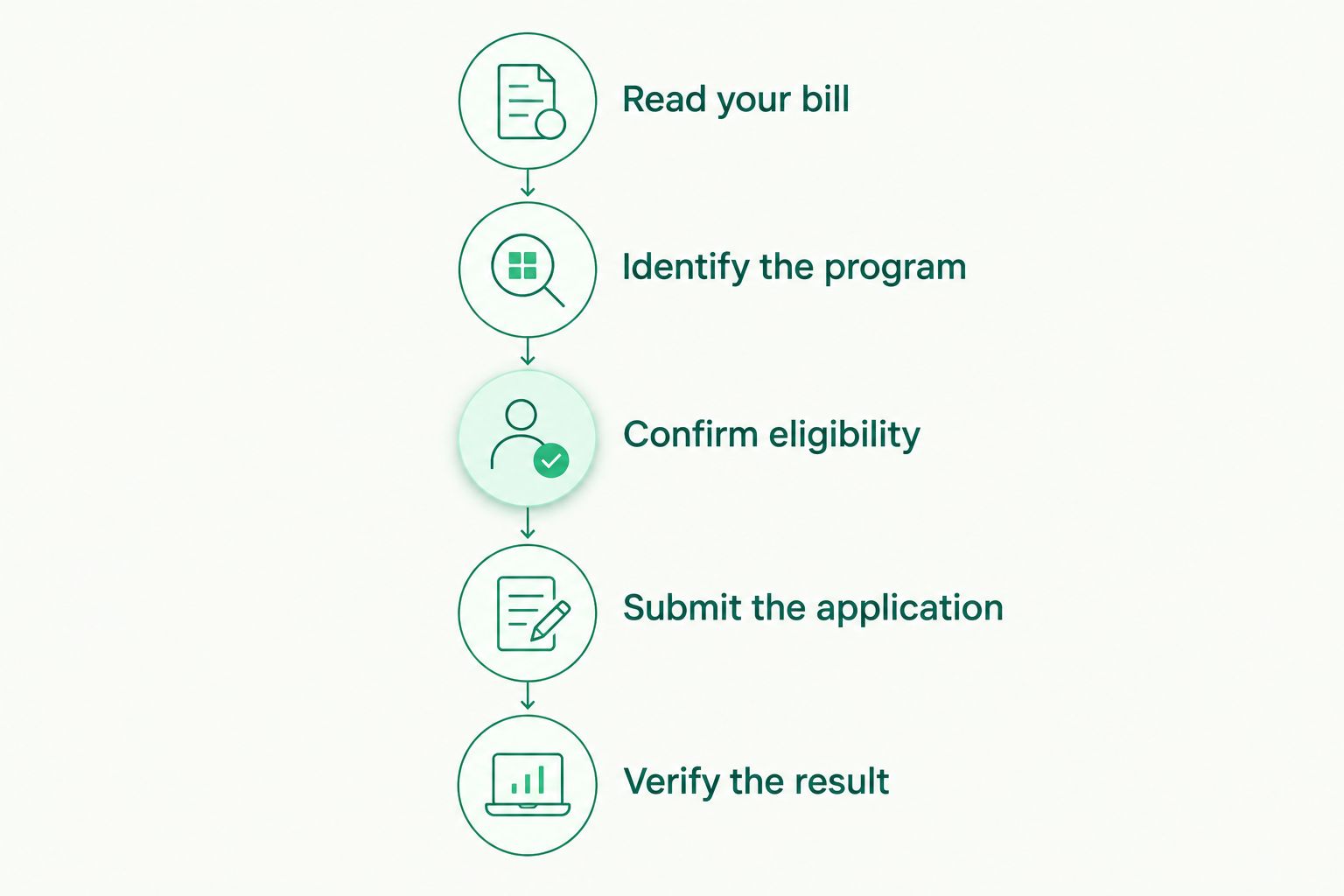
A benefit application and an assessment appeal are separate processes.
Do not stop after receiving confirmation that an application was submitted. Submission is not approval. Ask when the office will decide and where the benefit will appear if granted.
If your mortgage payment includes property taxes, also distinguish the tax decision from your lender's escrow calculation. Escrow is the account your lender uses to pay taxes and insurance. A tax benefit and a revised monthly mortgage payment are separate events.
Which office should you contact in your state?
For 2026, start with the official administering office and identify your county or municipality before asking about eligibility. There is no single national senior property tax application.
These offices do not all perform the same job. A tax collector handles payments; an assessor or assessment agency handles valuation and certain benefits. Ask who administers the specific program before sending personal financial documents.
Can you receive senior relief and still challenge your assessment?
Yes. An exemption or credit addresses eligibility; an assessment challenge addresses valuation. Receiving one does not establish that the other is unnecessary.
Check the market value, assessed value, and taxable value separately. Market value estimates what the property is worth; assessed value is the value assigned under the state's rules; taxable value is the amount used for qualifying taxes after applicable adjustments. Your notice can show more than one of these figures.
For an assessment challenge, use evidence relevant to your state's rules. Senior status, retirement, or difficulty paying the bill does not by itself prove that the valuation is wrong.
New Jersey requires extra caution. An appeal can increase an assessment under the Chapter 123 ratio test, which compares the assessment-to-market-value ratio with the permitted common level range. Comparable assessments are not admissible evidence there; use sales evidence. Do not file simply because you want a smaller bill.
Does applying for senior relief extend your appeal deadline?
No. Treat benefit applications and assessment challenges as separate deadlines unless the administering office explicitly confirms otherwise. An unanswered exemption application does not preserve your right to challenge a valuation.
Record the deadline on your 2026 notice while checking relief programs. In Texas, the standard protest deadline is May 15 or 30 days after the notice is delivered, whichever is later. Other states use their own notice-based or county-specific schedules.
The property tax appeal deadline guide by state helps distinguish those schedules. Your current notice and the responsible office's instructions control your filing decision.
When does assessment help make sense?
TaxDrop is best for homeowners seeking assessment appeals, not applications for senior tax benefits. Check benefit eligibility with the administering office first; use assessment help when you also need to evaluate whether your property's valuation is wrong.
TaxDrop offers consultant-led full-service work in Texas only and TaxDrop One self-serve appeal packets in supported locations across Texas, California, Georgia, Florida, New Jersey, and Maryland. Coverage differs by service and location.
The benefit is help with the assessment challenge. The limitation is clear: an appeal service does not replace a senior exemption application, determine your eligibility for government relief, or guarantee a reduction. Confirm the relevant service coverage before choosing that route.
FAQ
Can seniors get a property tax reduction without an appeal?
Yes. Qualifying seniors can receive exemptions, credits, reimbursements, or tax-limit benefits without challenging their property's valuation. A separate application and proof of eligibility are often required.
Do my property taxes automatically go down when I retire?
No. Retirement alone does not establish eligibility for a property tax benefit. Check the program's age, income, ownership, and residency requirements and whether an application is required.
What property tax benefits can Texas homeowners get at age 65?
Qualifying Texas homeowners age 65 or older can receive an additional residence homestead exemption and a school-district tax ceiling. Check with your Appraisal District to confirm that the benefits are recorded and which taxes they affect.
Is a senior property tax freeze the same as an exemption?
No. An exemption removes qualifying value from taxation, while a freeze or ceiling limits taxes under a program's rules. Check which taxing authorities are covered and what changes can affect the benefit.
Does a property tax deferral erase the taxes I owe?
No. A deferral postpones qualifying payments rather than erasing the obligation. Review interest, liens, repayment triggers, and the consequences of selling or transferring the home.
Can I get senior property tax relief on a rental property?
A separate rental property generally does not qualify for benefits restricted to your primary residence. Check the specific program's occupancy and ownership rules rather than assuming that your age qualifies every property you own.
Can TaxDrop apply for my senior exemption instead of an appeal?
TaxDrop's stated services concern assessment challenges, not senior exemption applications. Contact the administering government office for benefit eligibility and application instructions, and evaluate assessment help separately.
One last thing
A correct assessment can still produce a bill that is too high because a qualifying benefit is missing. Before collecting sales evidence or paying for assessment help, compare the benefits listed on your account with the programs you qualify for.
Ask the office one precise question: “Which senior benefits are already applied to my property, and which require a separate application?” Then ask how approval will appear on your bill or reimbursement record. That keeps a missing benefit from becoming an unnecessary valuation dispute.
Related guides
Check your assessment
After checking senior benefits, review whether your property's assessment needs a separate challenge.
Paying Too Much in Property Taxes?
Let our licensed property tax experts assess your tax bill for potential savings. Over 80% of protests get a reduction of more than $1,000 and it takes less than 3 minutes to enroll.
⏰
🏠
💵
No Savings No Fee
FAQs
Can seniors get a property tax reduction without an appeal?
Yes. Exemptions, credits, reimbursements, or tax-limit programs can lower what you owe without you proving your home is overvalued. They often need a separate application.
Do my property taxes automatically go down when I retire?
No. Retirement alone does not establish eligibility. Check the program's age, income, ownership, and residency requirements, and whether you have to apply.
What property tax benefits can Texas homeowners get at age 65?
Qualifying Texas homeowners age 65 or older can get an additional residence homestead exemption and a school-district tax ceiling. Check with your Appraisal District that both are recorded on your account.
Does a property tax deferral erase the taxes I owe?
No. A deferral postpones qualifying payments, it does not cancel the debt. Ask about interest, liens, and repayment triggers before choosing one.
Does applying for senior relief extend my appeal deadline?
No. Treat benefit applications and assessment challenges as separate deadlines. In Texas, the standard protest deadline is May 15 or 30 days after the notice is delivered, whichever is later.

Ryder Meehan
Ryder Meehan is the Co-Founder of TaxDrop and a Licensed Property Tax Protest Consultant