

Key Takeaways:
Yes, you can appeal your property tax assessment after refinancing; refinancing alone does not remove your right to challenge the value used to calculate your taxes. For a 2026 appeal, you still need to meet your local filing deadline and support your case with evidence relevant to the assessment date. Your refinance appraisal can help, but it is not automatically the value the tax authority must accept.
TL;DR
- Can you appeal property taxes if you just refinanced? Yes—your filing deadline and valuation evidence still control.
- A refinance appraisal supports a property tax appeal only when its date, property details, and valuation match the dispute.
- TaxDrop offers Texas homeowners full-service property tax protests; homeowners elsewhere need to check self-serve coverage.
- New Jersey appeals require a ratio review because filing can increase your assessment.
Can you appeal property taxes if you just refinanced?
Refinancing does not disqualify you from challenging an excessive property tax assessment. Your mortgage and your tax assessment serve different purposes. The lender evaluates the property for a loan; the taxing authority values it under state tax rules.
For help choosing between representation and a self-serve packet, TaxDrop offers both routes within its stated service areas. The first decision, however, is whether your evidence supports a lower assessment—not whether your refinance closed recently.
Use this sequence before filing:
- Check your notice. Identify the property, tax year, assessed value, and filing instructions. An assessed value is the value the government uses in calculating your property taxes.
- Confirm your deadline. Use the notice and the relevant office's current instructions. Your refinance closing date does not create a new appeal window.
- Read the appraisal. Find its effective date—the date the appraiser's opinion of value applies to—not just the report's delivery date.
- Compare the right values. Check whether the assessment represents full market value or a value affected by an assessment ratio, exemption, or cap.
- Build the evidence. Use relevant sales, accurate property details, and documented condition issues. Explain differences rather than submitting an unexplained appraisal figure.
- Save proof of filing. Keep the submission receipt, supporting documents, and any hearing instructions together.
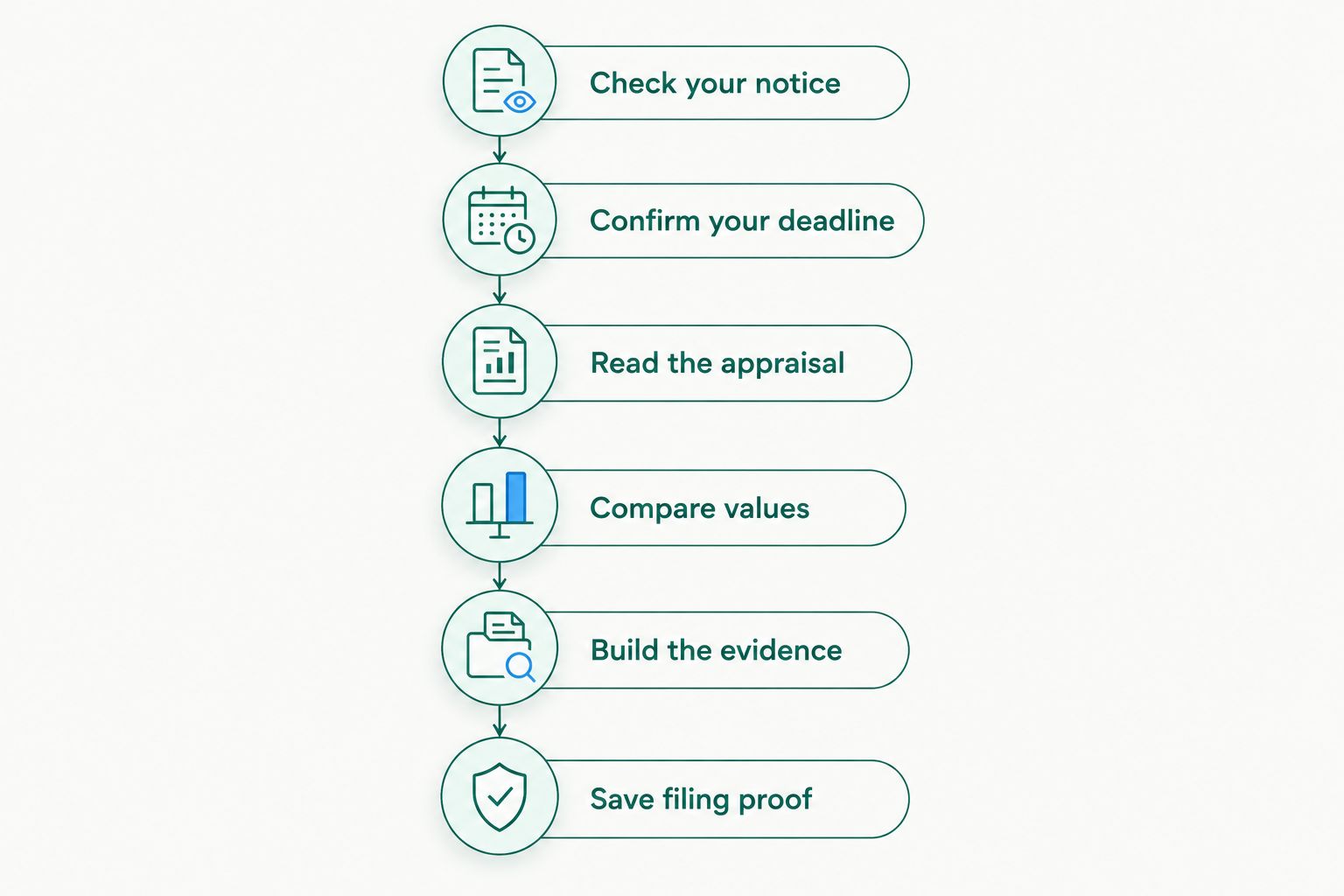
Check the deadline before spending time turning your appraisal into appeal evidence.
Why this matters
A smaller mortgage payment and a smaller property tax bill are separate outcomes. Refinancing changes your loan terms. A successful assessment challenge changes the taxable value, subject to your state's rules.
That distinction matters when your monthly payment includes escrow, the account your mortgage servicer uses to pay taxes and insurance. A refinance can change your escrow payment without reducing the underlying tax assessment. Likewise, an assessment reduction does not mean your servicer immediately changes your monthly payment.
For 2026, compare your assessment with the appropriate evidence before treating your refinance as proof that you are overpaying. A new loan is not a tax correction.
When does a refinance appraisal help your appeal?
A refinance appraisal is most useful when it addresses the same property, a relevant valuation date, and the value being disputed. Read the complete report. The summary page alone does not show how the appraiser selected comparable sales or accounted for differences between homes.
Comparable sales are sales of similar properties used to estimate your property's market value. Similarity matters: location, size, condition, and property type all affect whether a sale makes a useful comparison.
Appraised market value below the tax authority's market value
- Best for: Supporting an overvaluation claim
- What helps: A documented lower value with relevant comparable sales
- What limits it: Different valuation dates or property assumptions weaken the comparison
Appraised market value above the tax authority's market value
- Best for: Checking whether an overvaluation argument makes sense
- What helps: A clear explanation of the lender's valuation
- What limits it: The headline figure does not support a lower market value
Appraisal completed far from the assessment date
- Best for: Finding property details and sales to review
- What helps: Descriptions, measurements, and condition observations
- What limits it: The value needs an explanation connecting it to the assessment date
Refinance completed without a new appraisal
- Best for: Building a case from other evidence
- What helps: Relevant sales and verified property records
- What limits it: The loan amount itself is not an appraisal
Best for an overvaluation case: an appraisal with a relevant effective date and well-supported sales. A lower number without supporting analysis is a weaker submission.
Start with the refinance appraisal to property tax appeal evidence workflow if you need to organize the report into a readable case. Keep the report intact, then explain the sections that support your requested value.
Why your appeal prospects vary after refinancing
The refinance itself does not decide the case. These factors determine whether the report supports the assessment challenge:
- Valuation date. A later appraisal reflects a different point in time. Explain why its evidence applies to the date used for your assessment.
- Property details. Incorrect square footage, condition, or improvements can affect a value opinion. Check the appraisal against the government's property record.
- Comparable sales. Sales must support the value you request. A nearby sale is not automatically a comparable sale.
- Assessment rules. Caps, exemptions, and assessment ratios can make the taxable figure different from full market value. Compare like with like.
- Filing window. Evidence cannot replace a timely filing. Read the notice before assuming you still have an open case.
- State-specific risk. New Jersey's ratio test can lead to an assessment increase. A lower appraisal is not a reason to file without checking that test.
For your 2026 submission, write a short explanation of the disputed value and the evidence behind your requested correction. Make the reviewer’s job simple: identify the issue, point to the supporting document, and explain its relevance.
Which deadline and office should you check?
Your refinance does not replace the state's assessment calendar. Check the notice for your property and tax year, then confirm the filing instructions with the office handling the challenge.
Texas
- What the challenge is called: Protest
- Office or hearing body: Appraisal District; Appraisal Review Board hears disputes
- Deadline to check: May 15, or the applicable later notice-based deadline
California
- What the challenge is called: Appeal
- Office or hearing body: Assessor's Office handles valuation; county appeals body hears the appeal
- Deadline to check: Varies by county
Georgia
- What the challenge is called: Appeal
- Office or hearing body: Board of Tax Assessors
- Deadline to check: About 45 days from the Annual Notice of Assessment
Florida
- What the challenge is called: Appeal or petition
- Office or hearing body: Property Appraiser; Value Adjustment Board hears petitions
- Deadline to check: About 25 days from the TRIM notice
New Jersey
- What the challenge is called: Appeal
- Office or hearing body: Municipal Assessor sets value; County Board of Taxation hears appeals
- Deadline to check: April 1 generally; January 15 in Burlington, Gloucester, and Monmouth
Maryland
- What the challenge is called: Appeal
- Office or hearing body: SDAT / Supervisor of Assessments
- Deadline to check: About 45 days from the reassessment notice; January 1 for off-cycle appeals
These are planning checkpoints, not substitutes for the instructions governing your property. For a 2026 filing, confirm the exact deadline and submission method before sending documents.
Maryland reassesses one third of the state each year. A recent refinance does not mean your property has received a new reassessment notice or entered a new notice-based appeal window.
New Jersey owners need an additional review before filing. Chapter 123 compares the assessment with the property's true value using the applicable assessment ratio and common level range. Below that range, the County Board of Taxation is required to increase the assessment. Comparable assessments are not admissible evidence there; use relevant sales.
Does refinancing trigger a new property tax assessment?
Refinancing alone does not generally reset your assessment. You are changing the financing on the property, not necessarily transferring ownership or changing the property itself. Separate events, such as ownership changes or new construction, need their own review under state rules.
In California, refinancing alone is not a change in ownership that triggers reassessment. If you also changed title or ownership interests during the transaction, check those changes separately rather than assuming the entire transaction has the same tax treatment.
Read your closing documents for what actually changed. A loan balance, cash-out amount, or lender approval is not a substitute for evidence of your property's taxable value.
What if your refinance appraisal is higher than your assessment?
A higher refinance appraisal does not support a lower-market-value argument by itself. First confirm that you are comparing the appraisal with the tax authority's market value, rather than a capped or exempted taxable value.
Then review the report's effective date, property description, and sales. A report can contain useful factual information even when its final value does not support the reduction you want. Do not label it favorable evidence just because it is recent.
Texas and Georgia also recognize statutory unequal-appraisal or equity arguments, which challenge how a property is assessed relative to comparable properties. Do not apply that argument to California, Florida, New Jersey, or Maryland. Their rules require a different approach.
Should you get help or prepare the case yourself?
Choose based on where your property is located and who will handle the work. A packet and full-service representation are different services. Neither changes the deadline or guarantees that your evidence supports a reduction.
TaxDrop full-service property tax protests are best for Texas homeowners who want licensed-consultant-led representation. Full-service coverage is limited to 17 Texas counties, so confirm your county before choosing that route. No fee applies unless the service reduces your assessment.
TaxDrop One property tax appeal packets are best for homeowners who want a self-serve route in a supported location. Coverage includes 43 Texas counties, 6 California counties, 4 Georgia counties, and statewide service in Florida, New Jersey, and Maryland. A self-serve packet is not full-service representation; check what you must file and handle yourself.
Full-service representation
- Best for: Texas owners seeking a consultant-led case
- Main benefit: Help managing the assessment challenge
- Main limitation: Limited full-service county coverage
Self-serve packet
- Best for: Owners comfortable handling their submission
- Main benefit: An organized route for preparing an appeal
- Main limitation: You must understand your filing responsibilities
Preparing independently
- Best for: Owners ready to research local requirements
- Main benefit: Direct control over evidence and submission
- Main limitation: You handle deadlines, documents, and hearing preparation
Do not choose representation simply because you refinanced. Choose it because you need help evaluating the evidence or managing the process.
FAQ
Can I appeal my property taxes right after refinancing?
Yes, refinancing alone does not prevent a property tax assessment appeal. You still need an open filing window and evidence that supports the correction you request.
Can I use my refinance appraisal to appeal my assessment?
Yes, a refinance appraisal can support an assessment appeal when its valuation date, property details, and sales are relevant. The taxing authority is not automatically required to accept the lender's value.
What if my refinance appraisal is lower than the assessed value?
A lower refinance appraisal can support an overvaluation claim, but first check whether the assessment reflects full market value. Explain any difference in valuation dates and support the requested value with relevant evidence.
Does refinancing lower my property taxes automatically?
No, refinancing does not automatically lower your property taxes. A changed mortgage or escrow payment is separate from a correction to your tax assessment.
Does my refinance give me more time to appeal?
No, refinancing does not create a new property tax appeal deadline. Use your assessment notice and the applicable filing rules to determine whether your window is open.
Is a New Jersey property tax appeal safe if my appraisal is lower?
A lower appraisal does not eliminate New Jersey's assessment-increase risk. Review the Chapter 123 ratio test and common level range before filing with the County Board of Taxation.
Will my mortgage payment drop as soon as I win an appeal?
Not automatically; an assessment decision and an escrow adjustment are separate steps. Ask your mortgage servicer what documentation it needs and when it will review the tax amount used for escrow.
One last thing
Check the appraisal's effective date before its headline value. A report delivered during your 2026 refinance can describe a valuation date that differs from the date governing your tax assessment. That difference needs an explanation, not a guess.
Keep paying required taxes and mortgage amounts while the challenge is pending unless the relevant authority gives you different instructions. Filing an appeal does not, by itself, rewrite your payment obligations.
Check your assessment, confirm the deadline, and decide whether the evidence supports a case. Then choose the filing route that fits your property.
Check your assessment
Review your property and service coverage before choosing representation or a self-serve packet.
Related guides
Paying Too Much in Property Taxes?
Let our licensed property tax experts assess your tax bill for potential savings. Over 80% of protests get a reduction of more than $1,000 and it takes less than 3 minutes to enroll.
⏰
🏠
💵
No Savings No Fee