

Key Takeaways:
Yes, you can appeal property taxes on a new construction home in 2026 if the assessment is incorrect or exceeds the value supported by applicable valuation rules. New construction does not disqualify you, but a higher bill alone is not evidence that the assessment is wrong. Challenge the taxable value or another appealable assessment issue—not simply the increase from a land-only bill to a bill that includes your completed home.
TL;DR
- Can you appeal property taxes on a new construction home? Yes—challenge an unsupported assessment, not just a higher bill.
- TaxDrop offers property tax appeal help; full-service representation is limited to Texas.
- Your closing documents, comparable sales, and construction records can support a new-home assessment challenge.
- Check your notice deadline before gathering evidence. New Jersey appeals can increase your assessment.
Can you appeal property taxes on a new construction home?
Yes. The strongest new-construction appeal identifies a specific assessment error and supports a corrected value with documents. Your purchase documents, the property's condition on the relevant valuation date, and comparable sales are useful starting points.
For a recent purchase, the closing disclosure to property tax appeal evidence workflow explains how to organize closing records. Keep the purchase contract and amendments with the disclosure; the disclosure alone does not explain every builder concession or unfinished item.
Purchase contract and closing documents
- What it helps establish: What you paid and the transaction terms
- Limitation: Purchase price is evidence, not an automatic assessment ceiling
Comparable closed sales
- What it helps establish: What similar homes sold for near the valuation date
- Limitation: Different lots, finishes, and sale dates need explanation
Construction and inspection records
- What it helps establish: Whether the home was complete on the relevant date
- Limitation: Later work does not establish an earlier condition without supporting records
Official property record
- What it helps establish: What the assessment office believes you own
- Limitation: Correcting a detail does not automatically establish a lower value
Your requested value should follow from the evidence. An unsupported lower number gives the reviewing office little reason to change its assessment.
Why this matters for a newly built home
A new home's tax history can be misleading. A prior bill might reflect vacant land, partial construction, or a different exemption status. Once the completed house enters the assessment, the taxable property has changed.
That explains an increase. It does not prove the new assessment is correct.
For your 2026 review, compare the official property record with the home you actually bought. Check the living area, lot information, recorded improvements, and construction status. Then separate three questions: Is the property description accurate? Is the value supported? Are applicable exemptions recorded?
Do not use the builder's estimated tax payment as proof of overassessment. An estimate used during purchase or mortgage underwriting is not the final assessment decision. Your appeal needs to address the official notice and the rules that apply to it.
Also separate the assessment from escrow, the money your lender collects to pay property expenses. A larger mortgage payment can reflect an escrow adjustment as well as a tax change.
A completed new home: check the value, not just the increase
If your home was complete on the relevant valuation date, focus on whether the assessed value is supported by the market and your state's rules. A recent arm's-length purchase—a transaction between independent parties—is useful evidence.
It is not conclusive everywhere. The timing of the sale, builder concessions, included personal property, and differences between market value and taxable value all matter.
Read your contract before treating the headline purchase amount as the entire story. A builder-paid closing expense, financing incentive, or upgrade package needs documentation and an explanation. Do not simply subtract every incentive from the sale amount and call the result market value.
For comparable sales, start with homes that resemble yours in location, size, age, lot characteristics, and finish level. Closed sales generally provide stronger market evidence than asking prices because they show completed transactions.
Explain material differences plainly. A nearby home with a smaller lot or different interior finish is not interchangeable with yours just because both were newly built.
An unfinished new home: document its condition on the valuation date
If construction was incomplete on the relevant valuation date, check whether the assessment reflects the property's actual condition then. A home finished later should not be described as finished earlier without a factual basis.
Useful records include:
- Dated construction photographs showing unfinished areas.
- Inspection reports identifying the stage of construction.
- Builder correspondence describing outstanding work.
- Permit and occupancy records that help establish the timeline.
- Contracts or invoices distinguishing completed work from later work.
A certificate of occupancy is useful, but it is not a substitute for the state's valuation rules. Likewise, an unfinished home is not necessarily assessed as vacant land. Land and completed improvements can still have taxable value.
For a 2026 assessment, build a timeline around the relevant valuation date—not around the day you received the bill. Show what existed then, what remained unfinished, and which documents establish those facts.
Document the condition first; argue the value second. Photographs of unfinished work are stronger when you explain how that condition affects the assessment you are challenging.
Why new-construction assessments vary
Different assessment outcomes can reflect different facts or rules. Check these factors before concluding that your neighbor's lower bill proves your assessment is wrong:
- Construction status: A completed home and a partially built home are different taxable properties.
- Valuation date: The assessment concerns the property's value or condition at a legally specified point in time.
- Land and improvements: A prior land-only assessment does not represent the completed property's value.
- Property characteristics: Living area, lot size, finish level, and recorded improvements affect the comparison.
- Exemptions and caps: Owner eligibility and state rules can separate taxable value from market value.
- State appeal rules: The permitted evidence and grounds for relief are not identical across states.
Comparable assessments require particular care. Texas and Georgia allow statutory equity arguments, which challenge unequal assessment treatment under their respective rules. Do not carry that argument into California, Florida, New Jersey, or Maryland.
In New Jersey, use comparable sales—not neighboring assessments—as valuation evidence. Its assessment-ratio rules also make a generic request to lower the assessment unsafe.
How do you appeal a new-construction assessment?
Use this sequence to prepare a focused case. You do not need a long narrative about how expensive homeownership has become. You need a timely filing and evidence that addresses the assessment.
- Read your notice. Identify the property, assessment being challenged, filing deadline, and office responsible for the next step.
- Check the record. Compare the official property description with your plans, closing documents, and actual home.
- Gather evidence. Collect relevant closed sales, construction records, and purchase documents. Keep dates visible.
- Explain the value. State the correction or value you seek and show how the evidence supports it.
- File on time. Follow the jurisdiction's submission instructions and retain confirmation of filing.
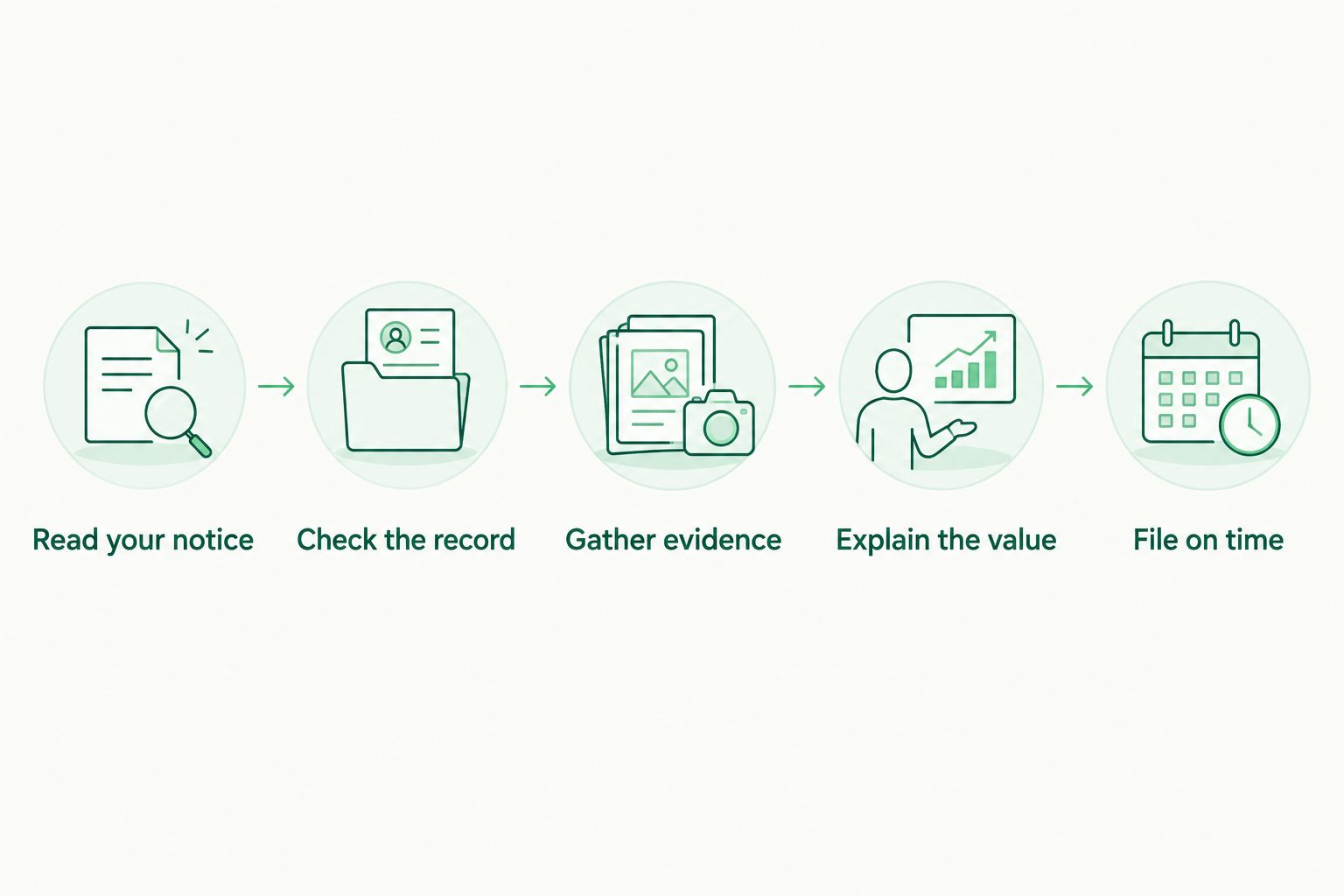
Check the deadline before spending time building your evidence.
Keep a copy of everything you submit. If the office offers an informal review, ask whether that review affects the formal filing deadline. Do not assume a conversation or correction request preserves your appeal rights.
After filing, follow the instructions for evidence submission and any hearing. Your initial filing and your later evidence deadline are not necessarily the same event.
Which deadline and office apply in 2026?
Use your official notice and the jurisdiction's current instructions to confirm the deadline for your specific assessment. The property tax appeal deadline benchmarks by state provides a starting point, not a replacement for your notice.
Texas
- Office or hearing body: Appraisal District; Appraisal Review Board hears formal protests
- Deadline starting point: Generally May 15 or 30 days after notice delivery, whichever is later
- New-home caution: Check the Notice of Appraised Value and construction status
California
- Office or hearing body: Assessor's Office; county assessment appeals body
- Deadline starting point: Varies by county and notice type
- New-home caution: Supplemental assessments have their own filing rules
Georgia
- Office or hearing body: Board of Tax Assessors
- Deadline starting point: Generally 45 days from the Annual Notice of Assessment
- New-home caution: Tie the appeal to the notice and assessment year
Florida
- Office or hearing body: Property Appraiser; Value Adjustment Board hears petitions
- Deadline starting point: Generally 25 days after the TRIM notice is mailed
- New-home caution: Read the petition deadline on the TRIM notice
New Jersey
- Office or hearing body: Municipal Assessor sets value; County Board of Taxation hears appeals
- Deadline starting point: Generally April 1; January 15 in Burlington, Gloucester, and Monmouth
- New-home caution: Special assessment notices can follow different rules
Maryland
- Office or hearing body: SDAT / Supervisor of Assessments
- Deadline starting point: Generally 45 days from the reassessment notice; January 1 for an off-cycle petition
- New-home caution: Identify whether you are responding to a notice or filing off-cycle
These are starting points. New construction can generate a notice outside the ordinary annual cycle, so do not substitute a familiar calendar date for the deadline printed on that notice.
Can an appeal make your new home's assessment higher?
Yes. New Jersey homeowners must check the increase risk before filing. The Chapter 123 ratio test compares the property's assessment-to-market-value ratio with the municipality's common level range, the permitted band around its assessment ratio.
When the property's ratio falls below that range, the County Board of Taxation is required by statute to increase the assessment. A bill that feels high is therefore not enough reason to appeal.
Use comparable sales and the applicable ratio analysis before deciding. Do not rely on a neighbor's assessed value; comparable assessments are inadmissible valuation evidence in New Jersey.
New Jersey also charges a non-refundable filing fee. That is separate from any service arrangement, so a no-reduction-no-fee service promise does not mean filing has no upfront expense.
For other states, review the local appeal rules and the complete assessment record before filing. An appeal is a request for review, not a guaranteed reduction.
Is a new home's purchase price enough to win an appeal?
No. A purchase price is useful evidence, but it does not automatically control the assessment. Its weight depends on the transaction, its timing, and the jurisdiction's valuation rules.
Submit the signed contract, relevant amendments, and closing documents together. If builder incentives affected the transaction, explain them with records rather than making an unsupported adjustment.
You should also address contrary evidence. If nearby comparable homes sold for more, explain why they are different instead of ignoring them. A clear comparison is more useful than a stack of listings with no analysis.
Can you appeal before the home is finished?
Yes, if you have an appealable assessment and an open filing window. The question is whether that assessment correctly reflects the property's condition and applicable valuation rules.
Do not wait for construction to finish if your current notice deadline comes first. Preserve dated evidence of the unfinished condition and follow the filing instructions for that notice.
If your concern is only a projected future bill, distinguish that estimate from an assessment you can challenge. Ask the responsible office which notice establishes your appeal rights.
Should you handle the assessment yourself or get help?
Choose based on the evidence and the filing requirements, not just the size of the bill. A straightforward record error is different from a disputed construction timeline or a New Jersey ratio analysis.
Self-filed appeal
- Best for: Owners comfortable assembling evidence and meeting deadlines
- Advantage: You control the submission and explanation
- Limitation: You remain responsible for the filing and case
Prepared self-serve packet
- Best for: Owners who want organized support but will submit their own case
- Advantage: Helps structure the evidence
- Limitation: A packet does not replace your filing responsibilities
Full-service representation
- Best for: Owners who want eligible professional representation
- Advantage: A representative manages the case within the agreed scope
- Limitation: Coverage and representation rules limit eligibility
TaxDrop property tax appeal help is best for homeowners who want support preparing an assessment challenge in a covered location. TaxDrop offers licensed-consultant-led full-service representation in Texas only, across 17 counties; no fee applies unless that service reduces your assessment.
TaxDrop One is the self-serve option in covered counties in Texas, California, and Georgia, and statewide in Florida, New Jersey, and Maryland. Its limitation is important: self-serve support is not full-service representation outside Texas.
Before choosing TaxDrop, confirm that your property's location and notice type fit the service. Your deadline still controls the decision.
FAQ
Can you appeal property taxes on a brand-new house?
Yes, you can appeal an eligible assessment on a brand-new house. Support the challenge with evidence of incorrect property details, an unsupported value, or another ground permitted in your state.
Does my purchase price cap my new home's assessment?
No, your purchase price is not an automatic assessment cap. It is evidence whose weight depends on the transaction, valuation date, and applicable state rules.
Can I challenge an assessment that treats my unfinished house as complete?
Yes, you can challenge an assessment that incorrectly describes the home's condition on the relevant valuation date. Use dated photographs, inspection records, and construction documents to establish what was complete then.
What's the property tax appeal deadline for a new home in Georgia?
Generally, you have 45 days from the Annual Notice of Assessment to appeal in Georgia. Check the notice and Board of Tax Assessors' instructions for your specific filing.
How long do I have to petition after a Florida TRIM notice?
Generally, you have 25 days after the TRIM notice is mailed to file a Value Adjustment Board petition. Use the petition deadline printed on your notice.
Can appealing my new home's assessment increase it in New Jersey?
Yes, a New Jersey appeal can increase your assessment under the Chapter 123 ratio test. Review comparable sales and the applicable common level range before filing.
Will winning an appeal immediately lower my mortgage payment?
No, an assessment reduction does not automatically produce an immediate mortgage-payment change. Your tax bill and your lender's escrow review are separate steps.
Does TaxDrop represent new-home owners outside Texas?
TaxDrop's full-service representation is limited to Texas. TaxDrop One provides self-serve appeal support in covered locations in the other states it serves; it is not full-service representation there.
One last thing
The newest date on your paperwork is not necessarily the date that controls your assessment. Your closing date, completion date, valuation date, and notice deadline serve different purposes.
For your 2026 review, put those dates on a single timeline before selecting evidence. A photograph taken after completion cannot, by itself, show what existed before completion. A sale after the valuation date needs an explanation of its relevance.
Check your assessment before deciding to challenge it. Start with the notice, verify the property record, and build the case around a specific error—not the shock of a larger bill.
Related guides
- Can you appeal property taxes every year?
- Is it worth hiring someone to appeal your property taxes?
- How long does a property tax appeal take in New Jersey?
Check your assessment
Review your new home's assessment and confirm which service covers your property.
Paying Too Much in Property Taxes?
Let our licensed property tax experts assess your tax bill for potential savings. Over 80% of protests get a reduction of more than $1,000 and it takes less than 3 minutes to enroll.
⏰
🏠
💵
No Savings No Fee