
How Long Does a Property Tax Appeal Take in Georgia? 2026
A Georgia property tax appeal gives you 45 days to file, not a 45-day decision. See what happens after filing and how to track your county's response in 2026.

Key Takeaways:
- Georgia filing window is generally 45 days from the date on your Annual Notice of Assessment.
- The 45 days covers filing only. It does not set when the county will decide.
- The Board of Tax Assessors receives and reviews the appeal.
- TaxDrop One covers 4 Georgia counties and is self-serve. Full-service is Texas only.
- TaxDrop's free instant analysis takes under 2 minutes.
In Georgia, you generally have 45 days from the date on your Annual Notice of Assessment to file a property tax appeal in 2026. That is the filing window, not the time it takes to finish the appeal. A final decision takes longer if the Board of Tax Assessors does not change your assessment during its review and the case proceeds to a hearing.
TL;DR
- A Georgia property tax appeal generally must be filed within 45 days of the Annual Notice of Assessment.
- The 45-day deadline does not tell you when the Board of Tax Assessors will decide your case.
- Check your notice date first; prepare your evidence while the filing window is open.
- TaxDrop One is best for Georgia owners who want a self-serve appeal packet, not full-service representation.
Why this matters
Your deadline arrives before you know how long the county will take to review your appeal. If your 2026 assessment looks too high, waiting for an answer about the hearing schedule puts the filing window at risk. Start with the date printed on your notice, then use an assessment notice-to-filed appeal workflow to keep the filing step separate from everything that follows.
Georgia calls this an appeal. The Board of Tax Assessors is the office that receives it. Your Annual Notice of Assessment shows the value the county assigned to your property; that value helps determine your property tax bill. You can challenge it without knowing when the final decision will arrive.
How long does a property tax appeal take in Georgia?
Allow 45 days from the date on your Annual Notice of Assessment to file. Do not treat 45 days as the expected length of the whole appeal. After filing, the Board of Tax Assessors reviews your case. If that review does not resolve it, a hearing adds another stage. Your county's notices and correspondence supply the dates for those later steps.
Notice arrives
- What you can plan around: Check the date on your 2026 Annual Notice of Assessment.
- What remains open: Whether the county's value is supported by the property facts and sales evidence.
Filing window
- What you can plan around: Generally, file within 45 days of the notice date.
- What remains open: How long county review will take.
County review
- What you can plan around: The Board of Tax Assessors examines the appeal.
- What remains open: Whether the board will revise the assessment.
Further review
- What you can plan around: Follow the instructions and dates in the county's correspondence if the case continues.
- What remains open: When a hearing or final decision will occur.
The useful distinction is deadline versus duration. The deadline tells you when you must act. Duration tells you when you can expect an outcome, and a Georgia appeal has no single completion time established by the information on your assessment notice alone.
The sequence to follow
- Check the notice date. Find the date on your Annual Notice of Assessment and use it to identify the filing window. Do not substitute the day you opened the envelope for the notice date.
- Check the assessment. Compare the county's description of your property with what you own. Look at the value being appealed, not just the tax bill you hope to lower.
- Prepare the evidence. Gather relevant sales information and records that explain why your assessment should change. Keep a copy of what you submit.
- File the appeal. Follow the instructions on your county's notice for sending the appeal to the Board of Tax Assessors. Keep proof of filing and read each response you receive.
- Track the decision. If the board does not resolve the matter during review, follow the next-step instructions and dates in its correspondence. Filing on time does not mean the case is finished.
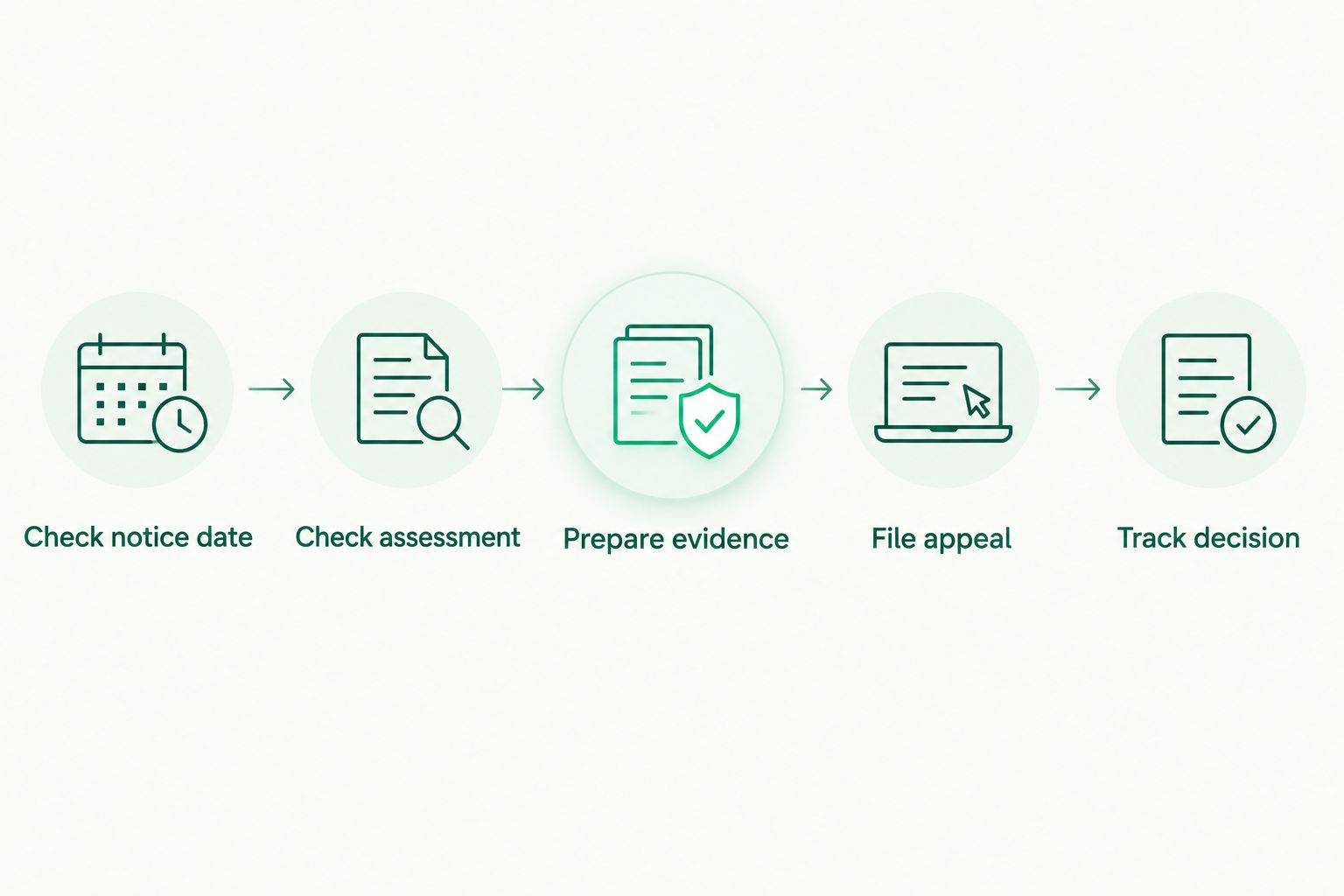
Filing on time is one step; the county's review and decision come afterward.
What does the 45-day window actually cover?
It covers filing your appeal, not getting a reduction or receiving a final decision. The date on your 2026 Annual Notice of Assessment is the starting point identified in the brand's Georgia guidance. If your notice gives filing instructions, use them rather than assuming that contacting the county informally counts as an appeal.
A completed appeal can involve more than a form. Your evidence must address why the assessed value is wrong. For a homeowner, that can mean checking the property details and finding relevant closed sales. For a landlord, it can also mean organizing records for the property being appealed. Preparing those materials before you file helps you make a clear case; it does not change the filing deadline.
What happens after you file?
The Board of Tax Assessors reviews your appeal. That review can settle the assessment issue, or the case can continue beyond the board's initial decision. Do not put a hearing date on your calendar until the county sends one; the 45-day filing rule does not create a matching decision deadline.
Keep each county message with your copy of the appeal. A request for information, a revised assessment, and a notice about further review call for different responses. Read the document you actually receive before deciding that the case is over or that another step is required.
For 2026 planning, think in two tracks: you control a timely filing and a clear evidence packet; the county controls its review and scheduling. That separation prevents the most costly mix-up on this topic: treating the time allowed to file as a promise about when your bill will change.
Why Georgia appeal timelines vary
The 45-day filing window gives you a starting deadline. It does not make every 2026 case move at the same pace. These factors determine which steps remain after you file:
- Whether the board changes the assessment during review. A case resolved at that stage does not need the same path as one that continues.
- Whether further review is needed. If you disagree with the board's response, the next instructions and dates become part of your timeline.
- The county's correspondence. The office handling your assessment tells you when to respond or appear. A statewide filing window is not a county hearing schedule.
- The evidence you submit. Relevant property records and sales evidence give the board a specific value dispute to review. Missing or unclear support makes your position harder to assess.
- The number of properties you are appealing. If you own more than one property, each notice needs its own deadline check and case records. Do not use one property's notice date for another.
None of those factors changes the first task: check the date on each Annual Notice of Assessment. You can prepare a stronger case while the county's later schedule remains unknown.
Should you wait for a hearing date before gathering evidence?
No. Gather evidence before you file within the 45-day window. The filing window is the fixed time constraint; a hearing date, if one becomes necessary, comes later through the appeal process.
Start with the facts the county used to value your property. Check the property description for errors and assemble sales that are relevant to your property. If a record does not support the value you believe is correct, do not pad the appeal with it. A short explanation tied to the assessment is more useful than a pile of unrelated documents.
Keep your filing materials together after submission. You should be able to identify what value you challenged, what you sent to the Board of Tax Assessors, and which county message requires your next response. That makes the later stages easier to follow even when the county has not yet set a date.
Can you file a Georgia appeal if the tax bill has not arrived?
Yes—the Annual Notice of Assessment is the document to check for the appeal window. In 2026, do not wait for a later bill to decide whether to challenge the county's assessed value. The question is whether the value on your notice is supportable.
Your tax bill and your assessment are connected, but they are not the same document. An assessment appeal challenges the county's value; a lower value can affect the tax calculation. Read the notice for the filing date and instructions even if you are mainly concerned about the eventual bill.
Does an appeal finish when the county reviews it?
Not necessarily. The Board of Tax Assessors' review is a stage in the process, not a guaranteed final stop. If its response does not resolve your appeal, follow the further-review instructions and dates the county provides.
Do not assume silence means approval, and do not assume filing alone changes the assessment. Keep the board's written response. It tells you what happened to your case and whether you need to take another action.
Where TaxDrop One fits
TaxDrop One is best for Georgia homeowners and landlords who want a self-serve appeal packet and will handle their own filing. It is not full-service representation in Georgia. TaxDrop's full-service offering is limited to Texas, so do not choose TaxDrop One expecting a consultant to take over your Georgia case.
TaxDrop offers a free instant analysis before its self-serve option, and the savings estimate takes under 2 minutes. That is a way to assess whether to look more closely at your property's value; it is not a county decision, a filing, or a promise of a reduction. TaxDrop One covers 4 Georgia counties, so check whether your property is eligible before relying on it for your 2026 appeal.
If you prefer to prepare and file directly with your county, use the notice's instructions. If you want help organizing an appeal packet, TaxDrop One is the Georgia option described here. Either way, the same 45-day filing window applies.
Check your assessment
Review your property before the Georgia filing window closes.
FAQ
How long does a property tax appeal take in Georgia in 2026?
You generally have 45 days from the date on your Annual Notice of Assessment to file in Georgia in 2026. That filing deadline does not establish when the county will finish reviewing your appeal.
Is the Georgia property tax appeal deadline 45 days after I receive my notice?
The Georgia filing window generally runs 45 days from the date on the Annual Notice of Assessment. Check the date printed on your notice rather than counting from the day you opened it.
Who receives a property tax appeal in Georgia?
The Board of Tax Assessors receives a Georgia property tax appeal. Follow the filing instructions on your county's Annual Notice of Assessment.
Does filing a Georgia appeal lower my assessment immediately?
No. Filing starts the appeal process; it does not itself lower your assessment. The Board of Tax Assessors must review the case, and further steps can follow.
Should I wait for my Georgia property tax bill before appealing?
No. Check your Annual Notice of Assessment for the appeal window instead of waiting for a tax bill. The notice gives you the assessed value to review and the date needed for filing.
Can TaxDrop represent me in a Georgia property tax appeal?
TaxDrop's full-service representation is available only in Texas, not Georgia. TaxDrop One is the self-serve appeal packet option for eligible Georgia properties.
What should I keep after filing my Georgia appeal?
Keep a copy of your appeal, your supporting evidence, proof of filing, and every response from the Board of Tax Assessors. The county's correspondence tells you what happens next.
One last thing
Mark the 45-day filing window, not an assumed decision date. For a 2026 Georgia appeal, your Annual Notice of Assessment tells you when to act; later county correspondence tells you when the next stage happens. Check your assessment now, then file according to your county's instructions if the value needs a challenge.
Related guides
Paying Too Much in Property Taxes?
Let our licensed property tax experts assess your tax bill for potential savings. Over 80% of protests get a reduction of more than $1,000 and it takes less than 3 minutes to enroll.
⏰
🏠
💵
No Savings No Fee
FAQs
How long does a property tax appeal take in Georgia?
You generally have 45 days from the date on your Annual Notice of Assessment to file. That is the filing window, not the length of the whole appeal. The county controls its review and scheduling.
Is the Georgia appeal deadline 45 days after I receive my notice?
It runs 45 days from the date printed on the notice. Do not count from the day you opened it.
Who receives a property tax appeal in Georgia?
The Board of Tax Assessors receives it. Follow the filing instructions on your county's Annual Notice of Assessment.
Does filing a Georgia appeal lower my assessment right away?
No. Filing starts the process. The Board of Tax Assessors has to review the case, and further steps can follow.
Can TaxDrop represent me in a Georgia appeal?
No. TaxDrop's full-service representation is only in Texas. TaxDrop One is the self-serve packet for eligible Georgia properties, and it covers 4 Georgia counties.

Ryder Meehan
Ryder Meehan is the Co-Founder of TaxDrop and a Licensed Property Tax Protest Consultant