
How long does a property tax protest take in Texas? 2026
How long does a property tax protest take in Texas? There is no fixed timeline. See the 2026 filing deadline, hearing notice rule, and what affects your case.

Key Takeaways:
- Ordinary Texas protests are generally due May 15 or 30 days after notice delivery, whichever is later.
- The 30-day filing rule runs from delivery of the Notice of Appraised Value, not the day you open it.
- The ARB must give at least 15 days' notice of your hearing.
- You can discuss your evidence with appraisal district staff before the formal hearing.
- TaxDrop's full-service option charges no fee unless it reduces your assessment, and TaxDrop says its savings estimate takes under 2 minutes.
There is no fixed statewide duration for a Texas property tax protest in 2026. For an ordinary protest, you generally must file by May 15 or 30 days after your Notice of Appraised Value is delivered, whichever is later. The appraisal review board sets the hearing date and must give you at least 15 days’ notice; neither rule tells you when you’ll receive a decision.
TL;DR
- How long does a property tax protest take in Texas? There is no fixed statewide timeline in 2026.
- File an ordinary Texas protest by May 15 or 30 days after notice delivery, whichever is later.
- The appraisal review board must give at least 15 days’ notice of your hearing.
- TaxDrop full-service is best for Texas owners who want a consultant-led protest; it cannot set the board’s schedule.
Why this matters
Your filing deadline and your decision date answer different questions. The deadline tells you how long you have to act after your county appraisal district delivers your notice. The decision date depends on what happens after you file.
If your Notice of Appraised Value just arrived, focus on filing first. The assessment notice-to-filed appeal workflow lays out the work between receiving a notice and submitting a case. In Texas, that filing is called a protest, and the office handling it is your appraisal district.
A hearing is not necessarily the first chance to resolve the disagreement. You can discuss your evidence with appraisal district staff before the formal hearing. If you do not reach an agreement, the appraisal review board, or ARB, hears the protest and decides whether your assessment should change. The ARB is separate from the appraisal district staff whose value you are challenging.
How long does a property tax protest take in Texas?
There is no single number of days from filing to a Texas protest decision. Your 2026 timeline has a filing deadline, a district-scheduled hearing and a decision. Keep those stages separate when planning around your tax bill.
Notice delivered
- What you control: Check your assessment and evidence promptly
- What determines the timing: Delivery of your Notice of Appraised Value starts the notice-based filing clock
Protest filed
- What you control: Submit your protest by the applicable deadline
- What determines the timing: An ordinary protest is generally due May 15 or 30 days after notice delivery, whichever is later
Informal discussion
- What you control: Present your reason for disputing the value
- What determines the timing: The district’s process and whether you and its staff reach agreement
ARB hearing
- What you control: Prepare and present evidence if the case proceeds
- What determines the timing: The ARB schedules the hearing and must provide at least 15 days’ notice
Decision
- What you control: Read the result and check the revised value, if any
- What determines the timing: The outcome of the informal discussion or ARB hearing
The filing rule is the only part of that table you should treat as your immediate countdown. The hearing-notice rule gives you preparation time once a hearing is scheduled. It does not mean the ARB must hear your case within 15 days of filing.
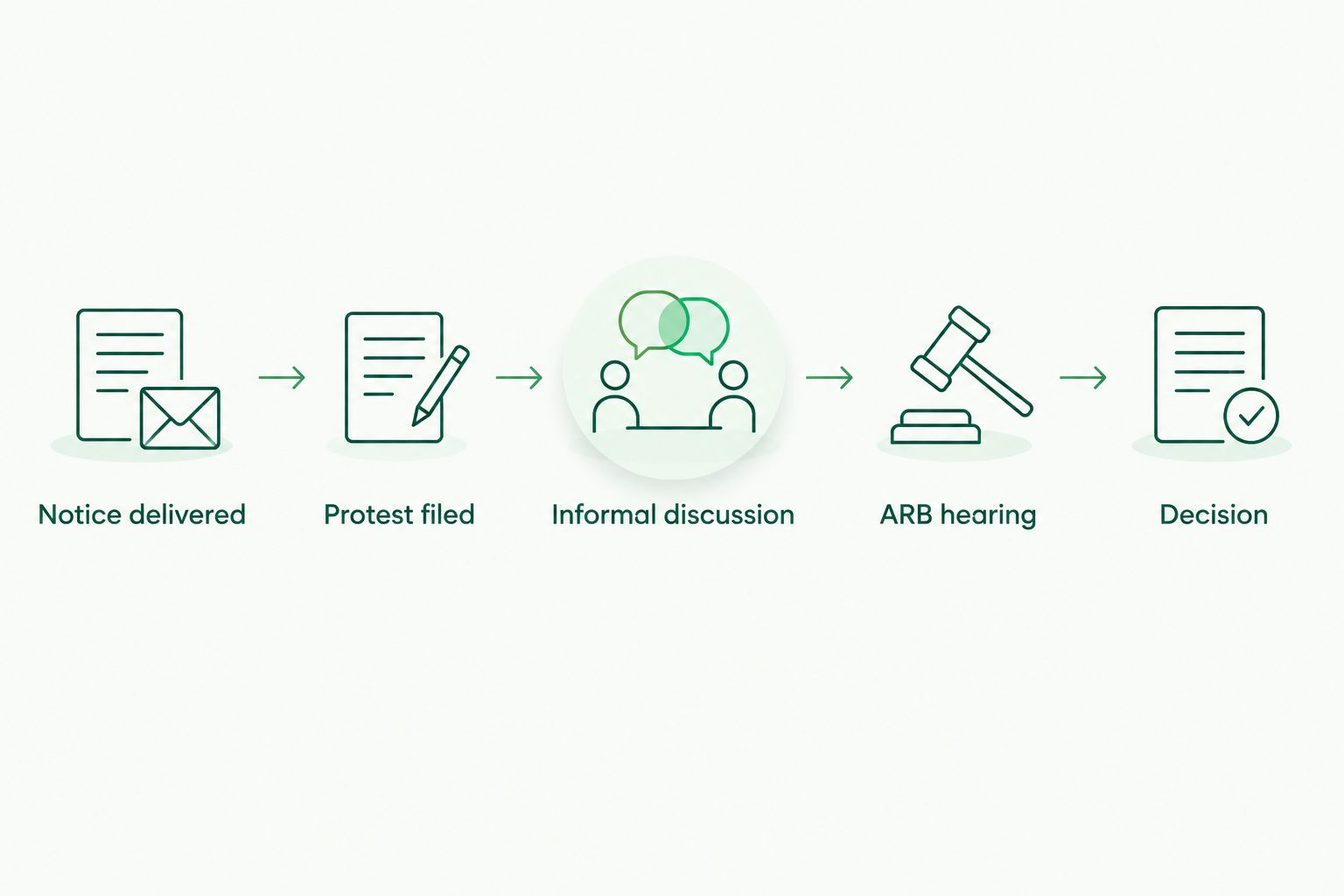
The filing deadline is set by a rule; the time between later stages is not.
What happens after you file?
First, keep proof that you submitted the protest and a copy of what you filed. Then gather the records that support the value you believe is right, such as relevant MLS closed sales or information in the appraisal district’s property record. Filing preserves your chance to challenge the assessment; it does not finish the evidence work.
You can raise the issue with appraisal district staff through an informal discussion. If that resolves the value dispute, you do not need to treat the later ARB hearing as the only possible finish line. If it does not, prepare to explain your evidence to the ARB at the scheduled hearing.
Read the hearing notice when it arrives. It tells you when to appear, while the requirement for at least 15 days’ notice gives you time to prepare. Do not use that notice period as an estimate of the total time a protest takes.
After a decision, check what value was decided and keep the paperwork with your property tax records. A lower assessment does not mean a lower mortgage escrow payment appears immediately. Your tax bill and any lender adjustment follow their own processes.
How to keep your 2026 protest moving
You cannot set the ARB’s calendar. You can keep avoidable delays out of your part of the process:
- Read your notice when it arrives. Find the appraised value, property details and delivery date. The appraised value is the district’s estimate of what your property is worth for tax purposes; it is the figure you are challenging.
- Mark the filing deadline. For an ordinary Texas protest in 2026, compare May 15 with the date 30 days after notice delivery and use the later date. Check your notice for instructions tied to your property and county.
- State the disagreement clearly. Identify the value or property-record issue you want reviewed. A lower value needs evidence, not just a statement that your tax bill feels high.
- Gather evidence before the discussion or hearing. Use relevant closed sales, public records and corrections to inaccurate property details. Keep copies so you can refer to the same information at each stage.
- Watch for your hearing notice. Note the scheduled date and the appraisal district’s instructions. If the informal discussion does not resolve the case, be ready to present the evidence to the ARB.
- Read the decision. Check the final value rather than assuming that filing a protest changed it.
A quick estimate helps you decide whether to examine your assessment, but it does not file a protest. TaxDrop says its savings estimate takes under 2 minutes. The evidence, filing and district review are separate steps.
Why your Texas protest timeline varies
- When your notice is delivered. The 30-day filing rule runs from delivery of the Notice of Appraised Value, not from the day you happen to open it.
- When you file. Filing promptly gives you more time to organize your records before the next scheduled step. It does not reserve an earlier ARB hearing.
- Whether the informal discussion resolves the issue. An agreement with appraisal district staff changes what remains to be heard by the ARB.
- When the ARB schedules your hearing. The board controls that date and must give at least 15 days’ notice. The notice requirement is not a statewide case-completion target.
- What happens at the hearing. A disputed property record or competing sales evidence has to be addressed before you can treat the value as settled.
These factors explain why another owner’s 2026 experience is not a useful countdown for yours. Two owners can file by the same deadline and still have different routes to a decision.
Should you file yourself or use a Texas protest service?
Choose based on who will prepare and handle the case, not a promised decision date. Neither filing route controls when the ARB schedules a hearing.
File yourself
- Best for: Owners willing to review records, prepare evidence and manage notices
- Advantage: You control what you submit and present
- Trade-off: You do the preparation and track each step
TaxDrop full-service
- Best for: Texas owners who want a licensed consultant to lead the protest
- Advantage: A consultant handles the protest work
- Trade-off: Representation does not shorten the ARB’s schedule or guarantee a reduction
TaxDrop is best for Texas owners who want a consultant-led property tax protest rather than managing the evidence and hearing themselves. Its full-service option charges no fee unless it reduces your assessment. That arrangement changes who handles the work and when a fee applies; it does not change your county’s filing deadline or hearing schedule.
If you file yourself, put the notice, evidence and hearing instructions in one place. If you use a representative, still read notices about your property and confirm what value was decided. Either way, measure progress by completed stages, not by a predicted finish date.
Does a successful protest lower your bill right away?
A lower assessment and a lower payment are not the same event. A protest addresses the value used in the property tax calculation. You still need to check the resulting tax bill; if your mortgage lender collects taxes through escrow, its payment calculation is another step.
Do not use the date of an ARB decision as a promised date for a changed mortgage payment. Keep the decision and compare the final assessment with the value on your original 2026 notice. That comparison tells you what changed in the protest itself, before you look for a change in what you pay.
For a landlord, keep each property’s notice and result separate. A decision on one parcel does not establish a hearing date or result for another, even when you own both properties in the same county.
FAQ
How long does a property tax protest take in Texas in 2026?
There is no fixed statewide duration for a Texas property tax protest in 2026. The appraisal review board sets the hearing date, and an informal discussion can resolve the disagreement before a hearing.
What is the Texas property tax protest deadline in 2026?
For an ordinary protest, the deadline is generally May 15 or 30 days after your Notice of Appraised Value is delivered, whichever is later. Check the notice and your appraisal district’s instructions for your property.
Does the ARB have to hear my protest within 15 days of filing?
No. The appraisal review board must generally give at least 15 days’ notice before the hearing; that is not a deadline for holding it after you file.
Can a Texas property tax protest end before the ARB hearing?
Yes. An informal discussion with appraisal district staff can resolve the value disagreement before the formal ARB hearing. If it does not, prepare to present your evidence to the board.
Does filing early guarantee an earlier Texas hearing?
No. Filing early protects time for your own preparation but does not let you set the appraisal review board’s hearing date.
Will TaxDrop make my Texas protest decision arrive sooner?
No. TaxDrop can handle a Texas protest through its consultant-led full-service option, but the appraisal review board controls its hearing schedule. Choose representation for help with the work, not a guaranteed turnaround.
When will a successful Texas protest change my mortgage payment?
A protest decision does not set the date of a mortgage escrow change. Check the final assessment and tax bill, then review any separate escrow update from your lender.
One last thing
The 15-day hearing-notice rule is preparation time, not a finish-time estimate. If your 2026 Notice of Appraised Value is in hand, act on the filing deadline first. Then use the time before any discussion or hearing to check the district’s property details and choose evidence that addresses the value you dispute.
Check your assessment and start your protest before the applicable deadline. A decision can wait for the county’s process; your filing cannot.
Related guides
Paying Too Much in Property Taxes?
Let our licensed property tax experts assess your tax bill for potential savings. Over 80% of protests get a reduction of more than $1,000 and it takes less than 3 minutes to enroll.
⏰
🏠
💵
No Savings No Fee
FAQs
How long does a property tax protest take in Texas?
There is no fixed statewide timeline in 2026. The appraisal review board (ARB) sets the hearing date, and an informal discussion can resolve the dispute before a hearing.
What is the 2026 Texas protest deadline?
For an ordinary protest, it is generally May 15 or 30 days after your Notice of Appraised Value is delivered, whichever is later. Check your notice for instructions tied to your property.
Does the ARB have to hear my protest within 15 days?
No. The ARB must generally give at least 15 days' notice before the hearing. That is preparation time, not a deadline for holding it after you file.
Can my protest end before the ARB hearing?
Yes. An informal discussion with appraisal district staff can settle the value before the formal hearing. If it does not, you present your evidence to the board.
Does filing early get me an earlier hearing?
No. Filing early gives you more time to organize your records, but you cannot set the ARB's hearing date.

Ryder Meehan
Ryder Meehan is the Co-Founder of TaxDrop and a Licensed Property Tax Protest Consultant