Investor vs Homeowner Property Taxes: The 47% Gap
On a home of the same value, an investor pays a property tax rate averaging 47% higher than the owner-occupant next door - 152% higher in Florida. Here is the gap state by state, where it comes from, and the one part of it you can actually appeal.

Key Takeaways:
- 47% — how much more an investor pays than an owner-occupant on a home of the same value, averaged across all 50 states and DC
- +152% — Florida's gap, the fourth largest in the country; Georgia is +72% and Texas +60%
- 15 of 51 — states where the investor pays the same as, or less than, the owner next door
- No cap — what a rental gets in Texas, Georgia and Maryland while the homestead next door is capped
- Not appealable — the premium is written into state law; the assessment it multiplies is not
- 29,493 — residential assessment appeals filed in all of California in 2024–25, out of millions of rental properties
I own six rental properties and the house I live in. Same paperwork, same county, same market. The rentals are the ones that keep getting the assessment wrong — and they're the ones where an appeal is worth the afternoon.
That isn't bad luck. It's how the property tax is built. Nearly every state hands the owner-occupant a set of protections that the investor next door doesn't get, and the gap compounds every year. Nationally, a rental is taxed at a rate about 47% higher than an owner-occupied home of exactly the same value.
Here's what that looks like state by state, why it happens, and the one part of it you can actually do something about.
So how much more does an investor pay?
On a property worth the same money, a rental carries an effective tax rate averaging 47% higher than an owner-occupied home — measured across the largest city in all 50 states and DC (Lincoln Institute of Land Policy and the Minnesota Center for Fiscal Excellence, 50-State Property Tax Comparison Study, taxes paid in 2025). In Florida the gap is two and a half times. In fifteen states there's no gap at all — and in nine of those it runs the other way.
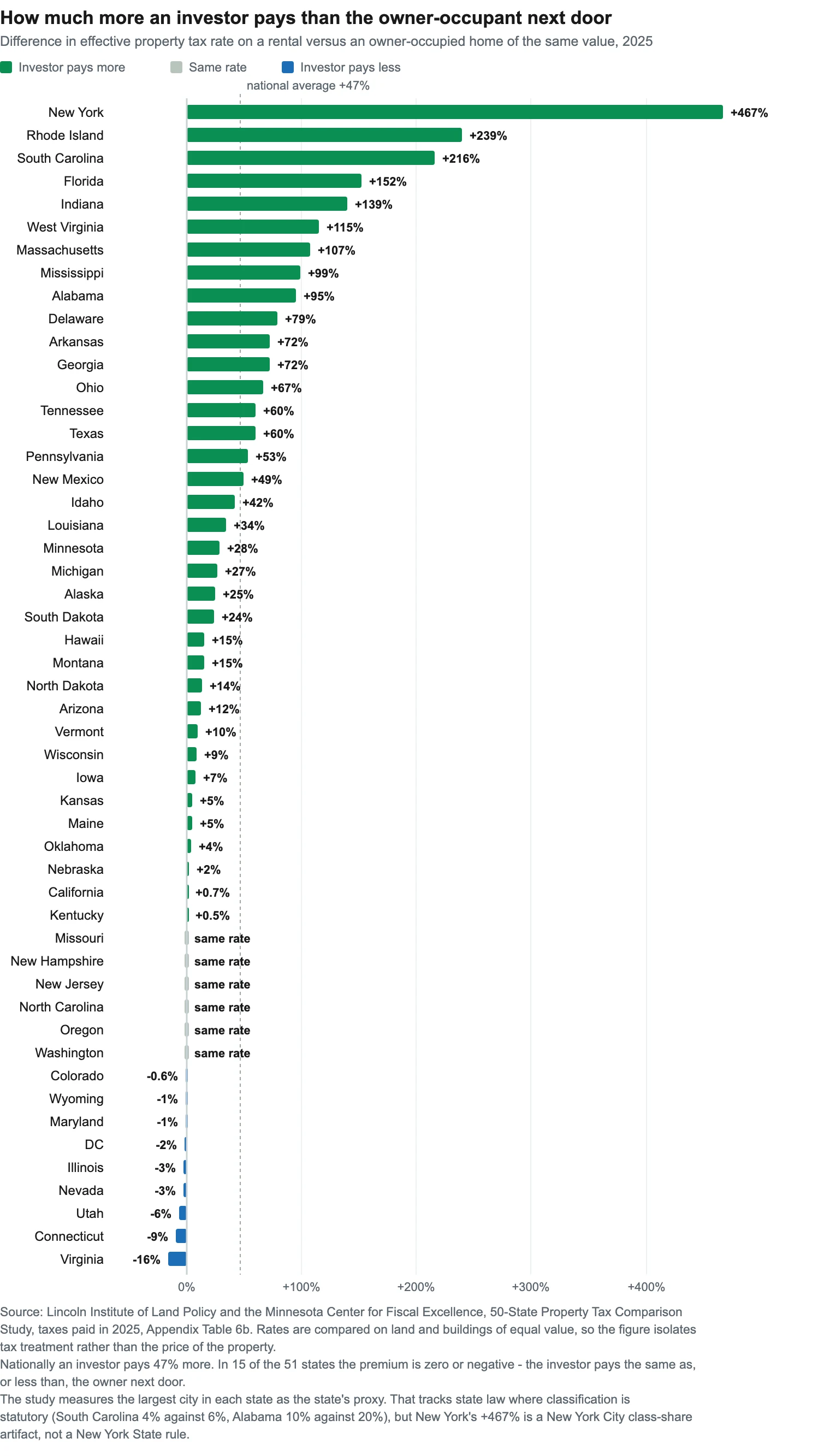
Read the middle of that chart, not just the top. The premium isn't a national rule — it's a state-by-state accident of whichever protections your legislature happened to hand homeowners. New York City sits at the extreme because of its own class-share system, not because New York State decided investors should pay five times more.
What matters for you is which side of zero your state lands on, and that turns out to be very predictable once you know the mechanism.
Why does the same house cost more to own as a rental?
Because the owner-occupant's taxable value is held back while the investor's tracks the market in full. Florida caps a homesteaded assessment at 3% a year and everything else at 10%; Texas caps a homestead at 10% and a rental at nothing at all. The gap isn't a surcharge on investors. It's the absence of a brake.
Three tools do almost all the work, and most states use at least one:
- Assessment caps. A limit on how fast your taxable value can rise each year. Almost always tied to living in the property. Florida's Save Our Homes cap is 3% or inflation, whichever is lower. Texas caps homesteads at 10%.
- Homestead exemptions. A flat slice of value taken off the top before the rate applies. Your rental gets none of it.
- Split assessment ratios. A few states tax the two classes on different fractions of value outright. South Carolina assesses an owner-occupied home at 4% and everything else at 6%. Alabama uses 10% and 20%.
Caps are the sneaky one. An exemption is a fixed haircut you can see on the bill — the difference between assessed value and market value is where it hides. A cap is a ratchet — every year you stay put, your neighbour's taxable value drifts further below what the house would actually sell for, and yours doesn't.
Stay ten years in a market that ran hot and the same two houses can end up 40% apart on paper while being worth identical money. That's the whole story, and it's why the gap is widest in states that had the biggest run-ups.
Which states punish investors hardest?
Florida, at 152% — a Jacksonville rental is taxed at two and a half times the rate of the homesteaded house next door. Georgia follows at 72% and Texas at 60%. All three combine a homestead cap with an exemption, and all three saw values climb fast enough for the ratchet to bite.
Florida
The non-homestead cap is 10%, and it doesn't apply to school district levies — the largest single line on most Florida tax bills. So the practical exposure on a rental is worse than the 10% figure suggests.
The upside: because your rental has no Save Our Homes cushion, its assessed value and its market value are supposed to be the same number. When the county gets that number wrong, a win moves your bill immediately. For a capped homesteader, winning often changes nothing — which is exactly why we turn down so many Florida homestead cases and take the rental ones. Your window is roughly 25 days from the TRIM notice. More on how Florida works.
Texas
The 10% homestead cap has no equivalent for rentals or second homes, so an investor's value resets to market every single year. Texans filed 3,006,864 protests in 2024 (Texas Comptroller, Appraisal District Operations Survey). Protesting here is routine, not confrontational, and the districts are staffed to expect it.
Texas also gives you a second ground almost nowhere else has: unequal appraisal. If comparable properties are assessed lower than yours, that's an argument on its own, separate from what the property is worth. How Texas protests work.
Georgia
Georgia's statewide floating homestead exemption arrived in 2025 and caps homestead growth at inflation — but 47 counties and every school system in the five largest counties opted out. Your rental never had the cap either way. Georgia also allows the uniformity argument, so you can challenge on market value and on comparable assessments at once. Georgia appeal basics.
What about California, New Jersey and Maryland?
There's essentially no premium in any of them. California sits at 0.7%, New Jersey at parity, Maryland at -1%. In these states a rental is taxed at almost exactly the rate of the house next door, because the protections either apply to everyone or barely exist.
California is the clean case: Proposition 13 caps every property at 2% a year regardless of who lives there. Buy a rental and a residence on the same day and they drift upward together. New Jersey and Maryland get there differently — New Jersey has no meaningful cap for anyone, and Maryland's homestead credit is small enough that it doesn't move the ratio.
That doesn't mean the bill is small. Rate and premium are different things:
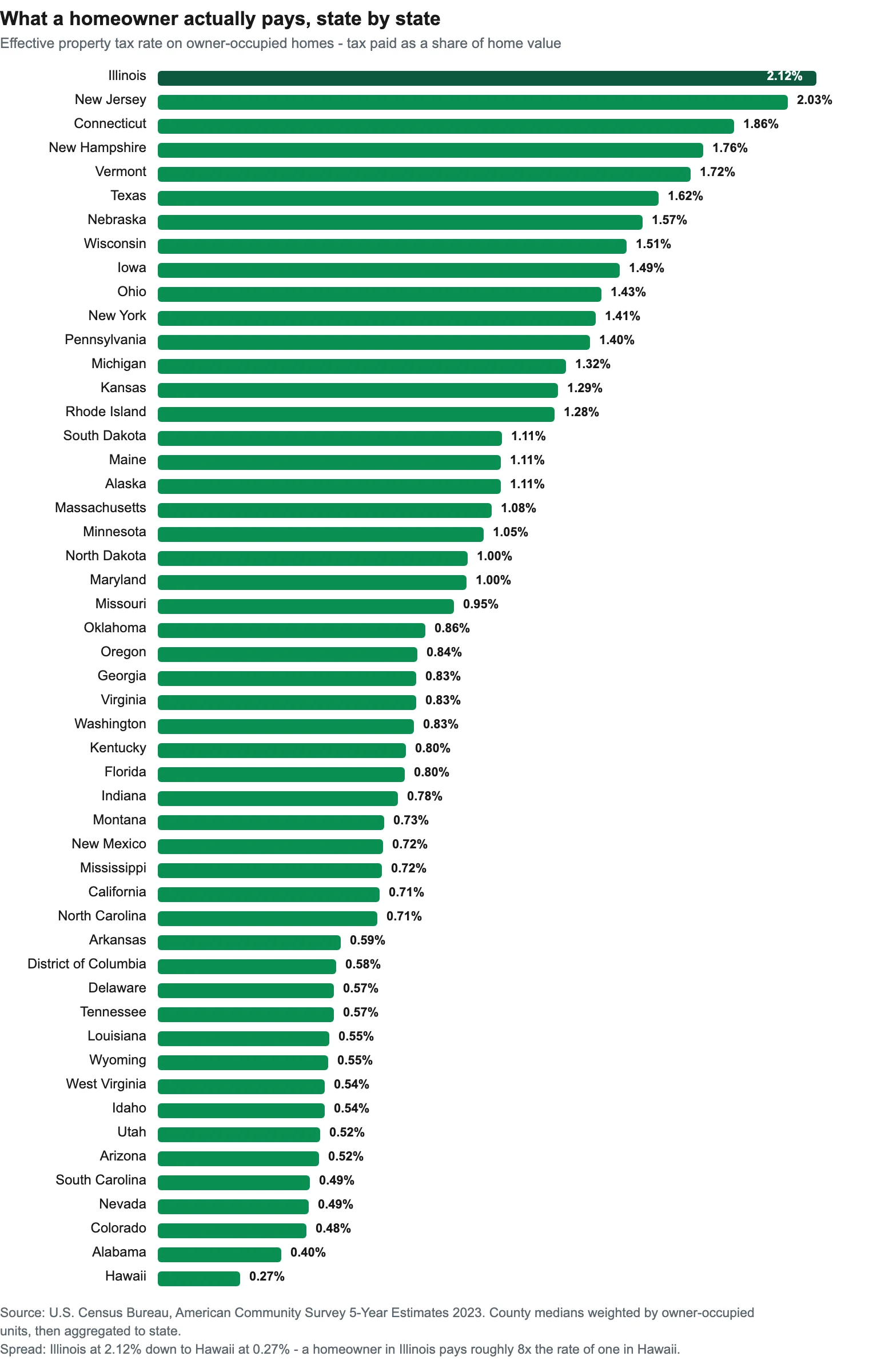
New Jersey has no investor premium and the second-highest effective rate in the country. Florida has the fourth-largest premium and a below-average rate. A landlord in Newark and a landlord in Jacksonville have opposite problems.
One warning specific to New Jersey, because getting it wrong is expensive: appeals there are decided on the Chapter 123 ratio, not on market value. If your assessment sits inside the common level range, nothing moves however over-assessed the property looks — and if it falls below the range, the county board is required by statute to raise it. New Jersey is also the one state we serve that charges to file, $5 to $150 up front by assessed value, and it isn't refundable. Don't file there on a hunch.
Can you appeal the investor premium?
No. The premium is written into state law, and no county board has the authority to hand your rental a homestead cap it doesn't qualify for. What you can appeal is the number the premium gets multiplied by — and that number is far more likely to be wrong on an investment property than on a home.
Here's the part that actually pays. Because your rental has no cap, its assessed value is supposed to equal market value every year. That means two things:
- The county has to be right annually. A capped homestead can be badly mis-valued and still produce a correct bill, because the cap is doing the work. A rental has no such buffer, so an error goes straight through to what you owe.
- A win is worth more. Reduce a capped homestead and you may just shrink a gap nobody was taxing anyway. Reduce an uncapped rental and the saving lands on this year's bill.
The counties know this asymmetry exists. Owners mostly don't. California assessors received 72,064 appeals in the 2024–25 fiscal year and only 29,493 of them were residential (California State Board of Equalization), in a state with millions of rental properties.
What should an investor actually do?
Check the rental first and the residence second — the opposite of most people's instinct. Then work the calendar, because every one of these states runs a different clock and missing it costs you the whole year.
| State | Investor premium | Deadline | What actually wins |
|---|---|---|---|
| Florida | +152% | ~25 days from the TRIM notice | Comparable sales |
| Georgia | +72% | ~45 days from the assessment notice | Sales, plus uniformity |
| Texas | +60% | May 15 | Unequal appraisal, plus sales |
| California | +0.7% | Varies by county | Decline in value below your base year |
| Maryland | -1% | ~45 days from the reassessment notice | Comparable sales |
| New Jersey | Same rate | April 1 — January 15 in Burlington, Gloucester and Monmouth | Chapter 123 ratio only. Sales, never comparable assessments |
Three habits do most of the work:
- Open the notice the day it lands. Every deadline on that table runs from a mailing date, and most of them are short. A notice you find in October is a notice you can't use.
- Compare against sales, not against your own purchase price. What you paid is one data point and the county already has it. What matters is what similar properties sold for near the assessment date. How to pull comps.
- Check every property, every year. Uncapped values move annually, so a property that was fair last year can be wrong this year. This is the single biggest difference between running a portfolio and owning a home.
The short version
The investor premium is real, it averages 47% nationally, and it's concentrated in the states that protect homeowners hardest. You can't appeal it away. But the same rules that create it also strip the buffer off your rental's assessment — which makes that assessment both more likely to be wrong and more valuable to fix.
If you own rentals in Texas, Florida or Georgia, that's a case worth checking every year. If you own in California, New Jersey or Maryland, the premium argument isn't yours — but an inflated assessment still is.
Run one of your properties and find out in a couple of minutes whether there's a case worth filing. It's $129 per property per tax year for TaxDrop One, and we'll tell you plainly when the answer is no.
Keep Reading
Paying Too Much in Property Taxes?
Let our licensed property tax experts assess your tax bill for potential savings. Over 80% of protests get a reduction of more than $1,000 and it takes less than 3 minutes to enroll.
⏰
🏠
💵
No Savings No Fee
FAQs
Do landlords pay higher property tax rates than homeowners?
In most states, yes. Across the largest city in all 50 states and DC, a rental carries an effective rate averaging 47% higher than an owner-occupied home of the same value (Lincoln Institute of Land Policy and MCFE, 2025). In fifteen of those states the rate is the same or lower.
Why is my rental assessed higher than my house?
Usually it isn't assessed higher — it's assessed more accurately. Homestead caps hold an owner-occupied assessment below market, sometimes far below. Your rental has no cap, so its assessed value tracks the market every year while your residence lags behind it.
Can I claim a homestead exemption on a rental property?
No. Homestead exemptions and caps require the property to be your principal residence, and states audit for it. Claiming one on a rental typically triggers back taxes plus penalties. In Florida the penalty is the unpaid tax, a 50% penalty and 15% interest.
Is it worth appealing property taxes on a rental property?
More often than on your own home. An uncapped assessment has no cushion absorbing the error, so a reduction lands on this year's bill in full. In Florida a capped homesteaded owner can win an appeal and see no change at all — a rental owner won't have that problem.
Which state has the biggest gap between investor and homeowner property taxes?
New York, at 467%, though that's driven by New York City's own class-share system rather than state law. Among states where the gap comes from statewide rules, Rhode Island (239%), South Carolina (216%) and Florida (152%) lead.

Ryder Meehan
Ryder Meehan is the Co-Founder of TaxDrop and a Licensed Property Tax Protest Consultant