

Key Takeaways:
You do not always have to attend a property tax appeal hearing in person: an authorized representative, an approved remote appearance, or an accepted written-evidence procedure can replace your physical attendance. Do not skip a scheduled hearing unless the hearing office confirms how your case will proceed without you—filing an appeal or uploading evidence does not automatically excuse an appearance.
TL;DR
- Do you have to attend a property tax appeal hearing? Not always, but you need an accepted attendance alternative.
- An authorized representative and a self-serve appeal packet are different; a packet does not establish hearing representation.
- Texas owners have statutory alternatives to appearing in person at an appraisal review board hearing.
- Taxdrop full-service property tax representation is best for Texas owners who want help managing their case.
Do you have to attend a property tax appeal hearing?
You must follow the hearing body's attendance rules, but personal attendance is not always required. The answer depends on your state, the stage of your case, and whether someone has authority to appear for you.
For your 2026 appeal, start with the hearing notice—not the original filing confirmation. Look for the required appearance format, instructions for appointing a representative, and any separate deadline for requesting another format.
Attend in person
- Best for: Owners who want to explain their evidence directly
- Benefit: You can answer questions as they arise
- Limitation: You must arrange travel and time away
Attend remotely, when permitted
- Best for: Owners who cannot travel
- Benefit: You can participate without being physically present
- Limitation: You still need to join at the scheduled time and follow the office's instructions
Use an authorized representative
- Best for: Owners who want someone else to present their case
- Benefit: The representative handles the permitted hearing role
- Limitation: Authorization and representation rules must be satisfied
Submit written evidence without appearing, when permitted
- Best for: Owners whose hearing rules expressly allow it
- Benefit: You avoid a live appearance
- Limitation: Your documents must stand on their own, and submission rules still apply
Reach a documented resolution before the hearing
- Best for: Owners whose valuation dispute is resolved early
- Benefit: A hearing can become unnecessary
- Limitation: A discussion or tentative offer is not confirmation that the hearing is canceled
If you are deciding whether to handle the case yourself, read the guide to appealing property taxes without a lawyer. Permission to file your own appeal and permission to miss its hearing are separate questions.
Why this matters
You want a smaller bill, not an avoidable procedural problem. A hearing is your opportunity to explain why the value used for your taxes is wrong and support a different value with evidence.
An unattended hearing can put that opportunity at risk. Depending on the applicable rules, the hearing body can dismiss a case, proceed without your explanation, or leave the assessment unchanged.
Treat the hearing as scheduled until you receive confirmation otherwise. That rule protects you even when an assessor is discussing a settlement or a representative is still completing authorization paperwork.
How to confirm whether you need to attend
Use this sequence as soon as your 2026 hearing notice arrives. It separates the filing you already completed from the arrangements you still need to make.
- Read your notice. Identify the property, tax year, hearing date, hearing body, and appearance instructions. Check whether the notice concerns an informal discussion or a formal hearing; those are not interchangeable.
- Choose your format. Decide whether you will attend, request remote participation, or use an authorized representative. Use written evidence alone only when the applicable procedure expressly allows it.
- Confirm authorization. If someone will represent you, ask who will appear and whether the hearing office has accepted the required authorization. Buying help with documents does not answer that question.
- Submit your evidence. Follow the office's delivery method and evidence deadlines. Keep proof of submission, and confirm whether documents must also be exchanged with the assessing office.
- Keep confirmation. Save the accepted attendance arrangement, any approved postponement, or the document resolving your case. Do not substitute an unanswered email for approval.
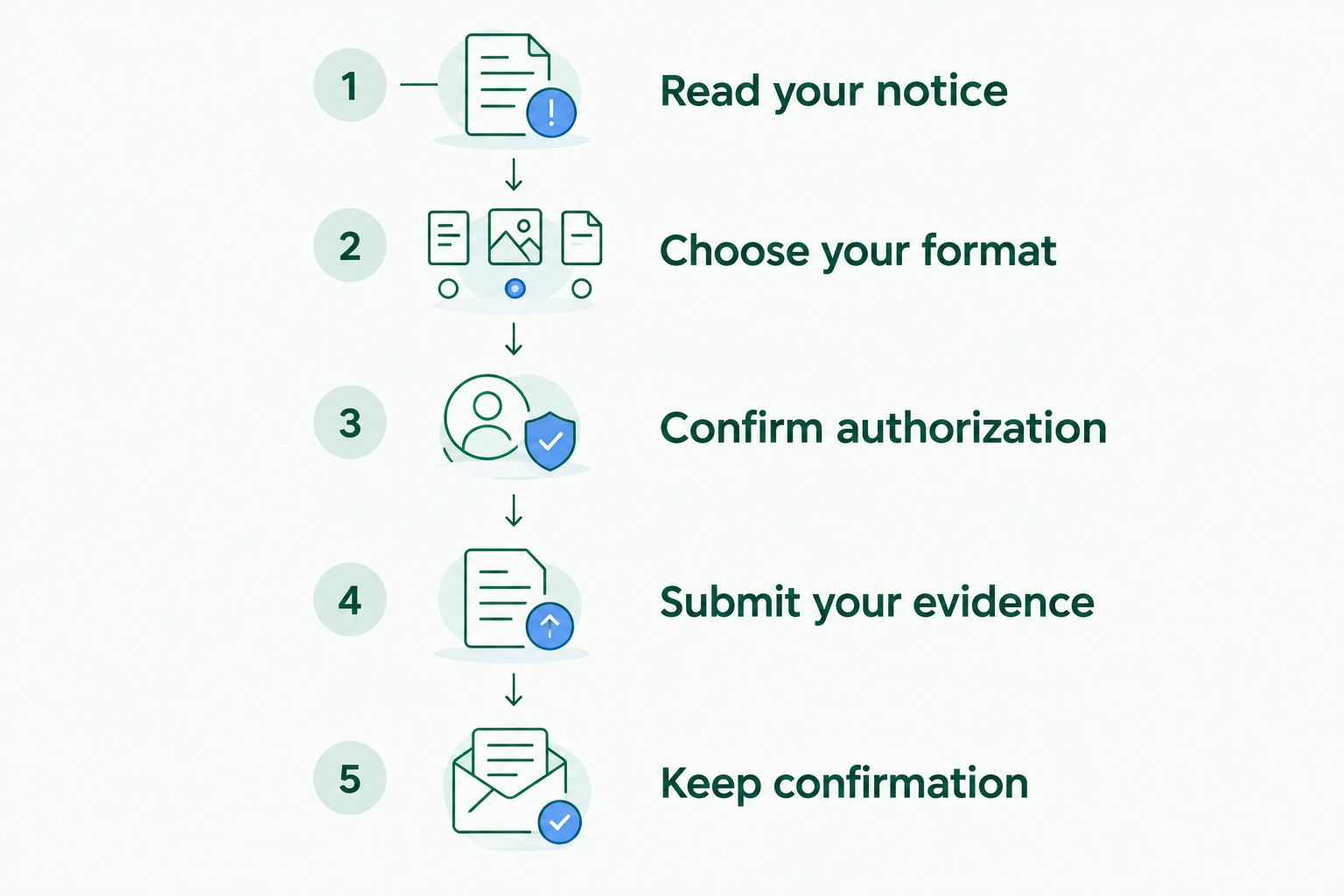
Confirm your attendance arrangement separately from filing your appeal.
Keep these records together so you can answer a simple question: who is responsible for presenting your case? If the answer is unclear, contact the hearing office before the scheduled date.
Texas: personal attendance is not the only route
Texas calls the challenge a protest, and the appraisal review board, or ARB, hears the formal dispute. The Appraisal District, often shortened to CAD, is the office responsible for appraising your property; the ARB decides the disputed issues.
Texas Property Tax Code Section 41.45 provides alternatives to an in-person appearance, including participation through a representative and procedures involving a written affidavit—a sworn statement presenting your evidence. Telephone and videoconference participation also have statutory procedures.
These alternatives have requirements. Follow the ARB's instructions rather than assuming that an ordinary email, an online filing, or a packet of sales records replaces your appearance.
For a Texas 2026 case, ask the ARB which procedure applies and what it needs before the hearing. The May 15 filing deadline is not your hearing date, and arrangements for the hearing are a separate task.
An informal agreement with the appraisal district can resolve the dispute before the ARB hearing. Keep the accepted agreement and confirmation of what happens to the scheduled hearing; an offer you have not accepted is not a completed resolution.
California and Georgia: confirm the hearing body's rules
California
California uses an appeal. The Assessor's Office sets the assessment, while an assessment appeals board or authorized hearing officer handles the hearing process.
Do not assume that sending documents to the assessor excuses attendance before the hearing body. Confirm whether you or an authorized agent must appear and whether the office permits a remote appearance for your hearing.
California filing deadlines vary by county. Your 2026 Assessment Notice and the county's hearing instructions answer different questions: one concerns challenging the assessment, and the other concerns presenting the case.
Georgia
Georgia uses an appeal, filed through the Board of Tax Assessors. An appeal can proceed through different routes, so identify the body named on your hearing notice before arranging attendance.
The usual filing window is about 45 days from the Annual Notice of Assessment. That is the time to file, not a promise that your hearing happens within 45 days.
Ask whether an authorized representative can appear, whether remote participation is permitted, and what evidence-submission rules apply. Do not treat a review by the Board of Tax Assessors as confirmation that a later hearing is unnecessary.
Florida and Maryland: filing does not settle attendance
Florida
Florida uses an appeal or petition. The Property Appraiser assesses your property, while the Value Adjustment Board, or VAB, handles the hearing process, including hearings conducted by special magistrates.
The usual petition window is about 25 days from the TRIM notice—the notice showing proposed property taxes. Your hearing notice provides the separate instructions for attendance and evidence.
If you want a representative or a remote appearance, confirm the applicable VAB procedure. A petition receipt establishes that you filed; it does not establish that someone will present your case.
Maryland
Maryland uses an appeal through the State Department of Assessments and Taxation, or SDAT. The Supervisor of Assessments is the relevant assessing office, and attendance instructions depend on the stage of your appeal.
The reassessment appeal window is about 45 days from the notice. Maryland also has an off-cycle appeal deadline of January 1; neither deadline tells you whether a scheduled hearing requires participation.
Confirm the hearing format with the office named on your notice. Maryland reassesses one third of the state each year, so do not assume another owner's schedule applies to your property.
New Jersey: review the risk before arranging a hearing
New Jersey's municipal Assessor sets the value, and the County Board of Taxation hears ordinary county-level assessment appeals. Check the board's instructions about appearances and who is permitted to represent the owner; entity-owned property requires particular attention to representation rules.
Attendance is not the only concern. New Jersey applies the Chapter 123 ratio test, which compares your assessment with market value using the municipality's assessment ratio and common level range—the permitted band around that ratio.
A New Jersey appeal can increase your assessment. When the applicable ratio falls below the common level range, the county board is required by statute to increase the assessment. A lower estimated market value alone is not a reason to file.
Comparable assessments are inadmissible in New Jersey; use relevant sales evidence instead. Review the ratio test before committing to an appeal or preparing for a hearing.
For 2026 filing, April 1 is not a statewide rule without exceptions: Burlington, Gloucester, and Monmouth use January 15. Once a case is filed, the board's hearing notice controls the attendance arrangements.
Why hearing attendance requirements vary
The requirement changes because the process changes. These factors determine which attendance arrangement you can use:
- State law: Texas expressly provides appearance alternatives; another state's procedure must be checked separately.
- Hearing stage: An informal review, an administrative hearing, and a later court proceeding have different requirements.
- Representation rules: The office determines what authorization it accepts and who can represent a particular owner.
- Hearing format: Permission to file online does not establish permission to attend remotely or rely only on documents.
- Case status: A documented resolution changes your obligations; an unresolved negotiation does not.
Ask about each factor rather than asking only whether attendance is optional. You need an accepted way to present your particular case, not a general description of someone else's experience.
What should you prepare if you will not attend personally?
Your representative or written submission needs a clear explanation of the value you are requesting. The evidence should address your property's condition and relevant market evidence, not simply your dissatisfaction with the bill.
Prepare a short case summary that identifies:
- The property and assessment you are challenging.
- The value you are requesting and why.
- Relevant closed sales and how those properties compare with yours.
- Documented errors in the property record.
- Condition problems supported by photos, reports, or other relevant records.
- The person responsible for submitting evidence and presenting the case.
If a representative will appear, review that summary together. Make sure the representative knows about material property issues and has the supporting documents before the hearing.
If written evidence is your accepted route, make the explanation understandable without you in the room. Label attachments clearly, connect each document to your argument, and follow any sworn-statement requirements.
Where professional help changes your responsibilities
Taxdrop full-service property tax representation is best for Texas owners who want help managing their case. Full-service coverage is Texas only, across 17 counties; confirm that your property is covered and what hearing responsibilities the engagement includes.
The benefit is help with the case rather than handling every step yourself. The limitation is that you still need to provide accurate property information, complete required authorization, and understand any requested participation.
TaxDrop One is self-serve: it provides an appeal packet, not automatic hearing representation. It covers 43 Texas counties, 6 California counties, 4 Georgia counties, and statewide in Florida, New Jersey, and Maryland.
Full-service representation
- Best for: Eligible Texas owners who want case-management help
- Benefit: Assistance with the representation process
- Limitation: Texas-only coverage; confirm hearing scope
Self-serve packet
- Best for: Owners comfortable managing their own appeal
- Benefit: Prepared material to support the filing
- Limitation: You remain responsible for hearing arrangements
For your 2026 case, choose based on responsibility, not the assumption that either approach eliminates attendance. An evidence packet and an accepted representative solve different problems.
Can I skip the hearing if I already submitted evidence?
No—submitted evidence alone does not establish permission to skip a hearing. Use a written-only procedure only when the hearing rules allow it and you have satisfied its requirements. Otherwise, attend or arrange an accepted representative or appearance alternative.
What if I cannot make the scheduled hearing?
Contact the hearing office promptly and request the permitted alternative or postponement. Explain the conflict and provide any documentation the office requires; keep the original date on your calendar until a change is approved.
Does hiring someone mean I never have to participate?
No—hiring help does not automatically remove your responsibilities. Confirm who will appear, whether authorization is accepted, and whether you must provide testimony or answer property-specific questions. An agreement to prepare documents is not an agreement to represent you at a hearing.
FAQ
Do I have to go to my property tax appeal hearing in person?
Not always. An authorized representative, approved remote appearance, or permitted written-evidence procedure can replace physical attendance, but you must follow the hearing body's rules.
Can someone attend my property tax hearing for me?
Yes, where the applicable representation rules permit it and the required authorization is accepted. Confirm who can represent you, especially if a business entity owns the property.
Does filing my property tax appeal online mean the hearing is online?
No. Online filing and remote hearing participation are separate arrangements; use the hearing notice to confirm the required appearance format.
What happens if I miss my property tax appeal hearing?
Missing a required hearing can put your appeal at risk. The outcome depends on the applicable rules, so contact the hearing office immediately rather than assuming your submitted documents protect the case.
Can I submit written evidence instead of attending a Texas hearing?
Texas provides a written-affidavit procedure for an appraisal review board hearing. Follow the applicable submission requirements; an ordinary evidence upload is not automatically a substitute.
Does a Taxdrop self-serve packet include hearing representation?
Taxdrop's self-serve approach provides an appeal packet, not automatic hearing representation. You need to manage attendance or separately arrange a representative permitted by the hearing body's rules.
Is a New Jersey property tax appeal guaranteed to lower my assessment?
No. New Jersey's Chapter 123 ratio test can require an assessment increase, so review the ratio and supporting sales evidence before deciding to file.
One last thing
A calendar invitation disappearing is not proof that your case has been resolved. Keep the actual resolution or the hearing office's confirmation, and check that it identifies the correct property and tax year.
For your 2026 hearing, write one sentence at the top of your case file: who will present the evidence, in what format, and under whose authorization? If you cannot complete that sentence, settle the attendance question before spending more time polishing attachments.
Related guides
- Can you switch from self-serve to full-service mid-appeal?
- How long does a property tax appeal take in New Jersey?
- Property tax appeal deadlines by state
- Is it worth hiring someone to appeal your property taxes?
Check your assessment
Taxdrop helps you review your assessment. Confirm service coverage and hearing responsibilities before choosing help.
Paying Too Much in Property Taxes?
Let our licensed property tax experts assess your tax bill for potential savings. Over 80% of protests get a reduction of more than $1,000 and it takes less than 3 minutes to enroll.
⏰
🏠
💵
No Savings No Fee