

Key Takeaways:
If you don't appeal your property tax assessment, the assessed value remains unchallenged through the appeal process, and your bill follows the normal rules for that value, exemptions, and tax rates. Skipping an appeal does not create a separate penalty, but missing the filing deadline can close your ordinary route to challenging that assessment; your tax payment deadline still applies.
TL;DR
- What happens if you don't appeal property taxes? Your assessment stays unchallenged, and your payment obligations continue.
- Check your assessment notice and filing deadline before deciding whether to challenge the value.
- New Jersey appeals can increase assessments; filing is not automatically the right choice.
- TaxDrop property tax services suit Texas homeowners and landlords seeking licensed-consultant-led help.
What happens if you don't appeal your property tax assessment?
You give up the opportunity to challenge that value through a timely appeal, not your responsibility to pay the bill. For your 2026 notice, separate the deadline to dispute the assessment from the deadline to pay property taxes. They serve different purposes.
Start with the notice, not the bill. The property tax appeal deadline guide explains why your state and notice date matter.
Leave the assessment unchallenged
- What happens: The ordinary tax calculation continues without an appeal-based change
- Best for: Owners whose assessment is supported by the evidence
- Main drawback: An unsupported value can remain in place
File a timely challenge
- What happens: The designated office or board reviews the dispute under state rules
- Best for: Owners with evidence and a valid filing window
- Main drawback: Filing takes preparation and does not guarantee a reduction
Ask about a correction or exemption
- What happens: The responsible office considers a separate issue under its own rules
- Best for: Owners with record errors or an eligibility question
- Main drawback: This is not a substitute for preserving an appeal deadline
Doing nothing does not automatically make your assessment rise. It also does not make an excessive assessment correct itself. Your county or state can still change values through its normal assessment process, whether you filed an appeal previously or not.
Why this matters
Your assessed value is the value used in the property tax calculation. It is not necessarily the same as your home's selling price, and it is not the amount you owe. Exemptions, assessment limits, and tax rates affect the final bill.
A 2026 assessment deserves a check even when the bill looks familiar. An unchanged payment does not prove the underlying value is correct. Likewise, a higher bill does not prove the assessment is wrong: rates or exemptions can change the result.
The useful question is whether the evidence supports your assessment, not whether you dislike the bill. Compare the notice with your property's records and relevant sales before choosing to file or skip.
What stays in place when you do nothing?
Your assessment remains unchallenged through an appeal
The assessment shown on your notice remains subject to the normal assessment process. Without a timely challenge, you have not asked the reviewing body to reconsider it through that process.
That distinction matters. A separate correction, exemption decision, or later reassessment can change a value or bill under applicable rules. But none of those is a reason to assume an appeal deadline will stay open.
If your property's record shows the wrong size, condition, or features, contact the responsible office. Ask whether the issue requires an appeal, a correction request, or both. Keep the answer and any submission confirmation with your notice.
Your payment obligation continues
Not appealing does not remove the tax bill. You still need to follow the payment instructions and due dates that apply to your property.
Not appealing and not paying are different decisions. Late payment can bring interest, penalties, or collection consequences under local law. Those consequences arise from nonpayment, not from declining to challenge the assessment.
If a mortgage servicer pays through escrow, the account used to collect money for taxes and insurance, check that the bill reaches the right party. Do not assume that reviewing an assessment changes what the servicer must pay.
Your ordinary filing window can close
Once the ordinary deadline passes, filing becomes a different question. Any late-filing route depends on the state, the type of assessment, and the reason for missing the deadline.
Do not treat next year's appeal as a guaranteed way to recover this year's overpayment. A later filing does not automatically reopen an earlier assessment or create a refund for an earlier tax period.
For a missed 2026 deadline, identify the exact notice and ask the responsible office which procedures remain available. A general request to lower the bill is not the same as a valid filing.
Why the consequences vary
The result of skipping a challenge depends on more than your property's estimated selling price. Check these factors before deciding that doing nothing is harmless—or that filing is necessary.
- State rules: Each state sets its own process, terminology, and grounds for review. A Texas approach does not automatically work elsewhere.
- Your notice: The notice type and its date can determine the filing window. Read the instructions attached to your actual assessment.
- The assessment cycle: A later reassessment is separate from the current opportunity to challenge a value. Maryland reassesses one third of the state each year.
- Your evidence: Relevant sales, property records, and documented condition issues determine whether you have a supportable case.
- Exemptions and limits: These can affect taxable value, the portion of the assessment subject to tax, without resolving whether the underlying value is correct.
- The risk of an increase: New Jersey's assessment-ratio rules make filing risk a specific part of the decision, not an afterthought.
Which deadline and office should you check?
Use this table to identify the starting point for your 2026 notice. Then read the notice itself and confirm the filing instructions with the named office. Seasonal activity is not a filing deadline.
Texas
- Notice and responsible office: Notice of Appraised Value; Appraisal District, also called the CAD
- Filing window to check: Generally May 15 or 30 days after delivery of the notice, whichever is later
California
- Notice and responsible office: Assessment Notice; Assessor's Office sets the value
- Filing window to check: Varies by county; confirm the applicable appeal filing instructions
Georgia
- Notice and responsible office: Annual Notice of Assessment; Board of Tax Assessors
- Filing window to check: Generally 45 days from the notice
Florida
- Notice and responsible office: TRIM notice, the proposed property tax notice; Property Appraiser sets value and the Value Adjustment Board hears petitions
- Filing window to check: Generally 25 days from the TRIM notice
New Jersey
- Notice and responsible office: Municipal Assessor sets value; County Board of Taxation hears the appeal
- Filing window to check: Generally April 1, but January 15 in Burlington, Gloucester, and Monmouth
Maryland
- Notice and responsible office: Reassessment notice; SDAT, the State Department of Assessments and Taxation, through the Supervisor of Assessments
- Filing window to check: Generally 45 days for a reassessment notice; January 1 for an off-cycle appeal
In Texas, the challenge is called a protest. In the other states listed here, use appeal, or petition where Florida's process calls for it.
New Jersey deserves a separate check before filing. The Chapter 123 ratio test compares an assessment with market value using the applicable assessment ratio and permitted range. When the assessment falls below that range, the county board is required to increase it.
Comparable assessments are not admissible evidence in New Jersey; use sales evidence. Do not assume that another home's lower assessment proves you should file. In New Jersey, checking whether an appeal can raise your assessment comes before deciding whether to submit one.
How do you decide whether to challenge your assessment?
You do not need to decide from the headline number alone. Use a short sequence that separates an actual valuation issue from frustration about taxes.
- Read your notice. Find the property identifier, assessment, notice date, and filing instructions. Keep the complete notice, including attachments.
- Check property records. Compare the official description with your home's size, condition, and features. Identify specific errors rather than describing the assessment as unfair.
- Review sales evidence. Look for relevant closed sales and the valuation date used by the assessing office. A current asking price is not the same as a completed sale.
- Check filing risk. Confirm the deadline, allowed grounds, and potential consequences. Give New Jersey's ratio rules particular attention.
- Choose your route. Decide whether to file, request a separate correction, or leave a supported assessment alone. Save proof of any filing.
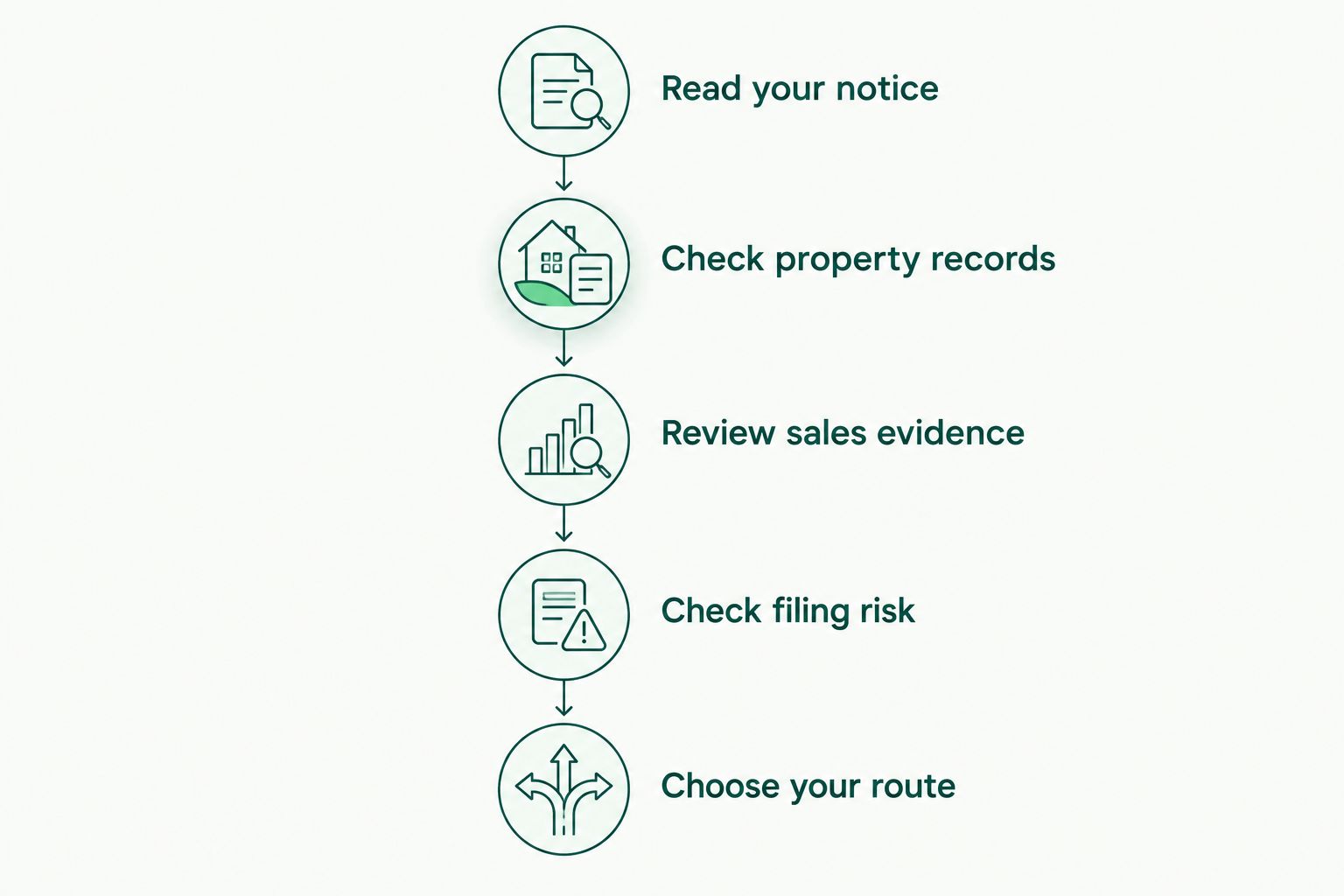
Check the evidence and filing risk before choosing your route.
Keep your records together: the notice, relevant sales, photographs of condition issues, correspondence, and confirmation receipts. A folder of evidence is more useful than a long statement about how much taxes have increased.
For landlords, repeat the check for each property. Different notices can carry different issues and filing dates. A strong case for one rental does not establish a case for the rest.
Can you appeal next year if you skip this year?
Skipping a 2026 appeal does not automatically prevent a later challenge, but a later filing does not automatically fix the skipped year. The next opportunity depends on your state's assessment cycle and filing rules.
Save this year's notice and evidence even if you decide not to file. Those records help you understand later changes, but the evidence must still fit the valuation date and grounds of the later case.
Does a lower home value automatically lower your tax bill?
A lower selling value does not automatically produce a lower tax bill. The assessment process, exemptions, limits, and tax rates still determine the result.
Check the valuation date before using recent sales. A sale after that date is not automatically proof that the value used for the assessment was wrong. Focus on evidence relevant to the period being reviewed.
Is leaving your assessment alone ever the right choice?
Yes—leaving a supported assessment alone is a valid decision. An appeal is a way to challenge a specific value or issue, not a requirement for every homeowner.
Filing is not automatically beneficial when your evidence does not support a reduction. In New Jersey, an assessment below the permitted ratio range creates a further reason to evaluate the risk before filing.
When professional help fits
TaxDrop's Texas property tax service is best for homeowners and landlords who want licensed-consultant-led help. It fits owners who want assistance evaluating evidence and handling a challenge rather than managing the process alone.
TaxDrop's full-service coverage is limited to 17 Texas counties. That is a coverage constraint, not a nationwide offer. A service also cannot turn unsupported evidence into a guaranteed reduction or replace the need to identify the correct filing window.
Check eligibility and your notice before choosing help. The outcome you want is a defensible assessment and a smaller bill when the evidence supports it—not a filing made simply because a deadline exists.
Check your assessment
Review your notice and service eligibility before deciding whether to challenge your assessment.
FAQ
What happens if I don't appeal property taxes in 2026?
Your assessment remains unchallenged through the appeal process, and your tax payment obligations continue. Missing the filing deadline can close the ordinary route to challenging that assessment.
Will I be fined for not appealing my property tax assessment?
Skipping an assessment appeal does not itself create a separate fine. Late payment is different and can bring interest, penalties, or collection consequences under local rules.
Do I still have to pay property taxes if I think my assessment is wrong?
Yes, disagreeing with your assessment does not remove your payment obligation. Follow the payment instructions for your property while checking any available challenge procedure.
Can I appeal my property taxes after the deadline?
Late-filing options depend on your state, notice type, and circumstances. Ask the responsible office about the procedure that applies to your assessment rather than assuming a late appeal will be accepted.
Is it safer to appeal every year in New Jersey?
No, filing every year in New Jersey is not automatically safer. The Chapter 123 ratio test can require an assessment increase when the assessment falls below the permitted range.
Will a lower assessment reduce my mortgage payment immediately?
A lower assessment does not automatically change your mortgage payment immediately. Your mortgage servicer's escrow review and the resulting tax bill determine how a tax change affects the payment.
Can TaxDrop handle a full-service appeal outside Texas?
No, TaxDrop's full-service property tax service is limited to 17 Texas counties. Self-serve coverage differs, so confirm eligibility for your property before choosing a route.
One last thing
The deadline on your assessment notice can matter before the tax bill arrives. Waiting to see the final bill can mean losing the ordinary opportunity to dispute the value used to calculate it.
For your 2026 assessment, put the filing date on your calendar when the notice arrives. Then check the evidence. A deliberate decision not to file is different from discovering the deadline after it has passed.
Related guides
- Is it too late to appeal property taxes after the deadline?
- Can you appeal property taxes every year?
- Is it worth appealing if your home value dropped?
- Is it worth hiring someone to appeal your property taxes?
Check your assessment.
Paying Too Much in Property Taxes?
Let our licensed property tax experts assess your tax bill for potential savings. Over 80% of protests get a reduction of more than $1,000 and it takes less than 3 minutes to enroll.
⏰
🏠
💵
No Savings No Fee