
Property Valuation Models: How Texas Sets Your Value

Key Takeaways:
Your appraisal district values your home with a property valuation model. That’s a formula run on sales data across thousands of homes at once. It can be wrong about yours, and knowing how it works shows you where to push back in a protest.
I’m Ryder Meehan, Founder and Licensed Property Tax Consultant at TaxDrop. I’ve been a landlord since 2012, with rentals in Dallas and Grayson counties. I’ve seen these models miss on my own properties. Our team builds protest evidence from the same kind of market data the districts use, and you only pay if your tax bill drops.
TL;DR
- Texas appraisal districts use three approaches to value: sales comparison, cost and income. Homes mostly get sales comparison.
- Districts run these as mass appraisal models. One model values thousands of homes, so it misses what makes yours different.
- AI and machine learning models can be accurate, but the data feeding them decides the result.
- Your best protest evidence is a short list of adjusted comparable sales and equal-value comparisons.
- TaxDrop One is $129 per year per property, and our full-service protests are no savings, no fee.
Table of Contents
- The three models behind every appraisal
- What the Texas Tax Code requires
- Mass appraisal: why one model values thousands of homes
- What data goes into the model
- AI and machine learning valuation models
- Where models miss your home
- Two ways to show the model is wrong
- What I’d do if I owned your house
- Let us run the numbers for you
- FAQ
- Sources
The three models behind every appraisal
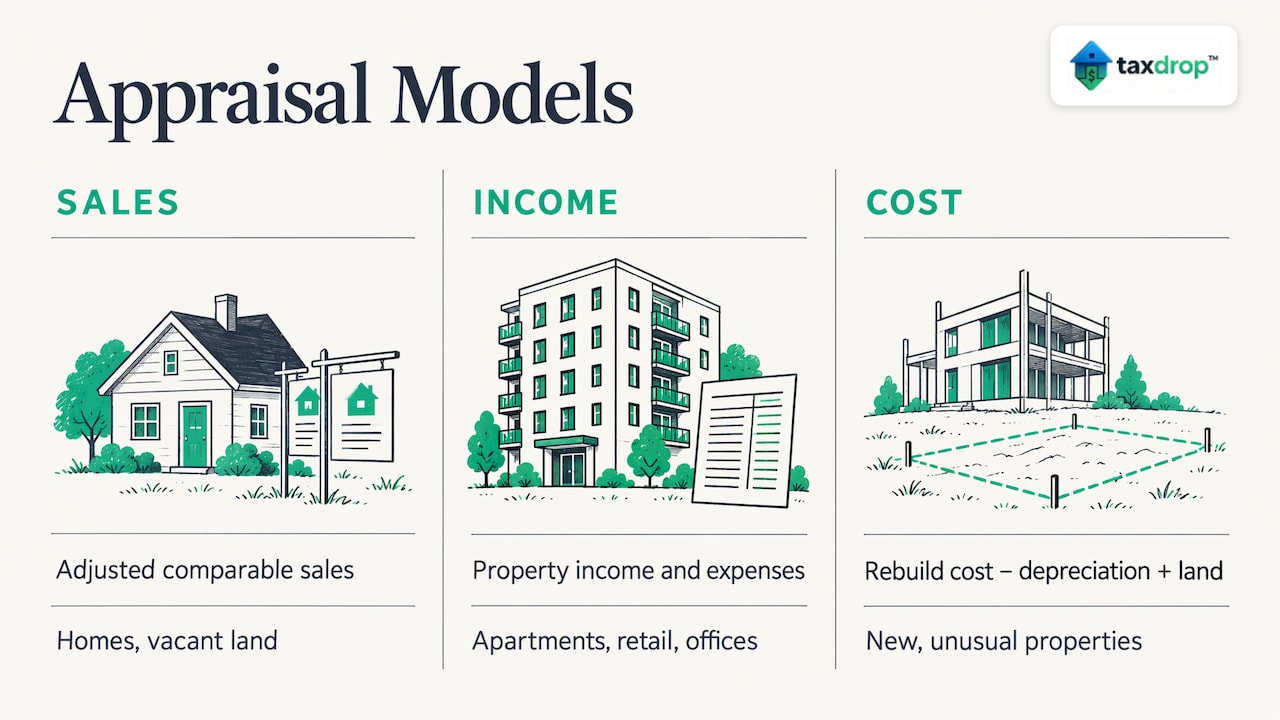
The Texas Comptroller says appraisal districts use three common approaches to value. Here they are in plain English.
Sales comparison. The district looks at what similar homes sold for. It adjusts for differences, like size or a pool. The Comptroller says this approach is preferred for single-family homes and vacant land when there’s enough sales data.
Income. The district uses a property’s income and expenses to estimate what its future earnings are worth today. It suits apartments, retail and office buildings. If you own rentals with five or more units or commercial space, expect this one.
Cost. The district estimates what it would cost to rebuild the building, subtracts depreciation (loss of value from age or wear), and adds the land value. It fits new construction and unusual properties where sales and income data are thin. Arkansas’s finance department describes the same formula: land plus improvements minus accrued depreciation.
For a typical Tarrant or Denton County house, sales comparison is the one that matters. Learn it first.
What the Texas Tax Code requires
The rules are public. Tax Code Section 23.01 says property is appraised at market value as of January 1, using generally accepted methods. It also says each property is appraised on its own characteristics and the evidence available for it.
That last part is your opening. A model gives a district-wide answer. The law asks for your property’s answer.
Section 23.013 also governs comparable sales. They must be adjusted, and they should generally fall within 24 months. For residential property in counties over 150,000 people, the window can stretch to 36 months. Denton and Tarrant both qualify as large counties, so older sales can show up in a district’s evidence.
The district must reappraise all property at least once every three years under Section 25.18. Many large districts update values every year.
Mass appraisal: why one model values thousands of homes
A district can’t send an appraiser to every house. So it uses mass appraisal. The Appraisal Foundation defines it as valuing a universe of properties on a given date with standard methods and common data, allowing for statistical testing.
The IAAO, the main professional body for assessors, explains the process in its Standard on Mass Appraisal. Analysts first specify the model, meaning they pick the factors that drive value, like living area. Then they calibrate it, meaning they find the dollar amount the market places on each factor, such as each square foot.
Here’s the catch. The model learns from averages. If your street has a busy road at the back fence, or your kitchen was never updated, the model doesn’t know. It only knows square feet, age, lot and a few other fields.
A worked example
Say the district assesses your home at $410,000. You find three similar sales nearby, adjusted for size and condition, that average $375,000. That’s a $35,000 gap.
If your combined tax rate is 2.2%, the estimated tax saved is about $770 for the year. That’s $35,000 times 0.022. Your rate will differ, so check your tax bill. If the district lowers your value, it also can’t raise it next year without clear and convincing evidence, under Section 23.01(e). That’s a quiet bonus of a successful protest.
What data goes into the model
Texas is a non-disclosure state. Sale prices aren’t public record. So districts have to gather them. El Paso’s appraisal district, in its 2025-2026 Reappraisal Plan, lists its sources: questionnaires, field discovery, renditions, protest hearings and commercial data vendors. It verifies each sale as an arm’s-length transaction before using it. That means a normal sale between unrelated parties, not a family transfer.
The same plan says districts test their work with ratio studies. These compare appraised values to actual market values and measure how level and how uniform the results are. The plan notes that reliability depends on the quantity and quality of sales data.
Two takeaways for you:
- Your protest hearing is itself a data source. What you submit can enter the district’s records.
- Thin data means weaker models. Rural areas, unusual homes and fast-moving neighborhoods get the shakiest estimates.
The state also checks the districts. The Comptroller’s Property Tax Assistance Division measures each district’s performance at least every two years, looking at uniformity and median appraisal levels.
AI and machine learning valuation models
An automated valuation model, or AVM, is software that estimates value from data on location, market conditions and property features. The IAAO’s Standard on Automated Valuation Models says its credibility depends on the data and the skill of the modeler.
Machine learning is the newer kind of AVM. Instead of fitting one straight-line formula, it tests thousands of combinations, like decision trees that split homes into groups. An IAAO task force comparative study from 2026 found ensemble machine learning models consistently beat traditional linear regression on datasets from Adams County, Belfast and Eindhoven.
A German study of about 1.2 million homes reached a similar result. It found XGBoost had the best overall accuracy, but also that different methods win in different regions.
So is AI better? On accuracy across a whole county, often yes. On your one house, it depends on the data. A review by Root, Strader and Huang says you can’t judge a machine learning valuation by its output accuracy alone. You also have to look at data quality, whether the inputs are available and whether it follows appraisal principles.
Texas regulators are watching this. In January 2026, the Texas Appraiser Licensing and Certification Board opened comment on proposed guidance AO-41. It says a tool’s output isn’t an appraisal conclusion. The appraiser stays responsible. It also says credibility rests on data relevance and quality, not dataset size or software sophistication.
That’s the same point I’d make to any neighbor. A smart model with bad inputs gives a confident wrong number.
Where models miss your home
These are the errors I see most often:
- Wrong square footage or an extra bathroom or garage that doesn’t exist.
- Comparables that are bigger, newer or in a better school zone.
- Sales older than the market supports in a year when prices dropped.
- Condition ignored: foundation work, a dated interior, storm damage.
- Values far above neighbors with similar homes.
Our guides on how assessments work and why they’re often wrong and the signs your home is overassessed go through each one.
Two ways to show the model is wrong
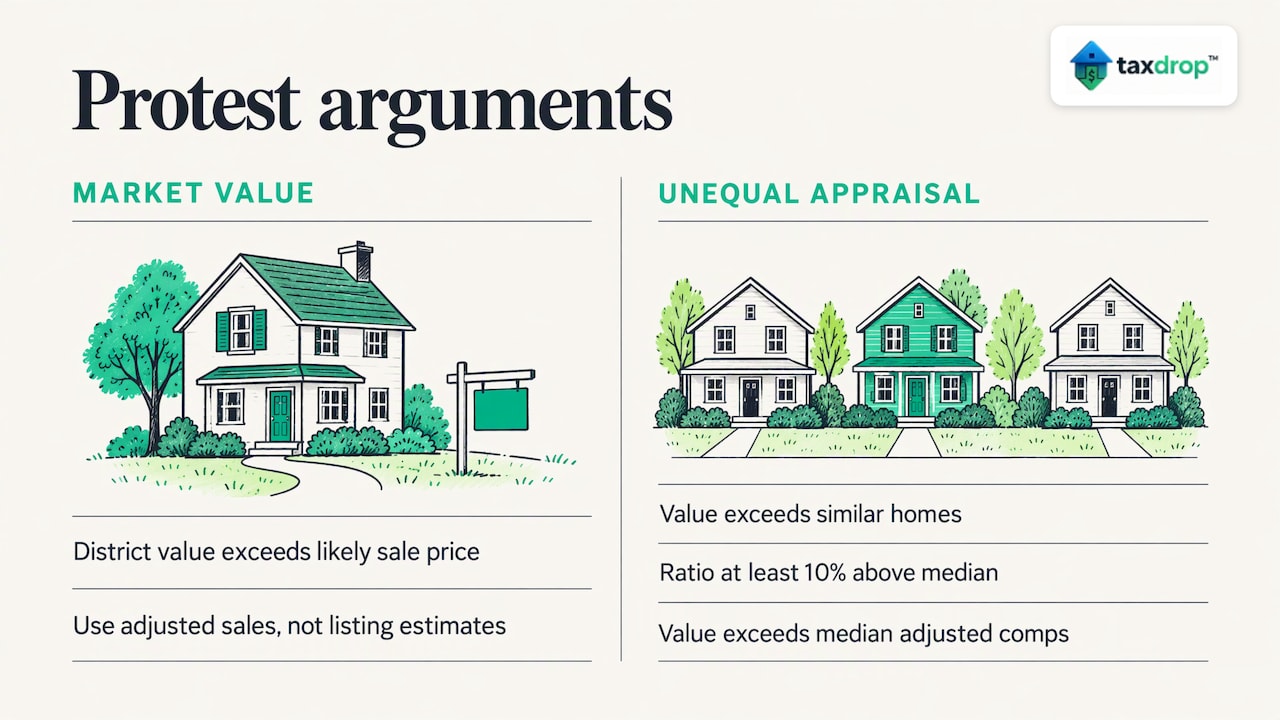
Texas lets you argue two things. Market value says the district’s number is higher than what your home would sell for. Unequal appraisal says your home is valued higher than similar homes around it.
For unequal appraisal, Section 42.26 gives court relief if your appraisal ratio is at least 10 percent above the median level for a representative sample, or if your value exceeds the median of adjusted comparables. Under Section 23.01(g), you can present your own opinion, argument and evidence on either one.
Here’s where I disagree with common advice. Many people say to lead with a home estimate from a public listing site. I’d skip that as your main evidence. Those numbers come from a model too, and a district reviewer knows it. Use adjusted sales and equity comps instead. If you’re curious how a listing estimate fits, we wrote about using a Zestimate as backup.
For how to pick comps that hold up, see how to find comps for tax protests. Aim for the three to five closest matches, adjusted for size, age and condition.
What I’d do if I owned your house
- Pull my notice of appraised value and read the square footage, bedrooms and baths.
- Fix any factual errors first.
- Gather recent sales of similar homes nearby and adjust them.
- Compare my value per square foot with the neighbors.
- Protest every year. A model re-runs every year, and so should I.
What I’d skip: arguing that taxes are too high. The district can’t change the rate. It only decides value.
Landlords with several rentals should look at our rental portfolio workflow. Income-approach properties need rent and expense data, not just sales.
How we think about models
We don’t see the district’s model as the enemy. It’s a decent tool for averages. Our job is to find where your home differs from the average.
We use AI-driven market data analysis to find comparable sales and equity comps. A licensed consultant reviews every case. That mix matters because, as the IAAO says, good models come from qualified analysts who verify data and check quality.
That’s the approach behind our service. The data does the heavy lifting, and a person checks that it fits your home.
the author
Let us run the numbers for you
If you’d rather not build the evidence yourself, we can handle it. Our full-service residential property tax protests cover filing, negotiation, hearing attendance and annual refiling. You pay a percentage of the savings, and only if your tax bill is reduced.

Prefer to present your own case? TaxDrop One is $129 per year per property. It gives you an evidence package built by licensed consultants. We also handle commercial and agricultural properties.
FAQ
Which valuation model do Texas appraisal districts use for homes?
Mostly the sales comparison approach. The Comptroller says it’s preferred for single-family homes when there’s enough sales data. Districts apply it through mass appraisal models that must follow USPAP, the national appraisal standards.
Are AI valuation models more accurate than traditional ones?
Often, across large datasets. An IAAO task force study found ensemble machine learning models beat linear regression. Accuracy on your single home still depends on the quality of the data behind the estimate.
Can I use a different model than the district’s in my protest?
Yes. You can present your own opinion, argument and evidence on market value or unequal appraisal under Tax Code Section 23.01(g). Adjusted comparable sales and equity comparisons are the most common choices.
Does the district use the same model for rentals and commercial property?
Not always. Apartments, retail and office buildings are usually valued with the income approach. Unique or new buildings may use the cost approach. Single-family rentals are generally valued like homes.
Sources
- Texas Comptroller: Valuing Property
- Arkansas DFA: Three Approaches to Value
- Texas Tax Code Chapter 23
- Texas Tax Code Section 23.01 (statutes site)
- Texas Tax Code Section 42.26
- IAAO Standard on Mass Appraisal
- IAAO Standard on Automated Valuation Models
- IAAO comparative study on AI-based valuation
- El Paso CAD 2025-2026 Reappraisal Plan
- Property Tax Administration in Texas (Comptroller, April 2024)
- Stang et al., German residential valuation study
- Root, Strader and Huang, machine learning review
- TALCB proposed guidance AO-41
Recommended
Paying Too Much in Property Taxes?
Let our licensed property tax experts assess your tax bill for potential savings. 92% of Texas protests we closed in 2026 got a reduction. It takes less than 3 minutes to enroll.
⏰
🏠
💵
No Savings No Fee
FAQs

Ryder Meehan
Ryder Meehan is the Co-Founder of TaxDrop and a Licensed Property Tax Protest Consultant


