
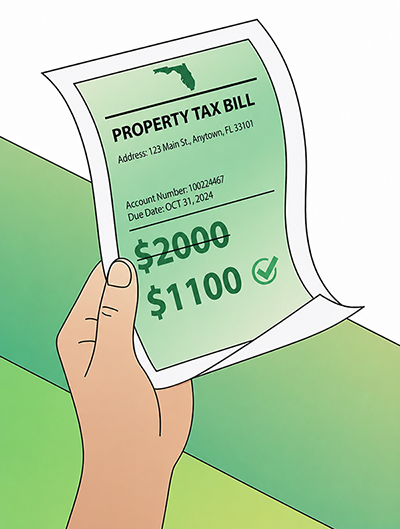
St. Lucie County, Florida homeowners overpay $250/year due to assessment errors. We help you fix that.
✔ Step-By-Step Platform - all the forms and evidence built for St. Lucie County
✔ Tax Consultant Reviewed - a licensed Florida pro checks your case before you file
✔ No Savings, No Fee Guarantee
⏰
🏠
💵
St. Lucie County, Florida homeowners overpay $250/year due to assessment errors. We help you fix that.
✔ Step-By-Step Platform - all the forms and evidence built for St. Lucie County
✔ Tax Consultant Reviewed - a licensed Florida pro checks your case before you file
✔ No Savings, No Fee Guarantee







The St. Lucie County Property Appraiser's Office relies on mass appraisal models to assess roughly 150,000 parcels across Port St. Lucie, Fort Pierce, and White City, and the rest of the county, every January 1st. These computer-driven models can miss the details that actually shape your home's true market value - flood risk, storm damage, an outdated interior, or a location on a busy road. When your Just Value comes in above what your home would actually sell for, you overpay by hundreds or thousands of dollars a year until you appeal.
Consider this: a $402,000 home in Port St. Lucie assessed at just 6% above true market value costs you an extra $205 per year in unnecessary taxes. Over a decade, that adds up to $2,050 in overpayment. Florida's Value Adjustment Board (VAB) process exists specifically to correct these valuation errors, yet most St. Lucie County homeowners let their TRIM notice go unchallenged every August.
Mass appraisal systems used across St. Lucie County can't always account for property-specific factors that affect value - interior condition, deferred maintenance, drainage issues, or noise from nearby roads and commercial areas. A home in Port St. Lucie could easily be valued using comparable sales from a stronger submarket, while storm or flood-related damage may not be reflected in the county's records at all. These systematic gaps create real opportunities for a successful St. Lucie County property tax appeal when you present the right evidence.
Florida's Value Adjustment Board hears these disputes through independent Special Magistrates - licensed appraisers or attorneys who review comparable sales data, property condition evidence, and appraisal methodology before making a recommendation. Well-prepared petitions backed by solid local comparable sales evidence are the ones most likely to succeed. Most homeowners, however, don't have the time, comparable-sales access, or VAB experience to build that kind of case on their own before the 25-day window closes.
Every year you let your TRIM notice go unchallenged, you forfeit potential savings permanently. Florida's Save Our Homes cap limits future increases on homesteaded property, but it does nothing to fix an assessment that was already too high the year you didn't appeal - that inflated baseline can follow your property for years. A St. Lucie County homeowner who secures a $250 annual reduction saves roughly $2,500 over the next decade.
Your assessed value isn't final until the tax roll is certified - it's an opinion of value that can be challenged with the right evidence. The question isn't whether you have grounds for a St. Lucie County property tax appeal, it's whether you'll file before your TRIM notice's 25-day window closes, because the only guaranteed loss is the appeal you never file.
TaxDrop One is our self-guided platform for St. Lucie County homeowners: step-by-step guidance, your required forms, an evidence package built from local MLS and county assessment data, negotiation and hearing talking points, and a licensed tax consultant review - $129/year, backed by our No Savings, No Fee Guarantee.
Start with the figures the county reports to the state. The average single-family home in St. Lucie County carries a just value of $341,127, and the county's 2024 operating millage was 4.2222 mills — about $1,440 of county operating tax on that average home, before school, municipal and special-district levies are added. Real property taxable value in St. Lucie County rose 7.6% on the 2026 preliminary roll, on top of 11.1% the year before. When values climb that fast, assessment errors get expensive quickly. In 2023 the St. Lucie County Value Adjustment Board heard 181 petitions and reduced 23 — 13%. Evidence quality matters here; a petition without comparable sales behind it rarely moves this board.
Sign up and TaxDrop handles the paperwork, the evidence, and the filing. It takes less than 3 minutes to enroll.
Step 1: Review Your TRIM Notice
Receive your Truth in Millage notice from the St. Lucie County Property Appraiser in mid-August, showing your Just Value, Assessed Value, and exemptions.
Step 2: Request an Informal Conference (Optional)
Contact the St. Lucie County Property Appraiser's office to discuss your assessment - many disputes resolve here without a formal petition.
Step 3: File Your VAB Petition
Submit Form DR-486 to the St. Lucie County Value Adjustment Board within 25 days of your TRIM notice mailing date.
Step 4: Evidence Submission
Provide comparable sales, appraisals, and property condition documentation to support a lower valuation.
Step 5: VAB Hearing
Present your case to an independent Special Magistrate, who reviews the evidence and issues a recommended decision (typically held between September and December).
Step 6: Decision & Adjustment
The Value Adjustment Board ratifies the recommendation; if successful, your assessed value and tax bill are adjusted accordingly.
St. Lucie County at a glance:
Source: Florida Department of Revenue, 2024 County Profiles and the 2026 preliminary tax roll.
Filing Deadlines:
Required Documents:
Where to Submit:
St. Lucie County Value Adjustment Board, c/o Clerk of the Circuit Court
Official resources:
A: St. Lucie County's operating millage for 2024 was 4.2222 mills, or $1,440 on the county's average single-family just value of $341,127. That is the county's operating levy only — your total bill also carries school, municipal and special-district millage, all of which appear line by line on your TRIM notice.
A: In 2023, 1,338 petitions were filed with the St. Lucie County Value Adjustment Board and 181 were heard. The board reduced 23 of them, about 13% of the petitions it heard. Those figures come from the Florida Department of Revenue's county profile, and they are the most honest guide to what a well-evidenced petition is worth here.
A: You have 25 days from the date the St. Lucie County Property Appraiser mails your TRIM (Truth in Millage) notice to file a Value Adjustment Board petition. TRIM notices typically go out in mid-August, which usually puts the deadline in early-to-mid September, but the exact date is printed on your notice - always confirm it there.
A: You can look up your property's Just Value, Assessed Value, Taxable Value, and exemptions directly through the St. Lucie County Property Appraiser's official website. This is the same data used to calculate your TRIM notice and tax bill, so it's the first place to check before considering a St. Lucie County property tax appeal.
A: A successful VAB petition lowers your property's assessed value, which directly reduces your tax bill going forward. Florida law caps the VAB filing fee at $15 per petition (s. 194.013, F.S.); your county sets the exact amount and it is due when you file. TaxDrop One gives you everything you need to build and file that petition yourself for $129 per property, per tax year.
A: Florida assesses property at 100% of Just (market) Value as of January 1st, then applies any exemptions to arrive at your Taxable Value. That taxable value is multiplied by the combined millage rate set by the county, your city, the school board, and any special taxing districts. Understanding this is why an inflated assessed value directly inflates your bill - and why a St. Lucie County property tax appeal matters.
A: Florida's Homestead Exemption can reduce your taxable value by up to $50,000 on your primary residence, and the Save Our Homes cap limits future assessment increases to 3% per year (or the CPI, whichever is lower) once homesteaded. Additional exemptions may be available for seniors, disabled veterans, and widows/widowers. Homestead applications are due by March 1st with the St. Lucie County Property Appraiser.
A: Overassessments often happen when mass appraisal models use outdated or non-local comparable sales, or when rapid price appreciation across Port St. Lucie and nearby cities pushes automated valuations above true market value. Storm or flood damage that isn't yet reflected in county records is another common cause. If any of this sounds like your property, a St. Lucie County property tax appeal may be worth filing.
A: No - TaxDrop One is a self-guided platform. You file your own St. Lucie County petition; we provide the forms, evidence package, negotiation scripts, and a tax consultant review for $129 per property, per tax year.
A: Absolutely. TaxDrop One works for homeowners, landlords, and investors across St. Lucie County - including rental and commercial property in Port St. Lucie and Fort Pierce. Non-homestead properties are capped at 10% annual assessment growth, but that cap doesn't prevent an overassessed starting point, so an appeal can still meaningfully protect your cash flow.
A: If you miss the 25-day VAB filing window, the St. Lucie County Value Adjustment Board can only accept a late petition if it finds "good cause" for the delay, and that isn't guaranteed. Otherwise, you'll need to wait for next year's TRIM notice. Set up your TaxDrop One account early so your evidence package and forms are ready the moment your next notice arrives.
A: The VAB is a quasi-judicial board established under Florida law to hear disputes between property owners and the St. Lucie County Property Appraiser. In practice, your case is heard by an independent Special Magistrate - a licensed appraiser or attorney appointed to review evidence and issue a recommended decision - rather than the full Board itself.
A: Starting your St. Lucie County property tax appeal with TaxDrop is simple. Visit TaxDrop.com and enter your property address. You'll instantly see your potential savings and can sign up for TaxDrop One to get your step-by-step platform, forms, evidence package, and tax consultant review for $129/year - .