California's SB 79 Explained: What Homeowners, Renters & Investors Must Know
California's SB 79 allows mid-rise housing near transit stops in 8 counties. Learn what this landmark law means—plus key dates and action steps.
Key Takeaways:
- Signed October 10, 2025 by Governor Newsom, takes effect July 1, 2026
- Affects 8 counties: Los Angeles, San Diego, Orange, San Francisco, Alameda, San Mateo, Santa Clara, and Sacramento
- Height limits: Up to 9 stories within 1/4 mile of major rail stops; 5-6 stories between 1/4 and 1/2 mile
- 1.5 million new units potentially zoned in Los Angeles alone
- Supply is the solution: Research shows market-rate housing reduces rent pressure on older, more affordable units
- Rent-controlled buildings protected from demolition if occupied in past 7 years
What Is SB 79?
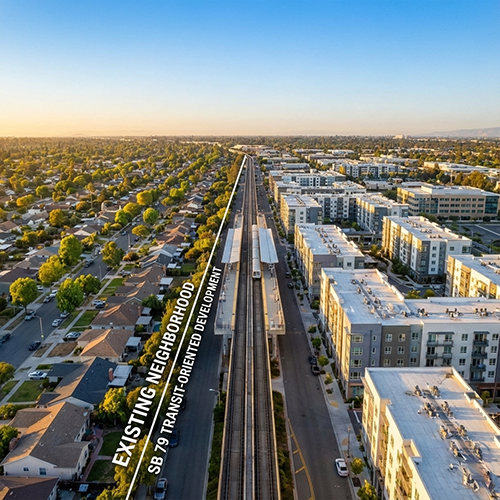
Senate Bill 79, officially named the "Abundant and Affordable Homes Near Transit Act," allows developers to build multi-family housing up to 9 stories tall near major transit stops—even in neighborhoods currently zoned only for single-family homes.
Governor Gavin Newsom signed it into law on October 10, 2025. It takes effect July 1, 2026.
"All Californians deserve an affordable place to live — close to jobs, schools, and opportunity," Newsom said at the signing. "Housing near transit means shorter commutes, lower costs, and more time with family."
The bill overrides local zoning restrictions in California's most populated urban areas, creating state-mandated building standards based on proximity to rail stations and high-frequency bus lines.
Which Areas Are Affected?
SB 79 applies only to "urban transit counties"—those with 15 or more passenger rail stations. Currently, that means 8 counties:
Northern California: San Francisco, Alameda, San Mateo, Santa Clara, Sacramento
Southern California: Los Angeles, Orange, San Diego
Within these counties, the law creates zones around qualifying transit stops where denser housing is now allowed by right—meaning cities cannot block it based on height or density restrictions.
Property Tax Implication: If you own property in any of these eight counties within a half-mile of transit, your land's development potential just changed. That change in "highest and best use" can trigger reassessment or affect your property's market value for tax purposes.
How Height and Density Work Under SB 79
The law uses a tiered system based on transit type and distance:
Tier 1 Stops (Heavy Rail/Frequent Commuter Rail):
- Within 1/4 mile: Up to 9 stories, 160 units/acre minimum
- 1/4 to 1/2 mile: Up to 6 stories, 80 units/acre minimum
Tier 2 Stops (Light Rail/Bus Rapid Transit):
- Within 1/4 mile: Up to 6 stories, 80 units/acre minimum
- 1/4 to 1/2 mile: Up to 5 stories, 30 units/acre minimum
A preliminary analysis estimated SB 79 could zone approximately 1.5 million new housing units in Los Angeles alone—enough to nearly double the city's current housing stock.
Why California Passed This Bill
California's housing crisis has been building for decades:
- The state has had a housing shortage since 1970
- California ranks 49th among all states for housing units per capita
- The median home now costs over $900,000, requiring an annual income of $237,000 to afford
- The state needs approximately 180,000 new units per year just to match growth
Senator Scott Wiener has pushed versions of this legislation since 2018. Previous attempts (SB 827 in 2018, SB 50 in 2020) failed. SB 79 finally passed with narrow margins—41-17 in the Assembly and 21-13 in the Senate.
"SB 79 is a historic step toward tackling the root cause of California's affordability crisis — our profound shortage of homes and too few people having access to transit," said Senator Wiener. "In California, we talk a lot about where we don't want to build homes, but rarely about where we do — until now."
Brian Hanlon, CEO of California YIMBY, which sponsored the bill: "SB 79 unwinds decades of overly restrictive land use policies that have driven housing costs to astronomical levels, forcing millions of people to move far away from jobs and transit."
What This Means for Homeowners
The Concerns Are Real
Homeowners near transit stops have legitimate worries:
- Property value uncertainty: Rezoning changes land values, but not always predictably
- Neighborhood character changes: Areas previously restricted to single-family homes could see 5-9 story buildings
- Infrastructure strain: SB 79 doesn't require upfront infrastructure upgrades
- Parking and traffic: More density means more people—though supporters argue transit-adjacent housing reduces car dependence
The Potential Upside
If you own property near transit, your land just became more valuable for development purposes. Commercial property owners may find it significantly more profitable to build residential units.
What Homeowners Should Do:
- Check if you're in an affected zone. City planning departments are publishing preliminary maps.
- Understand your property's new potential. Land near transit may have development options that didn't exist before.
- Monitor your property taxes. Rezoning can affect assessed values—you may have grounds to appeal if assessments increase unfairly.
- Get involved locally. Cities can adopt alternative plans with state approval through 2027-2032.
What This Means for Renters
Protections Built Into the Law:
- Rent-controlled buildings are protected from demolition if they've had tenants in the past 7 years
- Developers must provide relocation assistance if displacing existing tenants
- Cities can add stronger local tenant protections beyond state minimums
Affordability Requirements:
Every SB 79 project must include below-market-rate units: 7% for extremely low income (30% AMI), 10% for very low income (50% AMI), or 13% for low income (60% AMI). Where local inclusionary zoning requires higher percentages, those rules still apply.
Critics argue these percentages are too low. But this critique misses the bigger picture.
The real obstacle to affordable housing isn't zoning—it's funding. Subsidized housing costs $700,000+ per unit to build in California. There will never be enough public money to solve this crisis through subsidies alone. What actually works? Supply.
Michael Lens, professor of urban planning at UCLA: "The evidence is nearly unanimous that more housing supply—even when it's market-rate housing—leads to more affordable housing, including for low-income renters."
Ironically, rent control makes the problem worse. A Stanford study found San Francisco's rent control reduced rental housing supply by 15% as landlords converted apartments to condos or exited the market—resulting in a 5.1% increase in citywide rents.
Housing advocate Max Dubler put it bluntly: "The idea that we have to choose between building market-rate housing and building subsidized affordable housing for poor people is, to use a technical term, bullshit."
What This Means for Real Estate Investors
New Development Opportunities:
- Commercial property owners near transit can now build residential on land previously restricted
- Streamlined approvals available through SB 35 for projects meeting affordability requirements
- Density bonuses stack with SB 79 provisions for even greater height and unit counts
- Predictability increases—developers know the state will back projects against local opposition
Real estate consulting firm RCLCO analyzed the opportunity: "SB 79 effectively scales [Los Angeles's approach] statewide: transforming select, politically negotiated opportunities into a consistent, as-of-right framework that improves predictability for developers and their capital partners."
Property Tax Considerations for Investors:
- Reassessment triggers: In California, property is reassessed at sale. Factor in Prop 13 implications.
- Development land vs. improved property: Raw land near transit may see assessment increases reflecting new development potential.
- Supplemental tax bills: After any reassessment, expect a supplemental tax bill.
- Appeal timing: California's appeal deadline is typically September 15 (varies by county).
Key Dates and Timeline
- October 10, 2025: Governor Newsom signs SB 79
- July 1, 2026: Main upzoning provisions take effect in incorporated cities
- January 1, 2027: Penalties begin for cities that deny qualifying projects in high-resource areas
- ~2031 (7th RHNA Cycle): Provisions extend to unincorporated county areas
- 2032: Final deadline for Bay Area alternative plans
What SB 79 Says About California's Housing Future
This bill represents a fundamental shift—and it's the right direction.
State Standards Are the New Normal. For decades, local governments blocked housing, creating a catastrophic shortage. SB 79 establishes that housing supply is a "matter of statewide concern." When locals consistently block housing for decades, state intervention becomes necessary.
Supply Is the Solution. California's affordability crisis is fundamentally a supply problem, not a subsidy problem. Government-subsidized affordable housing costs $700,000-$1 million per unit and depends on limited public funding. Market-rate construction scales without taxpayer dollars and research shows it reduces pressure on existing housing.
The uncomfortable corollary: rent control actually worsens the shortage. Stanford economists found San Francisco's rent control reduced rental housing supply by 15% and increased citywide rents by 5.1%. SB 79's approach—dramatically increasing where housing can be built—addresses the root cause.
Your Property Taxes in a Changing Landscape
Major zoning changes affect property values—and that affects your property taxes.
How Rezoning Impacts Your Assessment
California county assessors determine your property's assessed value based on what it could sell for—including development potential. If your property is rezoned for higher density under SB 79, your assessor may increase your assessed value based on what a developer might pay—even if you have no plans to sell or develop.
This is especially likely for commercial properties near transit (now convertible to residential), large single-family lots in SB 79 zones, and properties in high-demand areas like West Los Angeles or the San Francisco Bay Area.
What to Watch For:
- Assessment increases following rezoning—Your assessor may revalue based on new development potential
- Changes to comparable properties—New multi-family sales may become comps for your property
- Unequal assessment—If similar properties outside SB 79 zones aren't reassessed, you may have appeal grounds
Your Right to Appeal
If your property taxes increase due to factors beyond your control, you have the right to appeal your assessment. California appeal windows typically run July 2 – November 30. Most appeals result in some reduction.
→ Check if your California property is overassessed
Bottom Line
SB 79 is the biggest change to California housing policy in decades—and it's a necessary one. After 50+ years of restrictive zoning that created the nation's worst housing shortage, California is finally letting the market build.
Key takeaways:
- The law takes effect July 1, 2026 in 8 major counties
- Up to 9-story buildings allowed near major transit stops
- Homeowners should check affected zones and monitor property taxes
- Renters will see more housing options over time—supply growth benefits everyone
- Investors gain new development options with predictable state backing
- Supply is the solution—subsidies can't scale, but market-rate construction can
- Watch your assessment—rezoning can trigger property tax increases you can appeal
Paying Too Much in Property Taxes?
Let our licensed property tax experts assess your tax bill for potential savings. Over 80% of protests get a reduction of more than $1,000 and it takes less than 3 minutes to enroll.
⏰
🏠
💵
No Savings No Fee
FAQs
Does SB 79 affect my single-family neighborhood?
It depends on your location. If you live within 1/2 mile of a qualifying transit stop in one of the 8 affected counties (Los Angeles, San Diego, Orange, San Francisco, Alameda, San Mateo, Santa Clara, or Sacramento), your neighborhood could see denser housing development starting July 1, 2026. Check your city's planning department for preliminary maps showing affected zones.
Can developers tear down my apartment building under SB 79?
SB 79 protects rent-controlled buildings from demolition if tenants have lived there any time in the past 7 years. Buildings with more than 2 units that were rent-controlled and occupied in the last 5 years are also protected. If your building isn't rent-controlled, check with a tenant rights organization about your specific protections.
Will SB 79 lower housing costs in California?
Yes—if we let it work. Research from the Legislative Analyst's Office, Pew Charitable Trusts, and multiple academic studies confirms that adding housing supply slows rent growth, with the biggest benefits for older, more affordable units. Government-subsidized affordable housing costs $700,000+ per unit and depends on limited public funding—there will never be enough subsidy dollars to solve this crisis alone. Market-rate supply is the scalable solution.
How does SB 79 affect property taxes?
Rezoning can affect assessed values. If your land is rezoned for higher-density development, your county may increase your assessment based on its new development potential—even if you're not planning to build. If you believe your assessment is unfair after SB 79 implementation, you can appeal.
When do SB 79 changes actually start?
The main provisions take effect July 1, 2026 for incorporated cities in the 8 affected counties. Unincorporated county areas won't be affected until approximately 2031 (7th RHNA cycle). Local governments can adopt alternative plans with different timelines through 2027-2032 depending on the county.

Ryder Meehan
Ryder Meehan is the Co-Founder of TaxDrop and a Licensed Property Tax Protest Consultant