

Key Takeaways:
Ownwell helps property owners challenge their property tax assessments, but choosing an appeal service still means matching its support to the work you want handled. If you want to prepare your own Georgia appeal instead of hiring someone to manage it, a self-serve packet or direct filing is a different fit. The best Ownwell alternative in 2026 is TaxDrop One if you want a self-serve appeal packet in a supported Georgia county; direct filing if you want to build and submit the case yourself.
TL;DR
- Ownwell alternatives Georgia homeowners should compare include TaxDrop One, direct filing, and a local property tax representative.
- TaxDrop One offers self-serve property tax appeal packets in four Georgia counties, not statewide full-service representation.
- Georgia generally gives you 45 days from your Annual Notice of Assessment to appeal.
- Choose based on who prepares evidence, submits your appeal, and handles any hearing.
Why this matters
A smaller property tax bill starts with a defensible assessment challenge, not a brand ranking. Your assessment is the value your county uses to calculate property taxes; an appeal asks the county to review that value or another permitted issue.
Georgia owners generally have 45 days from the Annual Notice of Assessment to appeal. Your county's Board of Tax Assessors handles the initial filing. Read the instructions on your notice before comparing providers, because changing services does not restart that window.
TaxDrop offers its self-serve property tax appeal option in four Georgia counties. Its full-service representation is Texas-only. That distinction matters: a prepared packet is not the same as someone taking responsibility for your entire case.
For your 2026 decision, start with three questions:
- Is your property in a supported county?
- Do you want prepared evidence, or someone to represent you?
- Can you meet your notice's deadline while comparing options?
Ownwell alternatives in Georgia at a glance
Compare the type of help first. A provider's name does not tell you who files the appeal or who answers questions at a hearing.
Ownwell
- Best for: Owners considering a property tax appeal service
- Standout feature: Assistance with challenging an assessment
- Difference from Ownwell: The benchmark; confirm your county's scope and responsibilities
TaxDrop One
- Best for: Owners wanting a self-serve packet in a supported Georgia county
- Standout feature: Free instant analysis before choosing a packet
- Difference from Ownwell: Explicitly self-serve in Georgia; not full-service representation
Direct county filing
- Best for: Owners comfortable researching and submitting their own appeal
- Standout feature: Direct control over evidence and filing
- Difference from Ownwell: You perform the work instead of engaging an appeal service
Local property tax representative
- Best for: Owners seeking county-specific representation
- Standout feature: A representative selected for the property's location and case
- Difference from Ownwell: Compare the individual engagement with Ownwell's offered scope
The right comparison is not simply online versus local. It is prepared evidence versus managed representation versus doing everything yourself. Get that distinction in writing before you authorize anyone to act for you.
1. TaxDrop One: best for a prepared self-serve appeal
TaxDrop One is a property tax appeal packet option for homeowners and landlords who want help preparing a case but are willing to manage the submission. Georgia coverage includes four counties. Check your property's eligibility before treating it as an alternative.
The free instant analysis comes first, and the savings estimate takes under 2 minutes. An estimate is a screening step, not a promise that your county will reduce your assessment.
Where the self-serve option shines
- You can review the initial analysis before deciding whether to proceed.
- The service model is clear: a self-serve packet rather than Georgia full-service representation.
- You retain control over your submission and the documents you include.
- The option serves homeowners and landlords in supported counties.
Where the self-serve option falls short
- Georgia coverage is limited to four counties, not the whole state.
- A packet does not replace a representative who handles your case.
- You still need to follow your county's filing instructions and deadlines.
- You need to decide whether the evidence fits your property and the issue you are appealing.
Best for: You want a prepared starting point, your county is supported, and you are comfortable taking responsibility for filing.
Self-serve packet versus Ownwell
Georgia eligibility
- Self-serve packet: Four supported counties
- Ownwell: Confirm eligibility for your property
Service model
- Self-serve packet: Self-serve appeal packet
- Ownwell: Confirm the offered appeal-service scope
Initial review
- Self-serve packet: Free instant analysis
- Ownwell: Review the offered assessment-review process
Representation
- Self-serve packet: Not Georgia full-service representation
- Ownwell: Confirm who handles filings and hearings
For a 2026 appeal, do not mistake help preparing evidence for someone managing the deadline. Read the packet's instructions against your county's notice before submitting anything.
If you are deciding whether preparation support is enough, read the guide to whether a flat-fee appeal packet is worth it.
Verdict: Choose the packet route when you want preparation help and can manage the appeal yourself. Skip it when you need someone to represent you.
2. Direct county filing: best for owners who want control
You can appeal your Georgia assessment directly through the process described on your Annual Notice of Assessment. You do not need to select a commercial service before taking that step. You do need a clear argument and supporting documents.
Start with your county's property record. Check the facts used to value your home, then identify what you dispute: the value, an incorrect property characteristic, or another permitted appeal issue.
Where direct filing shines
- You control the evidence and the explanation submitted with it.
- You deal directly with the county's stated process.
- You can focus the appeal on a specific factual error.
- You do not have to coordinate a change between commercial providers.
Where direct filing falls short
- You must research the evidence and prepare the argument.
- You are responsible for filing correctly and keeping proof of submission.
- You must track correspondence and any next steps.
- A complex rental property valuation demands more work than correcting an obvious record error.
Best for: Your case has a clear issue, you can gather supporting records, and you have time to follow the process.
Evidence preparation
- Direct county filing: You research and organize it
- Ownwell: Confirm what the service prepares
Submission responsibility
- Direct county filing: You submit using county instructions
- Ownwell: Confirm who files
Case correspondence
- Direct county filing: You monitor notices and requests
- Ownwell: Confirm how updates are handled
Hearing preparation
- Direct county filing: You prepare or arrange representation
- Ownwell: Confirm the engagement's hearing scope
Verdict: Choose direct filing when you can explain and document the error. Skip the do-it-yourself route when you cannot manage the evidence or follow-up.
3. Local property tax representative: best for representation
A local property tax representative is an option when you want a person to handle agreed parts of your appeal. The important word is agreed. Interview the representative about your county, your property type, and the tasks covered by the engagement.
Do not assume that a local address proves relevant experience. Ask how the representative would approach your actual assessment issue and whether hearing representation is included.
Where a local representative shines
- You can ask about experience with your county's appeal process.
- You can discuss property-specific complications before engaging anyone.
- You can request a defined scope covering preparation, filing, and representation.
Where a local representative falls short
- Scope varies by representative and engagement.
- You need to check qualifications rather than rely on location alone.
- You still need to provide accurate records and respond to document requests.
Best for: You want representation rather than a packet, especially when your property or evidence needs individual review.
Verdict: Choose a local representative only after confirming county experience and written responsibilities. Wait if those answers remain unclear.
Why consider switching from Ownwell?
Switching makes sense when another service model matches your responsibilities better. It does not require Ownwell to be a poor service. Your needs can simply be different.
These are valid reasons to compare alternatives, not claims that Ownwell has a particular shortcoming:
- You want self-serve preparation. A packet fits when you want support assembling the case but intend to file yourself.
- You want direct control. County filing fits when you prefer to choose every document and manage correspondence.
- You need a defined representative. A local engagement fits when you want clarity about who handles specific tasks.
- You need a different scope. Compare written responsibilities rather than assuming all appeal services do the same work.
Before changing an existing arrangement, check whether an appeal has already been submitted and whether anyone remains authorized to represent you. Ask for the case status and copies of documents. Avoid conflicting instructions to your county.
For 2026, protect the filing deadline before changing the service model. A comparison page is useful only if you still have time to act on it.
How to choose without losing your appeal window
Use the same sequence whether you choose a packet, a representative, or direct filing.
Read your notice
Find the Annual Notice of Assessment and its appeal instructions. Confirm the notice date, property identifier, filing deadline, and submission method with your county's Board of Tax Assessors.
Check county coverage
Ask whether the service supports your property's county and property type. State-level coverage is not enough. For a self-serve option, confirm what you receive and what remains your responsibility.
Assign responsibility
Identify who prepares the evidence, who submits the appeal, and who tracks correspondence. If a hearing becomes necessary, establish who will attend and what additional preparation is required.
Keep filing proof
Save your submission, supporting documents, confirmation, and county correspondence together. If the county asks for more information, those records let you respond without rebuilding the case.
This sequence separates eligibility from execution. You first establish that the option fits your property, then make sure every required task has an owner.
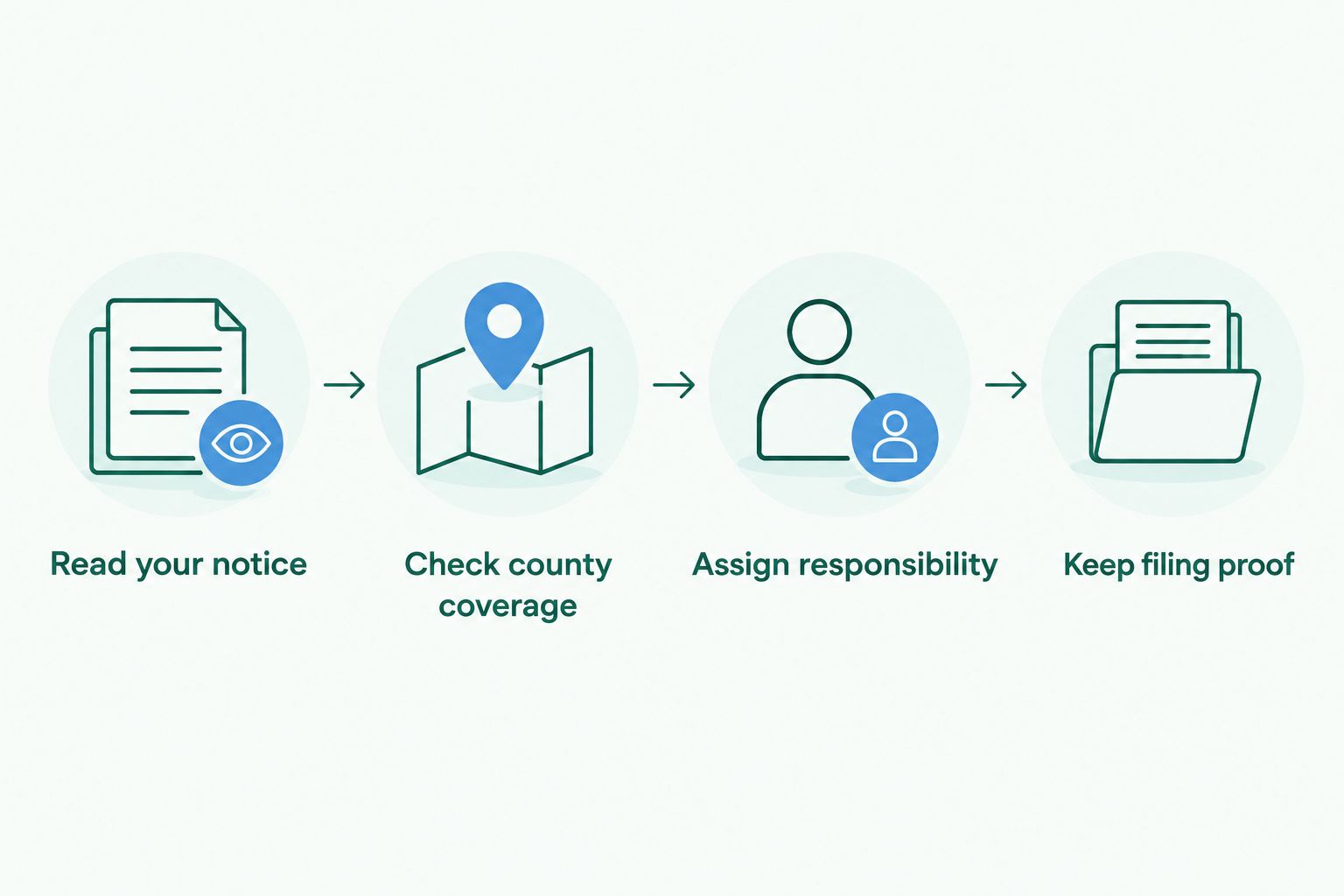
Choose the service model only after checking your notice and county coverage.
Compare evidence, not savings promises
A useful appeal explains why your county's conclusion needs review. A lower estimate from another source is not a complete argument by itself.
For a value dispute, comparable sales are sales of properties similar enough to help establish your property's value. Explain relevant differences, such as condition or size, instead of sending a list without context. Use public records, county assessor records, and MLS closed sales where available.
For a factual error, connect the correction to a record the county can review. State what is wrong, provide the supporting document, and explain why the error matters to the assessment.
Georgia also permits uniformity challenges, which question whether your property is assessed consistently with similar properties. That is a different issue from arguing that market value is too high. Make sure your evidence supports the ground you select.
For your 2026 comparison, ask each option the same question: What evidence supports my appeal, and who explains it to the county? A confident savings claim is not a substitute for that answer.
When staying with Ownwell is the right call
Stay with Ownwell when its offered scope fits your property and you understand the responsibilities. There is no reason to switch solely because another option ranks first on a list.
If you already have an active appeal, review its status before making a change. A new provider or packet does not erase the existing filing or create a new deadline. Keep the arrangement that gives you clear accountability and a documented next step.
FAQ
What's the best Ownwell alternative in Georgia in 2026?
TaxDrop One is a fit for owners who want a self-serve property tax appeal packet in a supported Georgia county. Direct county filing is the alternative for owners who want to prepare and manage the entire appeal themselves.
Does TaxDrop offer full-service appeals in Georgia?
No. TaxDrop's Georgia offering is its self-serve option, available in four counties; full-service representation is Texas-only.
Can I appeal my Georgia assessment myself?
Yes, you can file directly using the instructions on your Annual Notice of Assessment. You are responsible for the evidence, timely submission, and follow-up.
How long do I have to appeal in Georgia?
Georgia generally allows 45 days from the Annual Notice of Assessment to appeal. Check the deadline and filing instructions on your notice with your county's Board of Tax Assessors.
Is a self-serve appeal packet the same as representation?
No, a self-serve packet provides preparation support rather than a representative managing your case. Confirm who handles submission, correspondence, and any hearing before choosing it.
Can I switch services after my appeal has been filed?
Check your existing agreement, representative authorization, and county case status before switching. Obtain copies of the filed documents and establish who will handle the remaining steps.
Does a lower assessment guarantee a specific tax saving?
No, a lower assessment does not guarantee a particular saving. Your final bill also depends on applicable tax rates, exemptions, and how the reduction affects your taxable value.
One last thing
The most useful question is not whether an alternative looks easier. It is whether you know who owns the next step. Before choosing, write down the filing deadline and the person responsible for meeting it.
Related guides
- How long a Georgia property tax appeal takes
- Whether hiring someone to appeal is worth it
- Appealing after the deadline
Check your assessment
Start with the free instant analysis, then confirm whether your Georgia county is supported.
Paying Too Much in Property Taxes?
Let our licensed property tax experts assess your tax bill for potential savings. Over 80% of protests get a reduction of more than $1,000 and it takes less than 3 minutes to enroll.
⏰
🏠
💵
No Savings No Fee