

Key Takeaways:
Best self-serve option: TaxDrop through its One appeal packet, if your San Jose property is covered. Best for a complicated assessment dispute: a California property tax attorney. Best for documenting market value: an independent real estate appraiser. Best for handling a straightforward case yourself: direct filing with Santa Clara County.
TL;DR
- TaxDrop One is best for self-directed homeowners whose California property is covered; confirm Santa Clara County eligibility first.
- The best property tax appeal companies in San Jose match their services to your assessment dispute, not just your address.
- San Jose owners deal with the Santa Clara County Assessor’s Office; the Assessment Appeals Board decides formal appeals.
- For regular assessments, Santa Clara County’s 2026 filing window is July 2 through September 15.
Why this matters
A smaller property tax bill starts with the right assessment challenge. Paying someone to prepare paperwork does not automatically mean that person files your appeal, represents you at a hearing, or handles follow-up questions.
San Jose properties fall under Santa Clara County. The Assessor’s Office sets your assessed value—the value used to calculate your property taxes. The county’s Assessment Appeals Board hears formal disputes about that value.
For a regular assessment, Santa Clara County’s 2026 appeal filing window is July 2 through September 15. Supplemental assessments, which can follow a purchase or new construction, have separate filing rules. Read your specific notice before choosing a service.
What makes the best property tax appeal service?
Choose the service that addresses your actual problem. These criteria matter more than a national ranking:
- County coverage: The provider must accept your Santa Clara County property and property type.
- Scope of work: Know whether you receive evidence preparation, filing assistance, or hearing representation.
- Relevant evidence: Your case needs support for the correct valuation date, not simply today’s asking prices.
- California knowledge: The provider must distinguish a temporary market-value reduction from a dispute about the original assessment.
- Clear responsibilities: Your agreement should identify who files, tracks correspondence, and meets deadlines.
- Honest limitations: An appeal challenges an assessment. It does not guarantee a reduction or cancel your payment obligations.
TaxDrop One is best for self-directed homeowners who want an appeal packet for a covered California property. It is not the brand’s full-service representation offering; that service operates only in Texas.
San Jose appeal options at a glance
The useful comparison is between service models. A packet provider, attorney, appraiser, and county filing route solve different problems; they are not interchangeable.
TaxDrop One
- Best for: Self-directed owners seeking an appeal packet
- Standout feature: Self-serve preparation option
- Key limitation: Confirm county coverage; not full-service California representation
California property tax attorney
- Best for: Disputes involving legal issues
- Standout feature: Legal advice and an agreed representation scope
- Key limitation: Often unnecessary for a straightforward market-value case
Independent real estate appraiser
- Best for: Cases needing a supported valuation
- Standout feature: Property-specific opinion of value
- Key limitation: An appraisal alone does not file or resolve an appeal
Direct county filing
- Best for: Owners comfortable preparing their own case
- Standout feature: Direct control over the application and evidence
- Key limitation: You manage deadlines, submissions, and hearing preparation
For your 2026 decision, ask every candidate the same question: What work will you do, and what work remains mine? A clear answer makes the comparison useful.
1. TaxDrop One: best for a self-directed appeal packet
TaxDrop One is a self-serve appeal packet option. The service operates in six California counties, so confirm that your San Jose property is eligible before choosing it.
This route fits homeowners and landlords who want preparation support but are comfortable managing their own appeal. Do not confuse a packet with someone taking responsibility for your entire case.
Packet pros:
- Gives you a defined self-serve route rather than a full-service engagement.
- Suits owners who want to remain involved in their assessment challenge.
- Includes a free instant analysis before the self-serve purchase decision.
- Makes sense when you need preparation support rather than legal representation.
Packet cons:
- California coverage is limited to selected counties; statewide eligibility is not established.
- The California offering is not full-service representation.
- You need to understand your filing and hearing responsibilities before proceeding.
Best for: A homeowner with an eligible property who wants an appeal packet and can handle the remaining county process.
Ask whether your parcel is covered and what the packet contains. Then ask which tasks you must complete yourself. Make that distinction before your 2026 filing window closes.
Verdict: Hold until Santa Clara County eligibility and your responsibilities are confirmed.
2. California property tax attorney: best for legal complexity
A California property tax attorney advises on legal issues affecting your assessment. Depending on the engagement, an attorney can also represent you in the administrative appeal process.
This category deserves consideration when your dispute involves ownership changes, assessment rules, or an issue beyond a simple disagreement about market value. Choose someone whose work includes California property tax appeals, not merely general real estate transactions.
Attorney pros:
- Helps identify the legal issue behind the disputed assessment.
- Can explain the consequences of different appeal arguments.
- Can provide representation when that work is included in the agreement.
- Fits cases where valuation evidence alone does not resolve the dispute.
Attorney cons:
- Legal representation can be more service than a straightforward valuation case needs.
- The engagement does not automatically include an independent appraisal.
- You still need to supply accurate property records and relevant documents.
Best for: An owner facing a legal assessment question, a disputed reassessment, or a case requiring legal representation.
Before hiring, ask about experience with the Santa Clara County Assessment Appeals Board. Have the attorney explain who prepares valuation evidence and whether hearing attendance is included.
Verdict: Buy legal help when the assessment dispute turns on law, not just comparable sales.
3. Independent real estate appraiser: best for valuation evidence
An independent real estate appraiser develops an opinion of your property’s value. For an assessment appeal, that opinion must address the valuation date relevant to your case.
This route fits a property that is difficult to compare with nearby homes. Unusual condition, layout, location, or property characteristics can require more explanation than a list of sales provides.
Appraiser pros:
- Focuses directly on the value being disputed.
- Can explain differences between your property and comparable sales.
- Provides property-specific analysis rather than relying only on broad neighborhood trends.
- Can support a case you file yourself or prepare with a representative.
Appraiser cons:
- An appraisal report does not automatically include appeal filing or representation.
- A report prepared for another purpose needs review for relevance to your appeal.
- The county board decides the case; an appraisal does not guarantee acceptance.
Best for: An owner who needs a defensible valuation for a property with difficult comparisons.
Ask whether the appraiser has prepared reports for California assessment appeals. Specify the required valuation date before commissioning the work, and clarify whether testimony is included.
Verdict: Buy valuation support when property-specific evidence is the missing piece.
4. Direct county filing: best for a straightforward owner-led case
Direct filing means you prepare and submit your appeal through Santa Clara County’s assessment appeals process. You do not need to hire a company merely to challenge an assessment.
This route fits an owner who can gather relevant sales, explain property differences, and follow the county’s instructions. It is less suitable when you want someone else to manage correspondence or present the case.
Direct filing pros:
- Keeps you in control of your argument and supporting documents.
- Lets you address the property details you know firsthand.
- Avoids confusion about whether a provider is handling the filing.
- Works without hiring a representative when you can prepare the case yourself.
Direct filing cons:
- You are responsible for timely submission and a complete application.
- You must organize evidence and prepare for questions.
- You receive no independent professional assessment unless you obtain one separately.
Best for: An organized homeowner with a clear valuation argument and time to manage the process.
Read the county’s application instructions before drafting your evidence. A persuasive argument does not rescue a missed deadline.
Verdict: Buy no extra service when you can document and manage a straightforward case yourself.
Understand what you are challenging in California
California’s Proposition 13 generally limits annual increases in a property’s base-year value—the value established when ownership changes or qualifying construction occurs—to no more than 2% per year. That rule does not mean every tax bill or every reassessment is limited to the same increase.
A Proposition 8 reduction is different. It addresses a temporary decline in market value below the value otherwise used for assessment. A temporary reduction can be reviewed as market conditions change.
For a regular 2026 decline-in-value case, the relevant valuation date is January 1, 2026. A sale later in the year is not automatically evidence of what your property was worth on that date.
Your neighbor’s lower assessed value is not, by itself, proof that your assessment is wrong. California owners can have different taxable values because they bought at different times. Use relevant market evidence rather than building your case around neighboring assessments.
If your concern is a recent price decline, start with whether appealing your California assessment is worthwhile. Identify the assessment issue before paying for help.
Prepare your case before choosing a provider
A useful provider conversation starts with documents, not a request for a promised savings figure. Follow this sequence for your San Jose assessment.
Read your notice
Identify your parcel, assessment type, disputed value, and applicable deadline. A regular assessment and a supplemental assessment do not follow identical filing rules.
Identify the issue
Decide whether you dispute market value, property facts, or the basis for reassessment. That choice determines whether you need a packet, valuation help, or legal advice.
Gather evidence
Collect relevant closed sales, property records, photographs of condition issues, and documents supporting your argument. Explain why each item relates to your property and the correct valuation date.
Confirm responsibilities
Ask who prepares the application, submits it, receives county correspondence, and attends any hearing. Get those responsibilities in writing before relying on a provider.
File on time
Follow the Santa Clara County Assessment Appeals Board’s instructions. Contacting the Assessor’s Office about a value review does not replace meeting the formal appeal deadline.
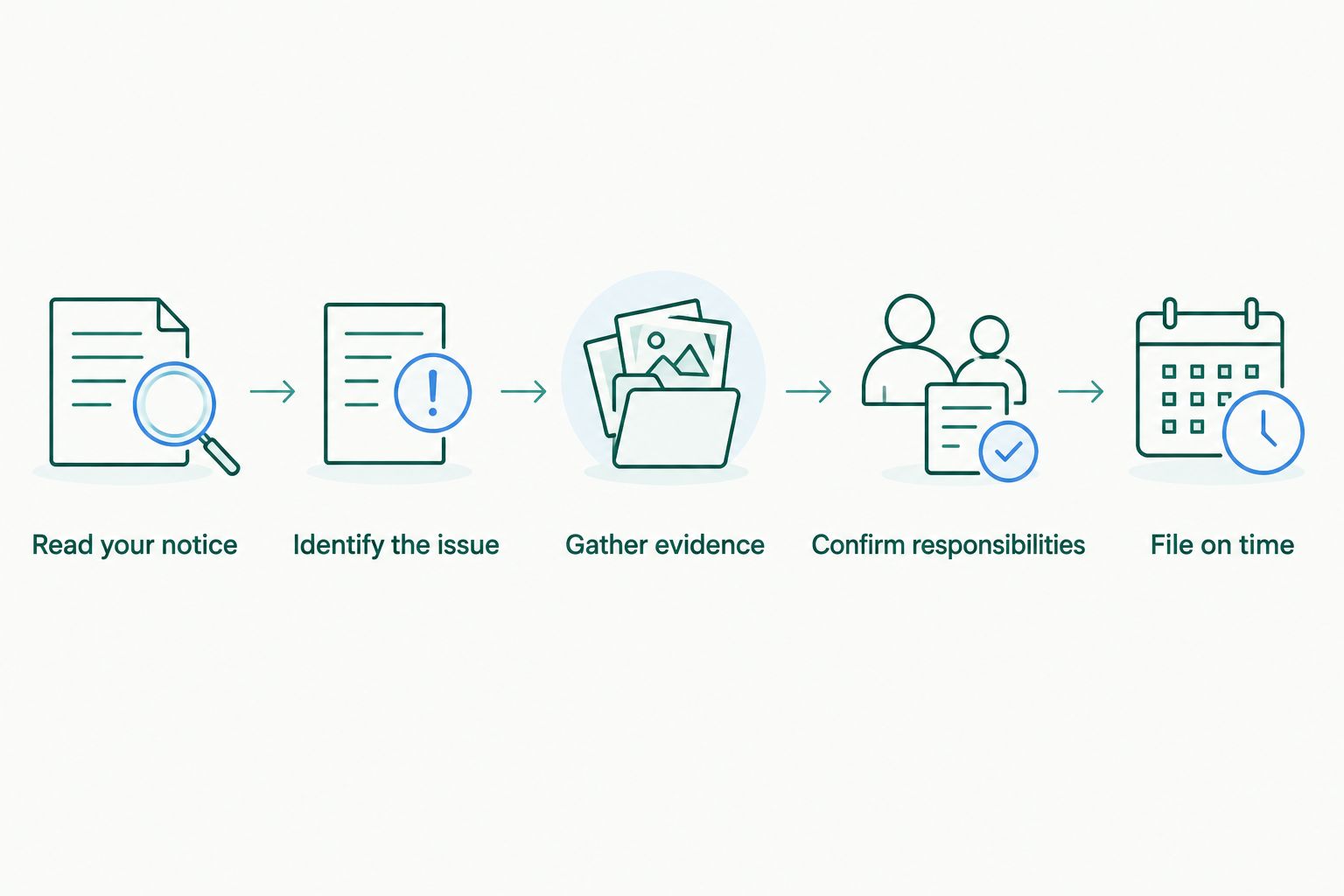
Match the help you hire to the issue you need to prove.
Keep a copy of your application and submission confirmation. Continue paying property taxes by their due dates while the appeal is pending; filing an appeal does not suspend payment requirements.
How these options are ranked
The order puts a self-serve packet first for owners who want preparation help, then separates legal representation, valuation support, and owner-led filing. Each option has a different job.
The ranking uses county eligibility, service scope, evidence needs, and owner responsibilities. It is not a claim that one provider wins more San Jose cases than another.
Which option should you choose?
Choose the least extensive service that addresses your actual assessment problem. For a straightforward market-value case, compare a self-serve packet with direct county filing. For difficult valuation evidence, consider an appraiser. For legal assessment questions, consult a property tax attorney.
Do not hire a representative just because your bill rose in 2026. First establish what value you dispute, why it is wrong, and which evidence supports a lower figure.
FAQ
What are the best property tax appeal companies in San Jose?
The best choice depends on whether you need an appeal packet, valuation evidence, or representation. Confirm Santa Clara County coverage and the exact work included before choosing a provider.
Does TaxDrop offer full-service appeals in San Jose?
TaxDrop’s full-service offering operates only in Texas. Its California option is the self-serve One packet in selected counties; confirm your San Jose property’s eligibility first.
What is the San Jose property tax appeal deadline in 2026?
Santa Clara County’s regular assessment appeal window runs from July 2 through September 15, 2026. Supplemental and other assessment notices have separate rules, so check your notice and the county’s instructions.
Which office handles a San Jose property tax appeal?
The Santa Clara County Assessment Appeals Board hears formal assessment appeals. The Santa Clara County Assessor’s Office sets the assessment and handles assessor-level valuation questions.
Can I appeal my San Jose assessment without a lawyer?
Yes, you can prepare and file your own assessment appeal. Legal advice is more relevant when your dispute involves assessment law rather than a straightforward market-value argument.
Will my neighbor’s lower assessment help me win?
A neighboring property’s lower assessment is not enough to establish your property’s market value. California assessments can differ because owners purchased at different times; relevant closed sales provide a different kind of evidence.
Should I stop paying property taxes while my appeal is pending?
No, keep paying property taxes by their due dates while your appeal is pending. An appeal does not suspend your payment obligations.
One last thing
A lower assessment does not necessarily produce an immediate change in your mortgage payment. If your lender collects property taxes through escrow, the account used to pay taxes and insurance, check how the lender handles the resulting tax adjustment.
Keep the county’s decision with your property records. The appeal result and the lender’s escrow calculation are separate steps.
Related guides
- Can you appeal property taxes every year?
- Is a flat-fee appeal packet worth it?
- Is it too late after the appeal deadline?
Check your assessment. Confirm your property’s eligibility, identify the value you dispute, and choose the help your case actually needs.
Paying Too Much in Property Taxes?
Let our licensed property tax experts assess your tax bill for potential savings. Over 80% of protests get a reduction of more than $1,000 and it takes less than 3 minutes to enroll.
⏰
🏠
💵
No Savings No Fee