

Key Takeaways:
Best for a straightforward self-serve appeal: TaxDrop One. Best for legal representation: a New Jersey property tax attorney. Best for a disputed property valuation: an independent real estate appraiser. The best property tax appeal companies in Jersey City in 2026 are the ones that assess your risk before encouraging you to file.
TL;DR
- TaxDrop One is a self-serve option when comparing the best property tax appeal companies in Jersey City.
- Choose a New Jersey property tax attorney when you need representation, not just an appeal packet.
- Jersey City appeals go to the Hudson County Board of Taxation; the municipal Assessor sets your assessment.
- New Jersey appeals can increase your assessment. Check the Chapter 123 ratio before filing.
Why this matters
A smaller property tax bill starts with a defensible challenge to your assessment, not a promise that every homeowner should appeal. In New Jersey, filing can expose an assessment that is too low as well as one that is too high.
Jersey City is in Hudson County. The Jersey City municipal Assessor sets your assessment, while the Hudson County Board of Taxation hears county-level appeals. Those are different jobs. A service should explain that distinction before asking you to sign anything.
For your 2026 decision, separate three needs: preparing evidence, establishing a property's value, and representing you in a legal proceeding. A packet service, an appraiser, and an attorney do different work. Buying one does not automatically give you the others.
TaxDrop One is best for Jersey City owners who want a self-serve property tax appeal packet and will manage their own filing. It is not full-service representation in New Jersey.
What makes the best Jersey City property tax appeal service
Use these criteria before comparing sales pitches:
- New Jersey coverage: Confirm that the provider serves your property address and offers the service you actually need.
- Assessment-increase screening: Ask how the provider checks whether filing could increase your assessment under New Jersey's ratio rules.
- Sales-based evidence: Look for relevant closed sales, not a list of neighboring assessments. Comparable assessments are inadmissible in New Jersey.
- Clear responsibilities: Establish who prepares the petition, files it, serves the required parties, and attends the hearing.
- Property fit: Ask whether the provider handles your property type, especially if you own a rental building or an unusual property.
- Deadline discipline: Require a plan tied to the Hudson County filing instructions for your tax year, not a generic national calendar.
For 2026, a provider's ability to explain these points matters more than an unsupported claim to be the city's top company. Choose the scope of help first. Choose the provider second.
Jersey City appeal options at a glance
TaxDrop One
- Best for: Owners handling a self-serve appeal
- Standout feature: Appeal-packet service offered statewide in New Jersey
- Key limitation: Not full-service representation in New Jersey
New Jersey property tax attorney
- Best for: Owners needing legal representation
- Standout feature: Legal advice and representation within the agreed engagement
- Key limitation: Evidence gathering and appraisal work must be clarified separately
Independent real estate appraiser
- Best for: Owners needing a supported market-value opinion
- Standout feature: Property-specific valuation evidence
- Key limitation: An appraisal is not a filed appeal or legal representation
Owner-led filing
- Best for: Eligible owners managing the entire appeal themselves
- Standout feature: Direct control over preparation and filing
- Key limitation: You carry the procedural workload and assessment-increase risk
These are service routes, not interchangeable products. An attorney can work with an appraiser, and a self-serve owner can obtain valuation help. The right combination depends on what your case needs.
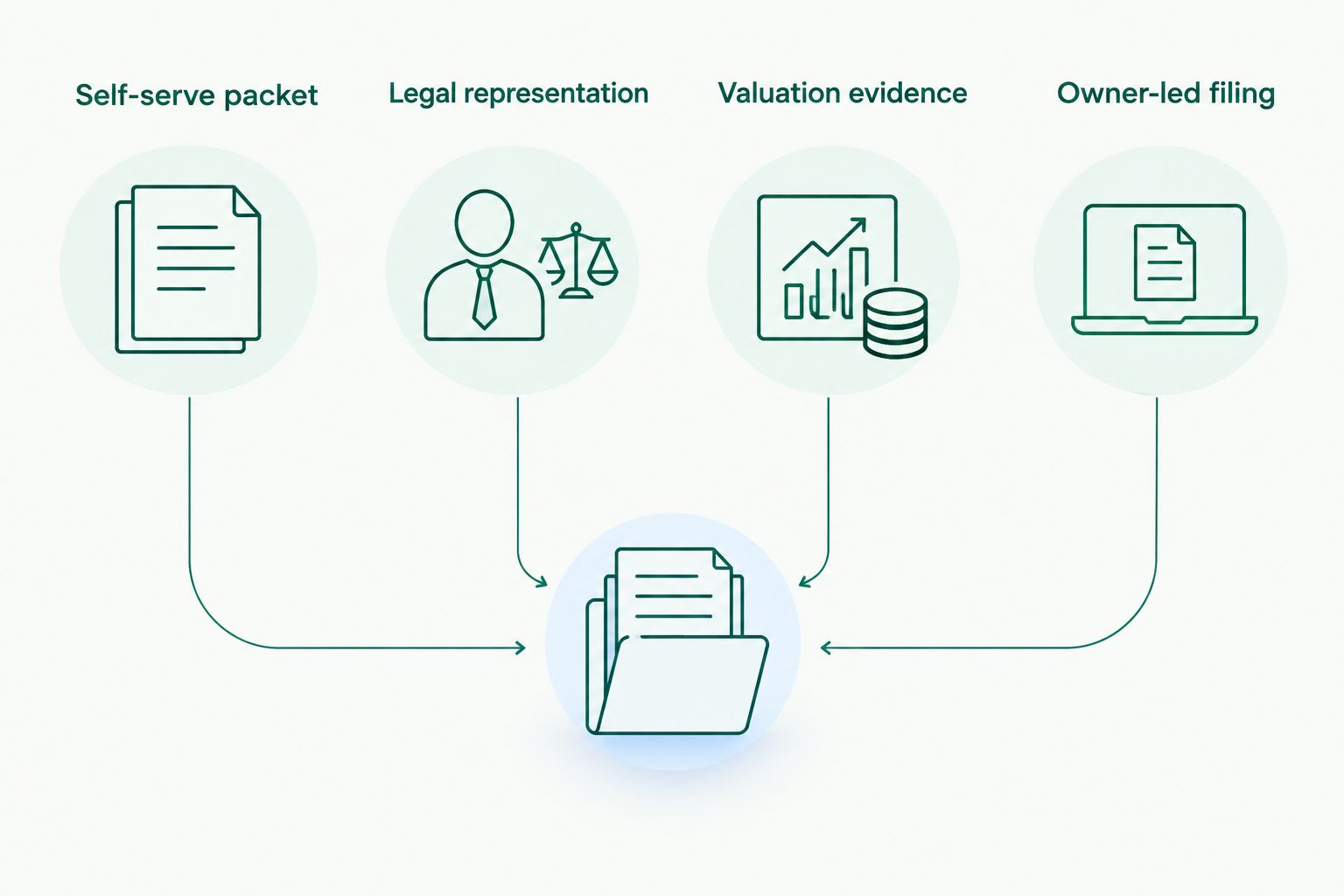
Pick the help your case needs; a packet, valuation, and representation are different services.
1. TaxDrop One: best for a self-serve property tax appeal
TaxDrop One provides a self-serve appeal packet and operates statewide in New Jersey. You start with a free instant analysis, then decide whether the self-serve route fits your property and your willingness to manage the appeal.
The distinction is important: TaxDrop's full-service offering operates in Texas only. A Jersey City owner should not expect the New Jersey packet service to include someone handling the entire case or appearing at a hearing.
TaxDrop One pros:
- Available statewide in New Jersey.
- Free instant analysis before choosing the packet.
- A defined self-serve route for owners who want help preparing an appeal.
TaxDrop One cons:
- Does not provide the Texas full-service offering in New Jersey.
- Leaves you responsible for managing the self-serve process.
- Does not remove the county's filing charge or the risk of an increased assessment.
Best for: A homeowner or landlord who wants an appeal packet, understands the New Jersey risk, and can manage filing responsibilities.
Read the guide to whether a flat-fee self-serve property tax appeal packet is worth it before deciding whether preparation help is enough.
Verdict: Buy only after checking that the assessment supports an appeal and that self-serve filing fits your situation.
2. New Jersey property tax attorney: best for representation
A New Jersey property tax attorney is the right service category when you need legal advice or someone authorized to represent you. Confirm the attorney's engagement covers the forum, property, and tasks involved in your case.
Do not assume “handles tax appeals” means every step is included. Ask whether the engagement covers the initial review, petition, service, negotiations, hearing, and any later court proceeding.
New Jersey property tax attorney pros:
- Can advise on the legal consequences of filing.
- Can provide representation within the engagement's scope.
- Can address procedural questions that a packet service does not resolve for you.
New Jersey property tax attorney cons:
- The engagement can require separate appraisal work.
- You still need to supply accurate property records and evidence.
- Representation does not guarantee an assessment reduction.
Best for: Owners who need representation, have a disputed legal issue, or do not want to manage the appeal themselves.
For a rental property held by a business entity, ask about representation requirements before choosing an owner-led route. Ownership structure is a procedural question, not just a detail on the application.
Verdict: Buy representation when your case requires it; confirm the scope before signing.
3. Independent real estate appraiser: best for valuation evidence
An independent real estate appraiser develops a supported opinion of market value, meaning what the property would sell for under the applicable valuation conditions. That helps when the central disagreement concerns the property's value rather than a filing form.
Ask whether the appraiser has experience with New Jersey assessment appeals and your property type. Also clarify whether the assignment includes testimony if the hearing requires it.
Independent real estate appraiser pros:
- Provides property-specific valuation analysis.
- Can explain differences between your property and comparable sales.
- Supplies valuation expertise for an owner-led or attorney-led case.
Independent real estate appraiser cons:
- Does not replace filing the petition correctly.
- Does not automatically include hearing testimony.
- Does not resolve every legal or procedural issue.
Best for: Owners whose case needs a supported value opinion, especially where straightforward comparable sales do not explain the property well.
Avoid buying an appraisal simply because your bill increased. First identify the disputed assessment and the evidence needed to challenge it. A strong valuation report still has to address the relevant tax-year valuation date.
Verdict: Buy when valuation evidence is the missing piece; skip it as a substitute for representation.
4. Owner-led filing: best for eligible, hands-on homeowners
Owner-led filing means you prepare and manage the appeal yourself, subject to the applicable representation rules. You use the county's instructions, assemble your evidence, and take responsibility for the required steps.
This route offers control, not automatic simplicity. You must understand the ratio test, filing requirements, evidence rules, and hearing process before deciding to proceed.
Owner-led filing pros:
- Keeps preparation and decisions directly in your hands.
- Lets you build the case around property records you know.
- Avoids purchasing a preparation or representation service.
Owner-led filing cons:
- Leaves deadline and service compliance to you.
- Requires you to assess the risk of an increase.
- Is not appropriate for every ownership structure or case.
Best for: Eligible individual owners with clear evidence and the time to follow Hudson County's instructions.
New Jersey charges a non-refundable filing fee. Filing yourself does not eliminate that charge, and losing the appeal does not make it refundable.
Verdict: Hold until you can explain both your evidence and your filing obligations.
Check the increase risk before choosing a company
New Jersey's Chapter 123 test compares your assessment with the property's true market value using the municipality's published assessment ratio. The common level range is generally 15% above and 15% below that average ratio. These percentages describe the ratio range, not a promised reduction in your bill.
Under N.J.S.A. 54:3-22, an assessment-to-value ratio below the lower boundary can require an increase, subject to the statute's applicable rules and exceptions. Above the upper boundary, the calculation can support a reduction. Within the range, the assessment generally stands under this test.
That is why a provider should not tell you to file just because a neighbor's assessment is lower. New Jersey requires a sales-based valuation case, not a comparable-assessment argument.
For your 2026 assessment, request the municipality's applicable ratio information and a clear explanation of the calculation. A lower estimated market value alone is not the complete decision.
Jersey City's filing deadline and the right offices
For Jersey City, the ordinary county-board appeal deadline is April 1, 2026, subject to the statutory later-notification rule. A municipality-wide revaluation or reassessment can move the deadline to May 1, 2026 under N.J.S.A. 54:3-21.
Confirm which deadline applies with the Hudson County Board of Taxation before relying on either date. A provider should check the current instructions and your notification circumstances, not assume the ordinary date applies to every property.
Use the right office for the right question:
- Jersey City municipal Assessor: Assessment records and property information.
- Hudson County Board of Taxation: County-level appeal instructions, filing requirements, and hearing procedures.
- Your selected representative: Legal advice and the tasks covered by the engagement.
Keep proof of filing and any required service, meaning delivery of the appeal documents to the required parties. Preparing a packet is not the same as completing those steps.
How these options are ranked
The 2026 ranking follows service fit: self-serve preparation first, representation second, valuation evidence third, and owner-led filing fourth. It does not treat different professional roles as competing versions of the same service.
The criteria are New Jersey coverage, assessment-increase screening, sales-based evidence, clear responsibilities, property fit, and deadline discipline. No unsupported provider win rate or claimed Jersey City savings determines the order.
Which property tax appeal service should you choose?
Choose the self-serve route when you want preparation help and can manage the process. Choose an attorney when you need representation. Add an appraiser when a supported property valuation is central to the case.
Before hiring anyone, ask:
- What exactly will you do, and what remains my responsibility?
- How will you check whether filing could increase my assessment?
- Which closed sales support the proposed value?
- Who confirms the deadline and completes required service?
- What happens if the evidence does not support filing?
A clear answer to the last question matters. The right recommendation is sometimes not to appeal.
FAQ
What's the best property tax appeal company in Jersey City for a self-serve case?
TaxDrop One is a self-serve option for Jersey City owners who want an appeal packet and will manage their own filing. It operates statewide in New Jersey, but it does not provide full-service representation there.
Can a property tax appeal increase my Jersey City assessment?
Yes, a New Jersey property tax appeal can increase your assessment. The Chapter 123 ratio test can require an increase when the assessment-to-value ratio falls below the applicable common level range, subject to statutory rules and exceptions.
Who hears property tax appeals in Jersey City?
The Hudson County Board of Taxation hears county-level property tax appeals for Jersey City. The Jersey City municipal Assessor sets the assessment; the two offices have different roles.
When is the Jersey City property tax appeal deadline in 2026?
The ordinary deadline is April 1, 2026, subject to the statutory later-notification rule. A municipality-wide revaluation or reassessment can make May 1, 2026 applicable; confirm your deadline with the Hudson County Board of Taxation.
Can I use my neighbor's assessment to win a New Jersey appeal?
Comparable assessments are inadmissible in New Jersey property tax appeals. Use relevant sales-based valuation evidence rather than arguing that a neighbor's assessment is lower.
Do I need an attorney to appeal my Jersey City property taxes?
Not every individual homeowner needs an attorney, but representation requirements depend on ownership and the proceeding. Confirm the rules before filing, especially if a business entity owns the property.
Is filing a New Jersey property tax appeal free?
No, New Jersey charges a non-refundable filing fee. A provider's analysis or service terms do not remove the county filing charge.
One last thing
A lower assessment and a lower market value are not the same argument in New Jersey. Before starting a 2026 appeal, ask for the ratio calculation that connects your evidence to the reduction you seek.
Your first move is to check the assessment, not commit to filing. Keep your notice, property records, and relevant closed sales together so you can make that decision with the facts in front of you.
Related guides
- How long does a property tax appeal take in New Jersey?
- Is it worth hiring someone to appeal your property taxes?
- Can you appeal property taxes every year?
Check your assessment
Start with an assessment check before deciding whether a New Jersey appeal makes sense.
Paying Too Much in Property Taxes?
Let our licensed property tax experts assess your tax bill for potential savings. Over 80% of protests get a reduction of more than $1,000 and it takes less than 3 minutes to enroll.
⏰
🏠
💵
No Savings No Fee