
Can You Appeal Property Taxes Every Year? Yes, With Rules | 2026
Can you appeal property taxes every year? Often, yes, when you meet your state’s filing rules. Check 2026 deadlines, Maryland’s cycle and New Jersey’s risks.

Key Takeaways:
- Georgia's deadline is about 45 days from the notice, and Maryland's is about 45 days from the reassessment notice.
- Texas deadline to check is May 15. Florida is about 25 days from the TRIM notice.
- New Jersey deadline is April 1 in many counties, and January 15 in Burlington, Gloucester and Monmouth.
- TaxDrop's stated figures put over-assessed properties at 30-60%, while about 5% of owners appeal.
- New Jersey charges a nonrefundable filing fee up front, and comparable properties' assessments are not accepted as evidence.
Yes, you can challenge your property tax assessment in more than one year. Whether you can file in 2026 depends on your state’s rules, your current notice and the filing deadline; a past appeal does not carry over automatically. Maryland is a key exception to a simple annual routine because it reassesses only one-third of properties each year.
TL;DR
- Can you appeal property taxes every year? You can challenge a new assessment when your state’s filing rules allow it.
- Maryland reassesses one-third of properties each year; check whether your property has a live appeal window in 2026.
- Texas owners file a protest with their appraisal district; owners in other TaxDrop states file an appeal or petition.
- In New Jersey, filing can raise your assessment. Check the Chapter 123 ratio before you file.
Can you appeal property taxes every year?
You can challenge a current assessment when you have the right to file and meet the deadline. The word for that challenge, the office that handles it and the available filing window change by state. Use your 2026 notice rather than last year’s calendar as your starting point.
Texas
- What you file: Protest
- Where to start: Appraisal District
- Timing to check: May 15
California
- What you file: Appeal
- Where to start: Assessor’s Office
- Timing to check: Varies by county
Georgia
- What you file: Appeal
- Where to start: Board of Tax Assessors
- Timing to check: About 45 days from the Annual Notice of Assessment
Florida
- What you file: Appeal or petition
- Where to start: Property Appraiser; the Value Adjustment Board hears petitions
- Timing to check: About 25 days from the TRIM notice
New Jersey
- What you file: Appeal
- Where to start: County Board of Taxation; the municipal Assessor sets the value
- Timing to check: April 1, except January 15 in Burlington, Gloucester and Monmouth
Maryland
- What you file: Appeal
- Where to start: SDAT or Supervisor of Assessments
- Timing to check: About 45 days from a reassessment notice; January 1 for off-cycle filings
These are different processes, not six names for the same form. In particular, a Texas protest belongs with the Appraisal District. If your property is in another state, follow that state’s appeal or petition instructions on the current notice.
Why this matters
Your property tax bill depends in part on the value used to tax your property. Challenging an assessment asks the responsible office to review that value; it does not mean the office must lower it. A successful challenge in a previous year is not evidence that your 2026 assessment is correct or incorrect.
Start with your notice. Find the assessed value, the date that applies to your filing and the office named on it. If you want help evaluating a covered property, TaxDrop offers licensed-consultant-led service in its Texas full-service counties and a self-serve appeal packet across its stated service areas. Check which service is available for your property before you act.
The reason to review your assessment each year is simple: a new notice gives you a new value to examine. It does not give every owner an identical filing opportunity. Maryland’s reassessment cycle and New Jersey’s rules make that distinction especially important.
What should you check before filing again?
- Find the current notice. Use your 2026 Notice of Appraised Value in Texas, Assessment Notice in California, Annual Notice of Assessment in Georgia, TRIM notice in Florida or reassessment notice in Maryland. In New Jersey, confirm the current filing instructions with the County Board of Taxation.
- Confirm your filing window. Read the date on your notice and the instructions from the office handling your case. Do not assume last year’s deadline applies to your 2026 filing.
- Check the value you plan to challenge. Compare your assessment with relevant MLS closed sales and county or public records. In New Jersey, use sales rather than comparable properties’ assessments as evidence.
- Identify the right argument for your state. A lower market value can support an assessment challenge when the evidence and state rules fit. Unequal-appraisal or equity arguments apply in Texas and Georgia; do not copy that argument into a California, Florida, New Jersey or Maryland filing.
- Decide whether filing is sensible. Review the evidence and the possible outcome before submitting. New Jersey deserves an extra check because an appeal can increase your assessment.
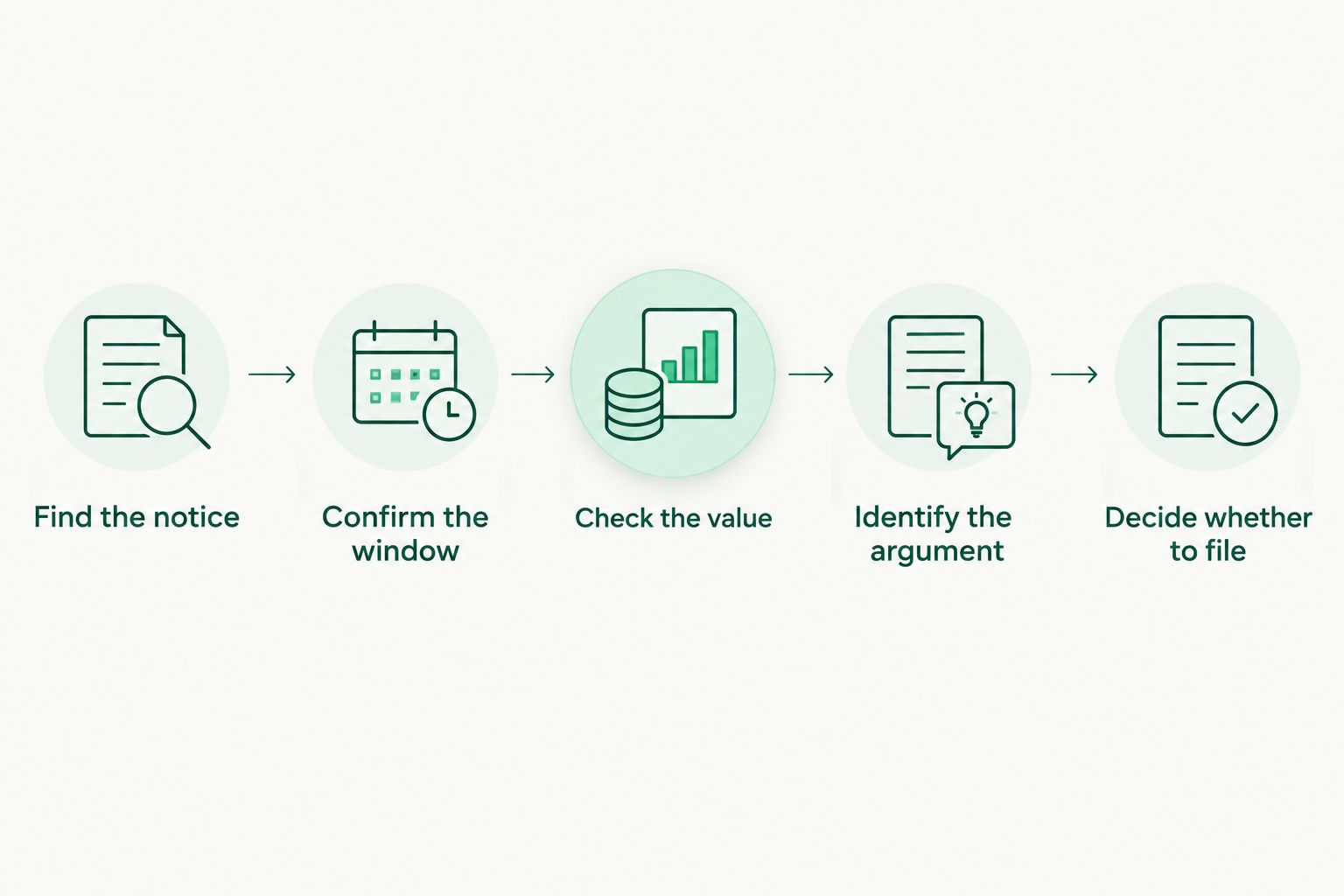
Check the current notice and your evidence before deciding to file.
A repeat filing needs a current reason to challenge the value. Reusing last year’s materials without checking the new assessment risks addressing the wrong notice, deadline or valuation question. Keep your prior decision for reference, then build your 2026 case around the current assessment.
Why does the chance to appeal vary?
- The assessment cycle differs. Maryland reassesses one-third of the state each year, so only about a third of owners have a live reassessment appeal window in a given season.
- The filing window differs. Texas uses a May 15 protest deadline; California’s appeal deadline varies by county. Georgia and Florida use windows tied to their notices.
- The office differs. Texas owners work with an Appraisal District. New Jersey’s municipal Assessor sets the value, but the County Board of Taxation hears the appeal. Maryland uses SDAT or a Supervisor of Assessments.
- The evidence rules differ. Comparable assessments are inadmissible in New Jersey; sales are the relevant comparison. An unequal-appraisal argument available in Texas and Georgia does not transfer to every state.
- The downside differs. A New Jersey appeal can raise the assessment under the Chapter 123 ratio test. New Jersey also charges a nonrefundable filing fee up front.
- Your current evidence differs. A past reduction does not establish what your property should be assessed at in 2026. Review the current value against evidence relevant to this filing.
The practical rule: treat every notice as a new decision, not an automatic renewal of last year’s appeal. That keeps you focused on the value, deadline and rules that apply now.
Can you file again if last year’s appeal failed?
Yes, a previous loss does not by itself answer whether you should challenge a later assessment. Check that you have a current filing opportunity and evidence addressing the current value. Repeating an unsupported argument gives the reviewer no new reason to change your assessment.
If you still have the prior decision, read why the earlier challenge failed. Then compare that reasoning with the new notice and your current sales evidence. Your next step is to file only when the present assessment and applicable rules support a challenge.
Do you need a new notice to appeal in 2026?
Your 2026 notice is the clearest place to start, but the filing rules depend on your state. In Georgia and Florida, the stated filing windows run from the notice. Maryland also identifies a January 1 off-cycle filing date, separate from the window following a reassessment notice.
Do not assume that silence from your county means you can use an old notice or that you have missed every possible route. Check the current instructions from the office responsible for your property. In Maryland, confirm whether your property is in the current reassessment group before planning an appeal around a reassessment notice.
Should you appeal every year just in case?
No. Review your assessment every year; file when the current value, evidence and state rules justify it. That distinction matters most in New Jersey, where the Chapter 123 ratio test can produce an increase rather than a reduction.
New Jersey’s test compares the assessed value with market value using the applicable common-level range. If the ratio falls below that range, the County Board of Taxation is required to increase the assessment. Check that risk before filing, and remember that the state charges a nonrefundable filing fee even if your appeal fails.
For a Texas property, ask a different question: does the 2026 Notice of Appraised Value give you a value you can challenge with current evidence before the protest deadline? For a California property, check your county’s appeal window instead of borrowing the Texas date. Your location determines the process.
Where does TaxDrop fit?
TaxDrop is best for Texas owners who want a licensed consultant to handle a property tax protest; its self-serve packet fits eligible owners who prefer to prepare their own filing. Its full-service option covers 17 Texas counties and charges a fee only when it reduces the assessment. Its self-serve option covers listed counties in Texas, California and Georgia, plus Florida, New Jersey and Maryland statewide.
The trade-off is who handles the filing. Full-service does more of the work for an eligible Texas owner but is not offered outside Texas. Self-serve gives you an appeal packet, but you remain responsible for checking your notice, following the correct state procedure and filing on time. Neither option makes a weak assessment challenge strong.
TaxDrop’s savings estimate takes under 2 minutes. Use it as a starting point, not as a substitute for reading your notice or checking New Jersey’s risk of an increased assessment. Check your assessment before you decide whether to file.
Check your assessment
Review your property before deciding whether to file.
FAQ
Can you appeal property taxes every year in 2026?
You can challenge a current assessment when your state’s rules give you a filing opportunity and you meet the deadline. A previous appeal does not automatically cover the 2026 assessment.
Can I appeal again after winning last year?
Yes, a prior win does not prevent you from reviewing a later assessment. Check the new value and filing instructions before deciding whether another challenge has support.
Can I appeal again after losing last year?
Yes, a prior loss does not by itself settle a later assessment. Use current evidence and address the reason your earlier challenge failed.
Do I have to file a Texas property tax protest every year?
File a Texas protest when your current Notice of Appraised Value supports a challenge and you meet the filing deadline. Review each notice rather than treating a previous protest as an automatic annual filing.
Can every Maryland homeowner appeal each year?
Maryland reassesses one-third of properties each year, so only about a third of owners have a live reassessment appeal window in a given season. Check your reassessment status and the rules for any off-cycle filing.
Can a New Jersey property tax appeal raise my assessment?
Yes, a New Jersey appeal can raise your assessment under the Chapter 123 ratio test. Check the applicable common-level range and your sales evidence before filing with the County Board of Taxation.
Is a property tax assessment appeal the same in every state?
No. Texas uses protests through Appraisal Districts, while the other states covered here use their own appeal or petition processes. Deadlines, hearing offices and acceptable arguments differ.
One last thing
Make the annual habit a review, not a filing. Put the current notice beside your prior decision and ask what changed in the value, the evidence and the deadline. In 2026, that check protects you from missing a valid opportunity and from filing a case that does not serve you.
Related guides
Paying Too Much in Property Taxes?
Let our licensed property tax experts assess your tax bill for potential savings. Over 80% of protests get a reduction of more than $1,000 and it takes less than 3 minutes to enroll.
⏰
🏠
💵
No Savings No Fee
FAQs
Can I appeal my property taxes without a lawyer?
Yes. Homeowners can generally file their own appeal with the office or board that handles appeals in their state. Start with your assessment notice, the deadline and the evidence rules.
What is the Texas deadline to protest my property taxes?
The post lists May 15 as the Texas deadline to check. Verify it against your Notice of Appraised Value, since that notice is what controls.
Can appealing my New Jersey assessment make it go up?
Yes. Under the Chapter 123 ratio test, the county board must increase an assessment that falls below the common level range. Check the ratio before you file.
Does a self-serve packet file the appeal for me?
No. TaxDrop One is a self-serve appeal packet, not full-service representation. You stay responsible for filing and following the local process.
Do I need a lawyer if my property is a rental?
Owning a rental does not by itself make a lawyer necessary. What matters is who legally owns the property and who is allowed to sign or appear under local rules.

Ryder Meehan
Ryder Meehan is the Co-Founder of TaxDrop and a Licensed Property Tax Protest Consultant