

Key Takeaways:
A Closing Disclosure — the five-page form you signed at your home purchase closing — can be some of the strongest evidence in a property tax appeal, because it shows a real, negotiated sale price instead of a county's mass-appraisal guess. Turn it into appeal evidence in four moves: pull the sale price and closing date, match those numbers against your assessed value, strip out anything unrelated to the sale, and attach it to your protest or appeal before the deadline.
TL;DR
- A closing disclosure property tax appeal uses your Sale Price field as direct proof of market value, not a computer estimate.
- Works in Texas, California, Georgia, Florida, New Jersey, and Maryland in 2026, but each state files it under a different name.
- Sale must be arm's-length and close to your assessment date, or assessors discard it before reading further.
- New Jersey only accepts sale comparables, never assessment comparables — this document fits that rule exactly.
- Roughly 30-60% of properties are over-assessed nationally, yet only about 5% of owners ever appeal.
Why This Matters
A county assessor's office values your home with a mass-appraisal model built from public records and neighborhood averages, then mails you one number a year. That model rarely knows what you actually paid for the house last month.
Your Closing Disclosure ties a real, negotiated price to a real date. TaxDrop's licensed consultants use this exact match when building a protest case for Texas homeowners, because a fresh purchase price is harder for a county to argue against than a market estimate. Nationally, 30-60% of properties are over-assessed, yet only about 5% of owners ever file — most people assume they have no evidence beyond a hunch that the bill looks high.
A closing disclosure property tax appeal works because it replaces a guess with a fact: what a buyer and seller actually agreed the property was worth. In Texas, where informal protests carrying this kind of evidence win 80-90% of the time, a recent purchase price is one of the fastest ways to close a case.
Before You Start
- Your Closing Disclosure. Ask your closing agent, lender, or title company for a copy if your own file is missing it.
- Your county's current assessment or appraisal notice, so you can put both documents side by side.
- The gotcha: counties only count arm's-length sales — a sale between unrelated buyer and seller at market terms. A sale to a relative, a foreclosure, or a distressed sale gets thrown out before anyone reads the rest of your packet.
Locate the Sale Price and Closing Date
- Open your Closing Disclosure to page 1 and find the Transaction Information box. Locate the Sale Price line inside it.
- In the Closing Information box on the same page, note the Closing Date.
- Write both figures down alongside the property address printed at the top of the form.
Expected result: you now have two hard numbers — what you paid, and when you paid it.
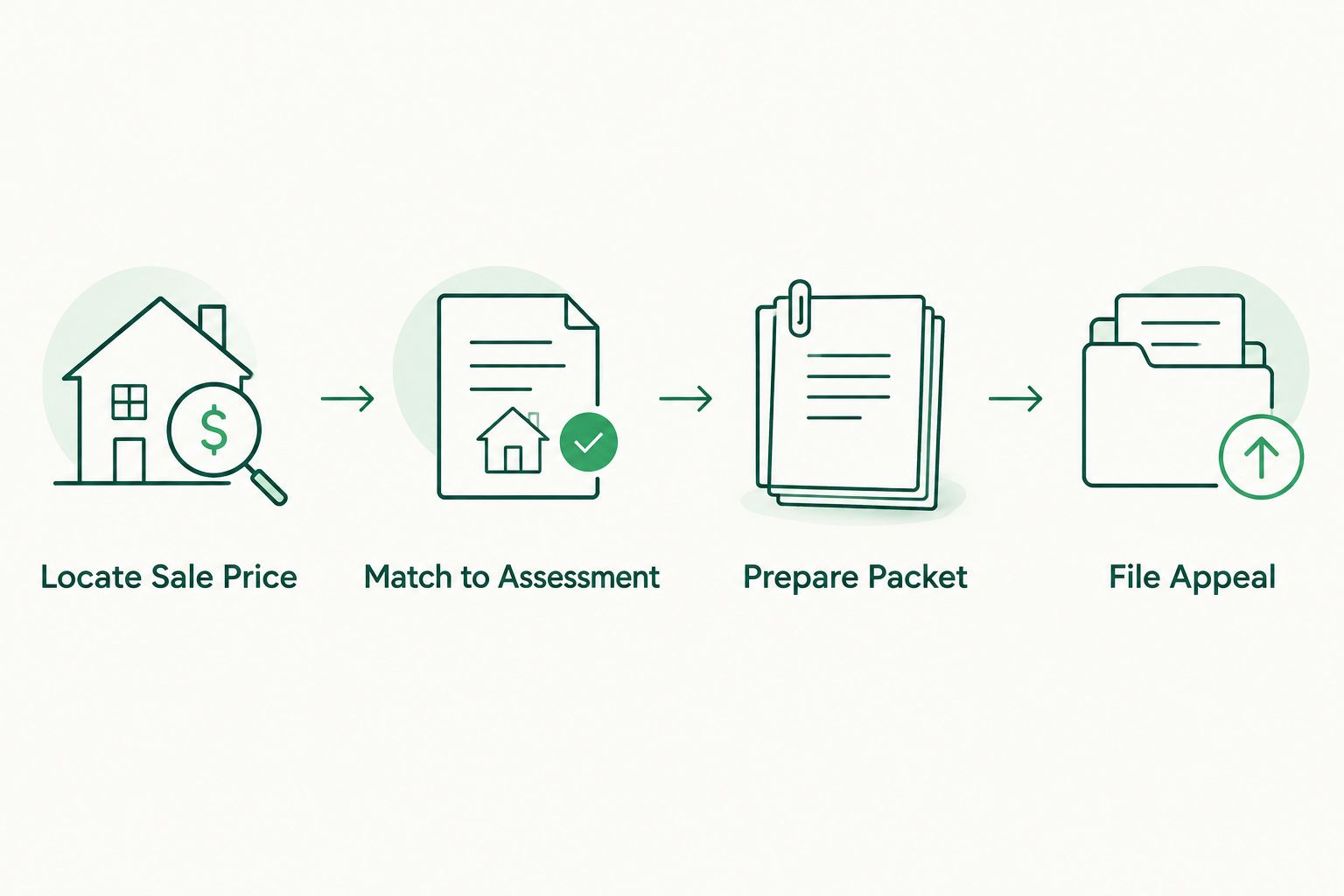
Each step feeds the next — skip the match step and the packet has no argument attached to it.
Match the Sale to Your Assessment
- Pull your current assessed value from your county notice. It's called a Notice of Appraised Value in Texas, an Assessment Notice in California, an Annual Notice of Assessment in Georgia, a TRIM notice in Florida, and a reassessment notice in Maryland.
- Subtract your Sale Price from that assessed value. If the assessed value is higher, that gap is your case.
- Check the calendar. Most counties want a sale within roughly a year of the assessment date — the closer the closing date sits to the valuation date, the harder it is for an assessor to call the price stale.
Expected result: a specific dollar gap and a closing date close enough to hold up.
Texas
- You'll File a(n): Protest
- Filed With: Appraisal District (CAD)
- How a Closing Disclosure Performs: Strong — pairs well with market and unequal-appraisal evidence.
California
- You'll File a(n): Appeal
- Filed With: Assessor's Office
- How a Closing Disclosure Performs: Strong — direct proof of market value.
Georgia
- You'll File a(n): Appeal
- Filed With: Board of Tax Assessors
- How a Closing Disclosure Performs: Strong — accepted alongside comparable sales.
Florida
- You'll File a(n): Appeal / Petition
- Filed With: Property Appraiser, heard by the VAB
- How a Closing Disclosure Performs: Strong, especially near the TRIM notice date.
New Jersey
- You'll File a(n): Appeal
- Filed With: County Board of Taxation
- How a Closing Disclosure Performs: Strong, but it's the only sale evidence allowed — no assessment comparables.
Maryland
- You'll File a(n): Appeal
- Filed With: SDAT / Supervisor of Assessments
- How a Closing Disclosure Performs: Works, but only inside your county's reassessment cycle.
Prepare and Submit the Evidence Packet
- Copy just the pages showing Sale Price, Closing Date, and the property address. Leave out loan terms, monthly payment projections, and other financial details that have nothing to do with value.
- Write a one-page cover note stating the sale was arm's-length, the closing date, and the price, then attach the excerpt.
- File it through your county's appeal or protest portal, or mail it with your paper form before the deadline: May 15 in Texas, varies by county in California, about 45 days from your notice in Georgia, about 25 days from your TRIM notice in Florida, April 1 in most of New Jersey (January 15 in Burlington, Gloucester, and Monmouth counties), and about 45 days from your reassessment notice in Maryland.
Expected result: a filed protest or appeal with your purchase price attached as your lead exhibit. TaxDrop's flat-fee self-serve appeal packet has a slot built for exactly this document, so you're not formatting a cover sheet from scratch.
Check your assessment before you file
See if your county's number is out of line with what you actually paid.
No Recent Purchase? Use a Refinance Appraisal Instead
If you haven't bought the property recently but refinanced in the past year or two, the appraisal your lender ordered for that refinance carries similar weight. It's a licensed appraiser's opinion of value tied to a specific date, and it works the same way in an appeal packet. The refinance appraisal property tax evidence workflow walks through pulling the right pages out of that report.
Troubleshooting
- The assessor rejects the sale as "not arm's-length." Family sales, foreclosures, short sales, and sales between business partners get excluded almost everywhere. Confirm your sale doesn't fall into one of those categories before you file.
- The closing happened more than a year before the valuation date. A stale price weakens the argument on its own. Pair it with recent comparable sales pulled from public records instead of leaning on the Closing Disclosure alone.
- You bought in New Jersey and worry about the filing backfiring. New Jersey decides appeals on the Chapter 123 ratio test, not raw market value, and accepts sale comparables only — never assessment comparables. Filing without checking the ratio first can push an assessment up instead of down.
- The sale price includes personal property. Furniture, a boat, or included appliances baked into the price inflate it above the real real-estate value. Back those items out before you use the number as evidence.
- You gathered the paperwork and missed the deadline. Deadlines run from your notice date, not from when you finish assembling evidence — set a calendar reminder the day the notice arrives.
Customize This Workflow
Once your protest or appeal is filed, the work isn't over. The filing to refund case tracking workflow covers what to expect between filing and the refund landing in your account, county by county. TaxDrop tracks your county's deadline automatically once your appeal is filed, so nothing slips between the filing date and the hearing.
Layer in other evidence types as they come up — a homestead exemption you haven't claimed yet, a second rental property with its own notice, or a refinance appraisal for a property you didn't recently buy. Each one strengthens the same case file rather than replacing it.
FAQ
What is a Closing Disclosure and why does it matter for a property tax appeal?
A Closing Disclosure is the five-page federal form you sign at a home purchase closing, listing the Sale Price and Closing Date. Those two fields work as direct proof of market value in a closing disclosure property tax appeal, which is harder for a county to dismiss than an online estimate.
Can I use a Closing Disclosure as evidence in a property tax protest in Texas?
Yes. Texas appraisal districts accept a recent, arm's-length Sale Price as protest evidence, and it pairs well with unequal-appraisal comparisons. File it with your county's CAD before the May 15 deadline.
Does a Closing Disclosure work as evidence in a California property tax appeal?
Yes, California assessor's offices accept a recent purchase price as direct market evidence in an appeal. Deadlines vary by county, so check your specific Assessment Notice.
How recent does the sale need to be to use it as evidence?
Most counties want the closing date within roughly a year of the assessment's valuation date. A sale older than that still helps, but pair it with current comparable sales to close the gap.
Can a Closing Disclosure raise my assessment instead of lowering it in New Jersey?
It can if you file without checking New Jersey's Chapter 123 ratio test first. New Jersey compares your sale price to the common level range, and a county board is required by statute to raise assessments that fall below it.
What if I don't have a Closing Disclosure because I didn't recently buy the property?
Use a refinance appraisal instead if you've refinanced in the past year or two — it's a licensed appraiser's opinion of value tied to a specific date and works the same way in a packet.
Is a Closing Disclosure better evidence than a Zillow-style estimate?
Yes. A Closing Disclosure documents an actual negotiated transaction between a real buyer and seller, while an automated estimate is a model's guess with no legal weight in a hearing.
What's the deadline to file a property tax appeal using this evidence?
Deadlines are set by your notice, not by how long it takes to gather documents: May 15 in Texas, county-specific in California, about 45 days from notice in Georgia, about 25 days from the TRIM notice in Florida, April 1 in most of New Jersey (January 15 in three counties), and about 45 days from notice in Maryland.
One Last Thing
Most homeowners treat a Closing Disclosure as a file to shred once the mortgage funds. Keep it. In 2026, it's one of the few documents that can undo a county's mass-appraisal guess with a single real number, and since you already have it, submitting it costs nothing extra.
Related Guides
Paying Too Much in Property Taxes?
Let our licensed property tax experts assess your tax bill for potential savings. Over 80% of protests get a reduction of more than $1,000 and it takes less than 3 minutes to enroll.
⏰
🏠
💵
No Savings No Fee