Key Takeaways:
Property tax rates vary more within the United States than almost any other cost of homeownership. The average effective property tax rate across the country runs about 0.90% of a home's market value, but that number hides a huge spread — from 0.27% in Hawaii to 2.23% in New Jersey. If you own property in Texas, California, Georgia, Florida, New Jersey, or Maryland, your state's rate tells you almost nothing about whether your individual assessment is fair. TaxDrop exists because the rate is fixed by your state, but the assessed value your tax is calculated on is not — and that's the number worth fighting.
TL;DR
- The average property tax rate by state ranges from 0.27% in Hawaii to 2.23% in New Jersey, against a national average near 0.90%.
- Texas homeowners face the highest rate among TaxDrop's six served states at roughly 1.60%; California sits lowest at roughly 0.75%.
- A low state rate does not mean a low bill — 30 to 60% of properties nationwide are over-assessed regardless of the rate applied to them.
- Only about 5% of eligible owners appeal each year, leaving most over-assessments uncorrected.
Why this matters
Your tax bill is two numbers multiplied together: the rate your state or county sets, and the assessed value your county or state puts on your property. Homeowners obsess over the rate because it's public and printed on every notice. The assessed value is the number that's actually negotiable, and it's the one most owners never check.
A property in a 0.75% state with an assessment that's 20% too high pays more than it should, even though the rate looks low on paper. A property in a 1.60% state with an accurate assessment is paying exactly what it owes. Rate comparisons make headlines. Assessment accuracy is what actually moves your bill in 2026.
Average property tax rate by state (2026)
Effective rate is the actual annual tax bill divided by the home's market value — the only way to compare states fairly, since assessment methods differ everywhere. The table below anchors on the national average, then shows where TaxDrop's six served states land relative to it.
National average
- Effective property tax rate: 0.90%
- Where it stands: Yardstick
Hawaii
- Effective property tax rate: 0.27%
- Where it stands: Lowest in the country
California
- Effective property tax rate: 0.75%
- Where it stands: Below average
Florida
- Effective property tax rate: 0.86%
- Where it stands: Near average
Georgia
- Effective property tax rate: 0.87%
- Where it stands: Near average
Maryland
- Effective property tax rate: 1.05%
- Where it stands: Above average
Texas
- Effective property tax rate: 1.60%
- Where it stands: Well above average
New Jersey
- Effective property tax rate: 2.23%
- Where it stands: Highest in the country
New Jersey leads the country at 2.23%; Hawaii trails at 0.27% — an owner in New Jersey pays roughly eight times the rate of an owner in Hawaii on an identically valued home. Among the six states TaxDrop serves, Texas carries the heaviest rate at roughly 1.60%, more than double California's 0.75%. If you're filing in Texas, the Houston protest companies comparison shows how local firms handle that higher-rate environment.
Maryland sits closest to the national average of any TaxDrop state at roughly 1.05%. Florida and Georgia both cluster just below the national line, in the 0.86% to 0.87% range — close enough that assessment accuracy, not the rate itself, decides who overpays.
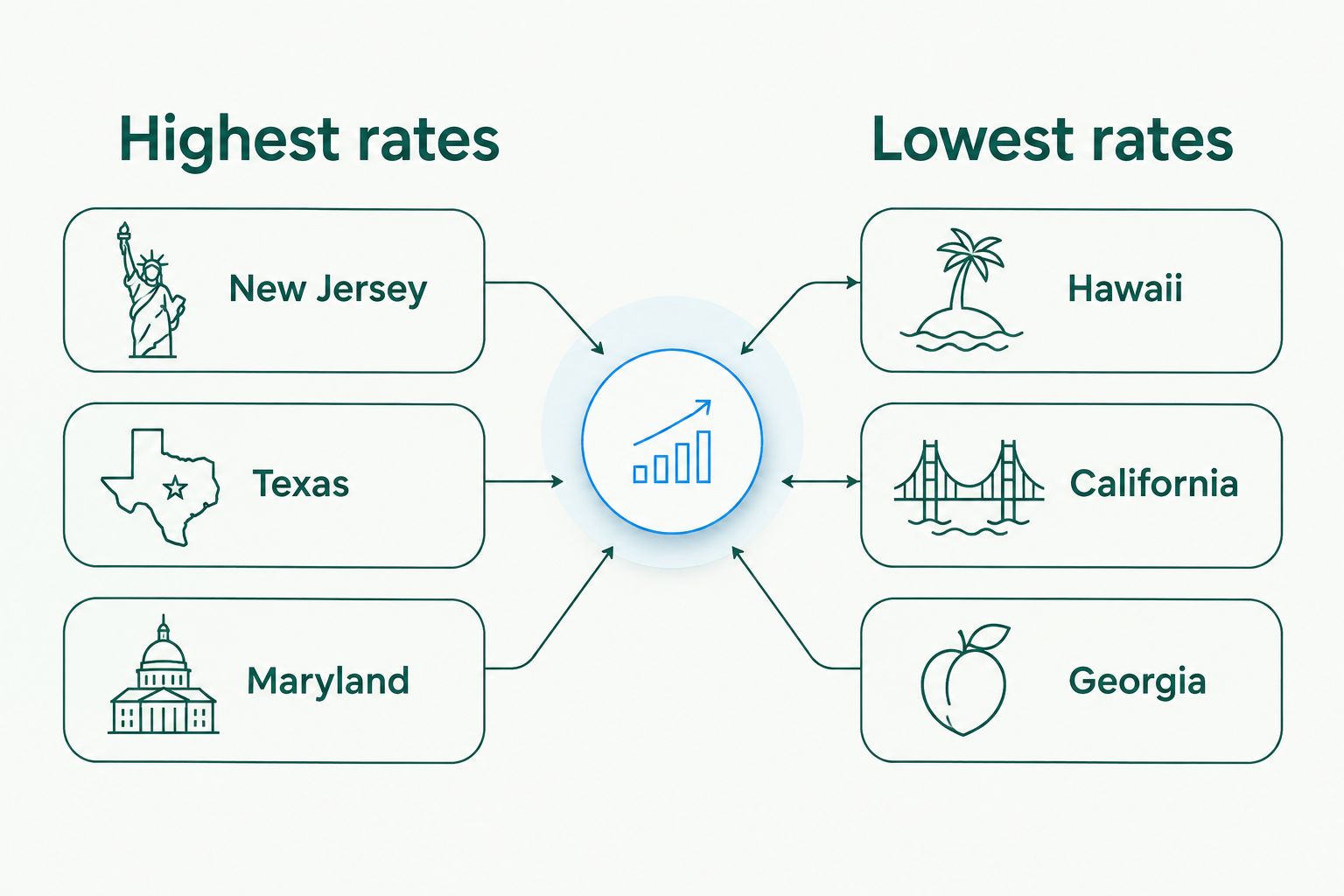
Texas and Maryland sit on the high side of TaxDrop's served states; California and Georgia sit on the low side.
Methodology and limitations
These effective rates are compiled from Census Bureau American Community Survey data on owner-occupied homes, the standard public source used for cross-state property tax comparison. ACS estimates typically run one to two years behind the current tax year, so a state's rate can shift slightly by the time your 2026 notice arrives — treat this table as a directional benchmark, not your exact county rate. It also averages every county in a state into one number, which flattens real variation: a Texas homeowner in a low-rate county can pay well under 1.60%, and one in a high-rate county can pay well over it.
How to use these benchmarks
- Don't judge your bill by your state's rate alone. A below-average state rate with an inflated assessment still costs you money every year.
- Check your assessed value first, not the rate. Between 30% and 60% of properties nationwide are over-assessed, and the rate applied to that inflated number compounds the problem.
- If you're in a high-rate state, the payoff from a correct assessment is bigger. A 1% reduction in assessed value in Texas or New Jersey saves more dollars than the same percentage cut in Hawaii or California, simply because the rate multiplying it is higher.
- Match your action to your state's process. Texas calls it a protest, filed with your county appraisal district by May 15. California, Georgia, Florida, New Jersey, and Maryland all call it an appeal, filed with the assessor's office, Board of Tax Assessors, Property Appraiser, County Board of Taxation, or SDAT respectively — and each runs on a different clock.
Only about 5% of eligible owners file an appeal or protest in a given year, even though the over-assessment rate is many times higher than that. That gap between who's overpaying and who's actually pushing back is where most of the wasted tax dollars sit.
Check your assessment against your state
Free 2-minute analysis, no fee unless your assessment goes down.
FAQ
What is the average property tax rate by state in 2026?
The national average effective property tax rate is about 0.90% of a home's market value in 2026. Rates by state range from 0.27% in Hawaii to 2.23% in New Jersey.
Which state has the highest property tax rate?
New Jersey has the highest effective property tax rate in the country at roughly 2.23%. Illinois follows closely, with several other Northeastern and Midwestern states above the 1.5% mark.
Which state has the lowest property tax rate?
Hawaii has the lowest effective property tax rate at roughly 0.27%. Its home values are high enough that the low rate still generates meaningful revenue for the state.
Is Texas a high property tax state?
Yes. Texas runs an effective rate near 1.60%, well above the 0.90% national average, because the state has no income tax and relies more heavily on property tax revenue.
Does a low state tax rate mean a low tax bill?
No. Your bill is the rate multiplied by your assessed value, and 30% to 60% of properties nationwide are over-assessed regardless of the state's rate. A low-rate state with an inflated assessment can still cost you more than it should.
How is a state's property tax rate calculated?
Effective rate is the total annual property tax bill divided by the home's market value, averaged across owner-occupied homes in that state using Census Bureau data. It differs from the nominal or statutory rate, which can look very different on paper.
Do property tax rates vary by county within a state?
Yes, significantly. State averages in this table can mask a full percentage point of difference between counties, especially in large states like Texas, California, and Florida.
How often do property assessments change?
It depends on the state. Maryland reassesses about one third of the state each year, so only roughly a third of Maryland owners have a live appeal window in any given season, while other states like Georgia and Florida reassess annually statewide.
One last thing
Maryland is the outlier in how it schedules reassessments: SDAT only reassesses about one third of the state each year, which means roughly two-thirds of Maryland owners have no active appeal window in a given cycle at all. If you own in Maryland, the first move isn't comparing your rate to the 1.05% average — it's confirming whether 2026 is even your reassessment year before you plan around a filing deadline that doesn't apply to you yet.
Related guides
Paying Too Much in Property Taxes?
Let our licensed property tax experts assess your tax bill for potential savings. Over 80% of protests get a reduction of more than $1,000 and it takes less than 3 minutes to enroll.
⏰
🏠
💵
No Savings No Fee