

Key Takeaways:
Manually checking assessment notices for every rental property creates missed deadlines and inconsistent evidence. In 2026, build a bulk property tax appeal rental portfolio workflow from one rent roll so every eligible property moves from notice to filing on a tracked schedule.
TL;DR
- A bulk property tax appeal rental portfolio workflow starts with one rent roll sorted by state, county, and deadline.
- TaxDrop property tax appeal options split between Texas full-service representation and wider self-serve coverage.
- 30-60% of properties are over-assessed, but only about 5% of owners appeal.
- New Jersey filings require a Chapter 123 ratio check because an appeal can raise the assessment.
- Use 2026 state-specific deadlines and evidence rules instead of applying one process across the portfolio.
Why this matters
A landlord with properties in several counties does not have one appeal deadline. Each county follows its state calendar, issues its own notice, and requires evidence tied to an individual parcel.
The guide to property tax appeals for landlords with multiple rentals explains the portfolio-level opportunity. The workflow below turns that opportunity into a repeatable 2026 filing process.
Between 30-60% of properties are over-assessed, while only about 5% of owners appeal. For a rental portfolio, that gap means an unchecked assessment can remain embedded in the operating costs for each property.
A rent roll already identifies the properties you manage. Add assessment, deadline, evidence, and status fields, and it becomes the control sheet for the entire appeal cycle.
Before you start
- Export the current rent roll. Include the property address, unit or parcel identifier, acquisition date, and ownership entity. Keep one row per tax parcel, not one row per tenant or lease.
- Collect the 2026 assessment notice for each property. Texas uses a Notice of Appraised Value. California uses an Assessment Notice. Georgia uses an Annual Notice of Assessment. Florida uses a TRIM notice. Maryland uses an SDAT reassessment notice.
- Confirm filing authority. The owner name on the appeal must match the county or state record, or an authorized representative must have the required authorization document.
- Pre-empt the deadline problem. Use the date printed on the notice and the rule for that jurisdiction. Do not calculate the deadline from the day the envelope reached you or your property manager.
The non-obvious issue is parcel count. A building with several rental units may have one parcel or several separately assessed parcels. Your filing roster must follow the assessor’s parcel structure, not the number of leases in your property management system.
Build the master appeal roster
Create one workbook for the 2026 cycle. Use a main roster for portfolio status and a separate evidence folder for each parcel.
- Add the fields Property Address, Parcel ID, State, County, Ownership Entity, and Notice Date.
- Add Current Assessment, Prior Assessment, and Assessment Change. The assessed value is the value the taxing authority assigned to the property; it is not the tax bill itself.
- Add Appeal Deadline, Evidence Status, Filing Status, and Confirmation Number.
- Add Acquisition Date and Recent Appraisal so recent transactions and refinance documents are visible before evidence review.
- Set Filing Status to one of four values: Review, Ready, Filed, or Closed. Do not track status through cell colors alone.
- Save every notice using the same naming pattern: parcel ID, county, and tax year. This keeps notices attached to the right property when street formats differ between systems.
Expected result: every assessed parcel has one row, one 2026 deadline, and one filing status. You can filter the portfolio without opening individual county portals.
Configure state and county deadlines
Sort the roster by Appeal Deadline, then by County. The deadline decides what gets handled first; the county grouping decides which filings can share research and administrative work.
Use these state rules as the first filter:
- Texas: file a protest with the Appraisal District by May 15 or 30 days after the Notice of Appraised Value was delivered, whichever applies under the notice.
- California: file an appeal with the local appeals board during the county’s filing period. The deadline varies by county, so copy the date from the county instructions.
- Georgia: file an appeal with the Board of Tax Assessors, generally within 45 days of the Annual Notice of Assessment.
- Florida: file a petition for the Value Adjustment Board after the Property Appraiser issues the TRIM notice. The window is generally about 25 days from the notice.
- New Jersey: file with the County Board of Taxation. April 1 is not a statewide rule for every county; Burlington, Gloucester, and Monmouth use January 15.
- Maryland: file with SDAT or the Supervisor of Assessments, generally within 45 days of the reassessment notice. Maryland reassesses one third of the state each year.
Add the exact 2026 deadline for each property rather than storing only the state rule. County instructions and the property’s notice control the filing calendar.
New Jersey requires another gate. Check the municipality’s Chapter 123 ratio and common level range before marking the property Ready. If the assessment falls below the permitted range, the County Board of Taxation is required by statute to increase it. New Jersey also charges a non-refundable filing fee, unlike the other states TaxDrop serves.
Expected result: the roster shows a dated queue of eligible properties, with New Jersey parcels held for ratio review and Maryland parcels limited to the active reassessment cycle.
Match evidence to each property
Do not attach one generic report to every rental. Each parcel needs evidence that supports its own requested value and follows the state’s admissibility rules.
- Texas: use relevant closed sales and an unequal-appraisal analysis when supported. Unequal appraisal compares your property’s assessment with similarly situated properties.
- Georgia: use relevant sales and, when supported, an assessment-uniformity argument. Georgia and Texas are the two served states where this equity argument applies.
- California: use relevant closed sales and property-specific facts. Do not import a Texas unequal-appraisal argument.
- Florida: use sales and property records that support the value presented to the Value Adjustment Board.
- New Jersey: use comparable sales. Comparable assessments are inadmissible, and the Chapter 123 ratio controls the result.
- Maryland: use relevant sales and property facts in the SDAT appeal. Maryland is state-assessed; there is no county assessor or appraisal district.
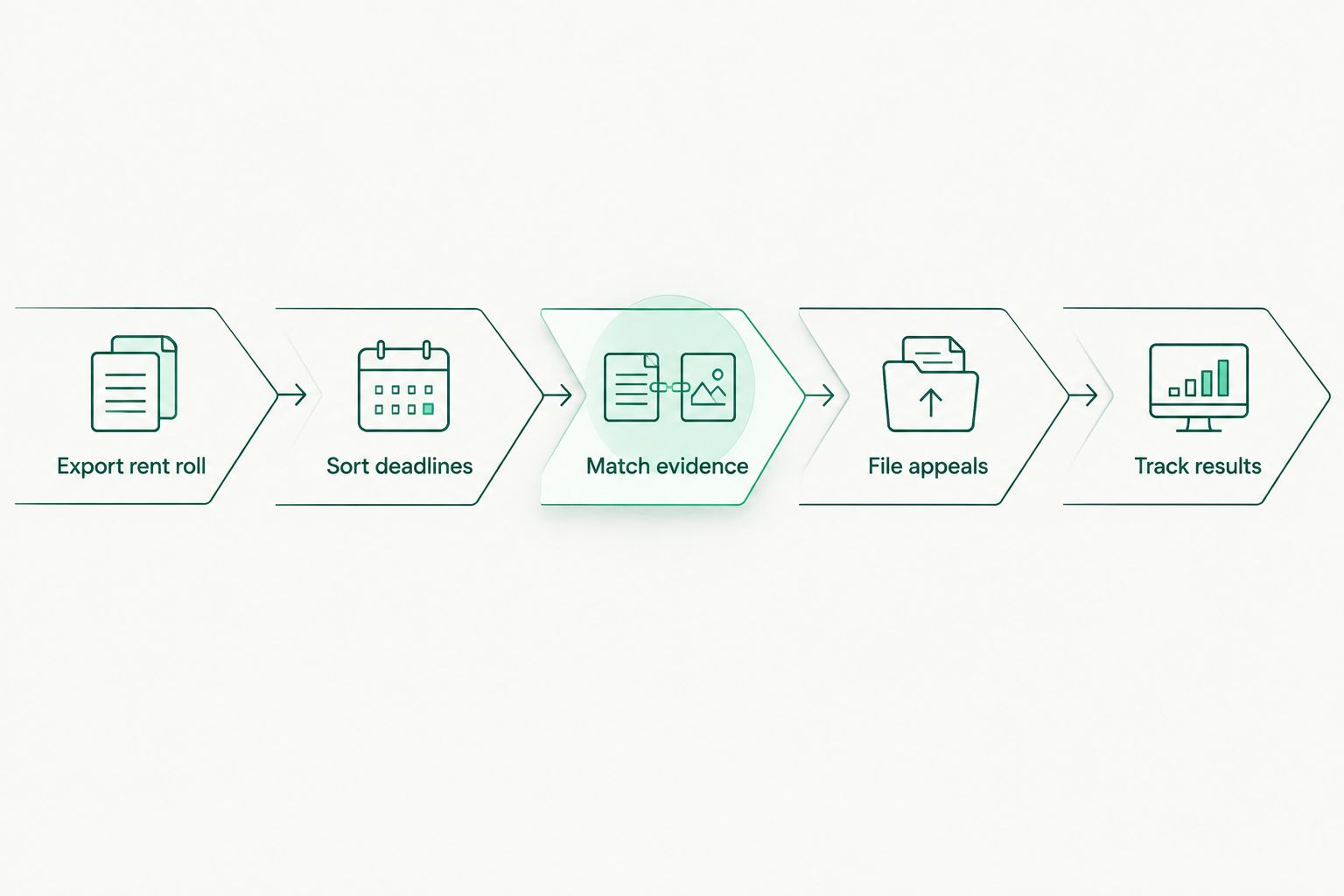
Every parcel follows the same tracked process, while deadlines and evidence change by state.
Process evidence in county groups, but verify the final comparable set for each parcel. Nearby rentals may share candidate sales, yet differences in property type, condition, size, or sale date can make a comparable unsuitable for a specific appeal.
- Set Evidence Status to Missing, Reviewing, or Complete.
- Attach the notice, property record, selected sales, and any recent purchase or refinance appraisal to the parcel folder.
- Record the requested assessed value and the evidence supporting it.
- Move the row to Ready only after the deadline, filing authority, and evidence have been checked.
Expected result: each ready property has a complete, state-appropriate evidence packet and a documented requested value.
Choose the filing path
TaxDrop offers two adjacent workflows. The right option depends on location and whether you want representation or a self-serve packet.
TaxDrop full-service property tax protest
- Best for: Texas landlords with properties in the 17 full-service counties
- What it handles: Licensed-consultant-led protest and representation; no fee unless the assessment is reduced
- Limitation: Full-service coverage is Texas only
TaxDrop One self-serve appeal packet
- Best for: Landlords filing across covered areas in Texas, California, Georgia, Florida, New Jersey, or Maryland
- What it handles: Property-specific analysis and a self-serve filing packet
- Limitation: You remain responsible for submitting the appeal and following local instructions
Full-service coverage includes 17 Texas counties. TaxDrop One covers 43 Texas counties, 6 California counties, 4 Georgia counties, and statewide service in Florida, New Jersey, and Maryland.
The benefit of full-service is that the Texas protest and hearing are handled for you. The trade-off is limited geography. The benefit of self-serve is wider coverage; the trade-off is that filing and deadline control stay with you.
TaxDrop’s full-service property tax protest is best for Texas landlords who want representation, while TaxDrop One is best for landlords who need a self-serve appeal packet across several states.
- Filter the roster by State and County.
- Assign Full-Service or Self-Serve in a new Filing Path field.
- Submit properties in deadline order, not portfolio-value order.
- Save the filing receipt or confirmation number in the roster immediately.
- Set Filing Status to Filed only when a confirmation exists.
Expected result: every eligible property has a filing path, submission record, and confirmation number.
Check your rental properties
Get a free instant analysis in under 2 minutes per property.
Trigger a review when a notice arrives
The second workflow starts with the assessment notice instead of a scheduled portfolio review. Use it when notices arrive on different dates or go to several property managers.
- Create one shared intake address or document folder for assessment notices.
- Require the person receiving a notice to record Received Date, Notice Date, State, County, and Parcel ID.
- Match the parcel ID against the master roster. Address matching alone fails when county records abbreviate street names differently.
- Calculate the appeal deadline from the state and county rule, then enter the exact date in Appeal Deadline.
- Set Filing Status to Review and assign the evidence task.
- Escalate any notice whose parcel ID does not match the roster. It may reflect a new parcel, ownership change, or data-entry error.
For Texas, this trigger starts a protest review. In California, Georgia, Florida, New Jersey, and Maryland, it starts an appeal or petition review using that state’s terminology.
Expected result: every new notice creates a dated review task instead of sitting in a mailbox until the portfolio’s next scheduled check.
Troubleshooting
The rent roll has no parcel IDs
Search the county or state property record by owner and address, then add the official parcel identifier to the roster. Do this before filing because addresses change format more often than parcel IDs.
One building has several parcel IDs
Create one row for each assessed parcel. Copy shared management details across the rows, but keep notices, evidence, requested values, and confirmations separate.
The ownership name does not match
Check whether the property record lists an individual, LLC, partnership, or trust. Use the recorded owner as the filing party and complete any required representative authorization before submission.
A refinance appraisal is available
Add it to Recent Appraisal and compare its effective date and property condition with the assessment date. A refinance appraisal is evidence to review, not an automatic replacement for state-specific sales or ratio rules.
A New Jersey appeal appears likely to increase the assessment
Move the property to Closed with the reason Chapter 123 Increase Risk. Do not include it in the bulk filing simply because other properties in the portfolio are being appealed.
Customize your workflow
Add three controls after the first filing cycle:
- Hearing Date for Texas protests and any appeal that advances to a hearing.
- Decision Date and Final Assessment for the result.
- Refund or Escrow Status so a successful reduction does not disappear after the decision notice.
The filing-to-refund case tracking workflow covers the next stage. Keep the original assessment, requested value, final assessment, and decision document attached to the same parcel row for the full 2026 cycle.
FAQ
What is a bulk property tax appeal rental portfolio workflow?
It is a process that converts a rent roll into a parcel-level tracker for assessment notices, deadlines, evidence, filings, and results. Each property keeps its own record while county-level tasks are handled in batches.
Can landlords submit several property tax appeals at once?
Landlords can prepare and manage appeals in county batches, but each assessed parcel still needs its own eligibility review, evidence, requested value, and filing confirmation. County procedures determine how submissions are delivered.
Which deadline should a multi-state landlord use in 2026?
Use the exact 2026 deadline for each property’s state, county, and notice. There is no single national property tax appeal deadline for a rental portfolio.
Can TaxDrop handle every appeal for a multi-state rental portfolio?
TaxDrop provides full-service representation only in 17 Texas counties. Its self-serve option covers specified counties in Texas, California, and Georgia, plus statewide service in Florida, New Jersey, and Maryland.
Can a New Jersey property tax appeal raise the assessment?
Yes. A New Jersey appeal can raise the assessment when the Chapter 123 ratio places the current assessment below the common level range. Check the ratio before filing.
What evidence works for a rental property tax appeal?
Relevant closed sales and accurate property records are the core evidence across the served states. Texas and Georgia also permit equity-based arguments, while New Jersey accepts sales rather than comparable assessments.
How should landlords track property tax appeal status?
Use parcel-level fields for review, evidence, filing, confirmation, hearing, decision, and final assessment. Mark a property filed only after saving a submission receipt or confirmation number.
Does every Maryland rental property get reassessed in 2026?
No. Maryland reassesses one third of the state each year, so only properties in the active reassessment group receive that cycle’s ordinary reassessment window.
One last thing
Do not let a property manager’s unit count define the filing count. The assessor’s parcel count controls how many notices, evidence packets, deadlines, and confirmations you need. Fix that mapping before the first 2026 notice arrives, and the rest of the workflow stays tied to the correct property.
Related guides
Paying Too Much in Property Taxes?
Let our licensed property tax experts assess your tax bill for potential savings. Over 80% of protests get a reduction of more than $1,000 and it takes less than 3 minutes to enroll.
⏰
🏠
💵
No Savings No Fee