
Protest Service Pricing in Texas: What You'll Pay and When

Key Takeaways:
Most Texas protest services charge one of two ways: a flat fee, or a percentage of what they save you. I’m Ryder Meehan, founder and licensed property tax consultant at TaxDrop. At TaxDrop, the flat plan, TaxDrop One, costs $129 per year per property. Our full-service protests are contingency: you pay only if your tax bill goes down.
I’ve been a landlord since 2012, with rentals in Dallas and Grayson counties. I’ve paid for protests and filed my own. Here’s how the pricing works and what I’d check before signing anything.
TL;DR
- A flat fee is a set price per property per year. A contingency fee is a cut of the tax savings, owed only if you save.
- TaxDrop One is $129 per year per property. Full-service protests carry no fee unless we reduce your tax bill.
- Read the contract for what the fee is based on, how it renews, and who attends your hearing.
- The Texas protest deadline is usually May 15. A service can’t fix a missed deadline, so sign up early.
Table of Contents
- The two fee models you’ll see
- A worked example with real numbers
- What to check before you sign
- What a service prepares for you
- Protest mistakes that cost money
- How to track your protest
- Where TaxDrop fits
- Our view on pricing
- FAQ
- Sources
The two fee models you’ll see
A protest is your formal objection to what the appraisal district says your property is worth. The appraisal district sets that value. Your value drives your tax bill. If the value drops, the bill drops.
Services charge for that work in two common ways.
Flat fee. You pay a set amount per property, per year. You know the cost up front. The tradeoff is that you pay whether or not the value moves.
Contingency fee. The service takes a percentage of the tax you save. If there’s no savings, there’s no fee. It’s the same idea behind fee models tied to tax savings in other kinds of tax work.
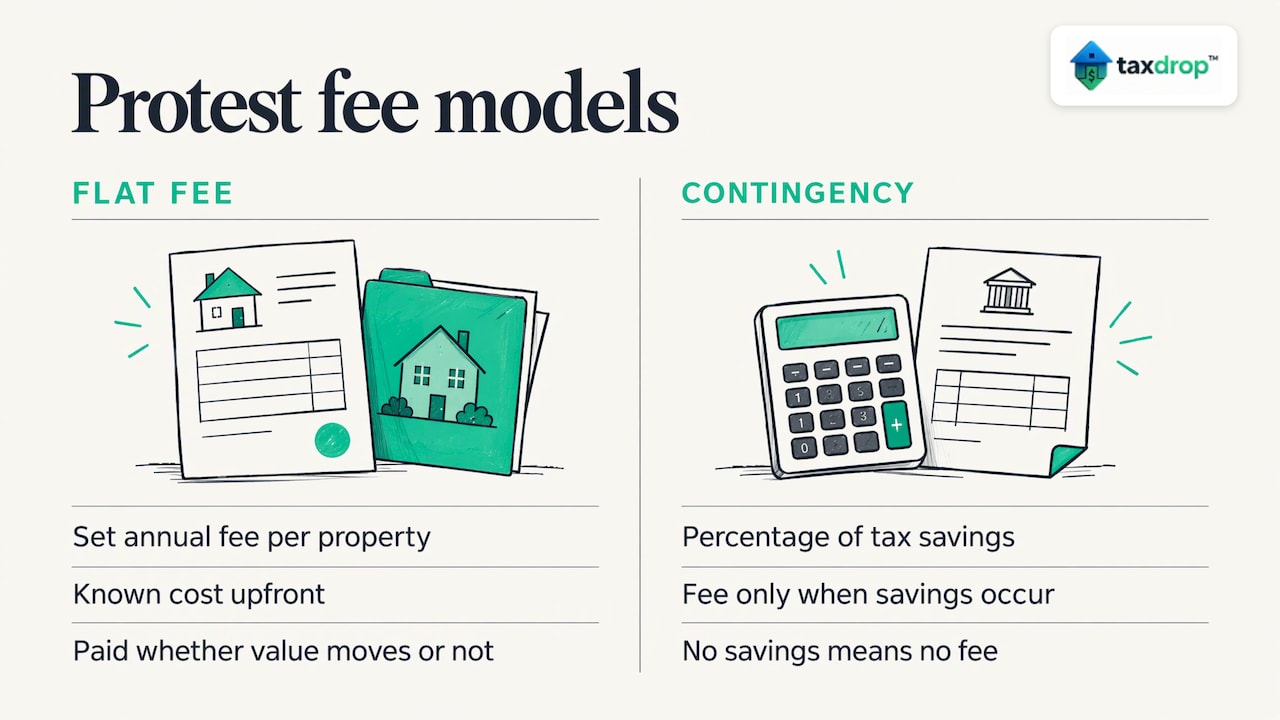
Our two products line up with those models. TaxDrop One is the flat annual fee: a self-service evidence package built by licensed consultants. Full-service is the contingency option: we handle negotiation, hearing attendance and annual refiling, and you pay a percentage of the savings only when there are savings. TaxDrop Pro is the other plan on our pricing page. Check that page for current terms.
If you want the long version of how fees compare across Texas, I wrote it up in our protest cost guide.
A worked example with real numbers
Here’s a made-up but realistic case. The numbers are mine, for illustration. Your rate and value will differ.
- Appraised value on your notice: $400,000
- Value after a successful protest: $360,000
- Reduction: $40,000
- Combined tax rate in this example: 2.2%
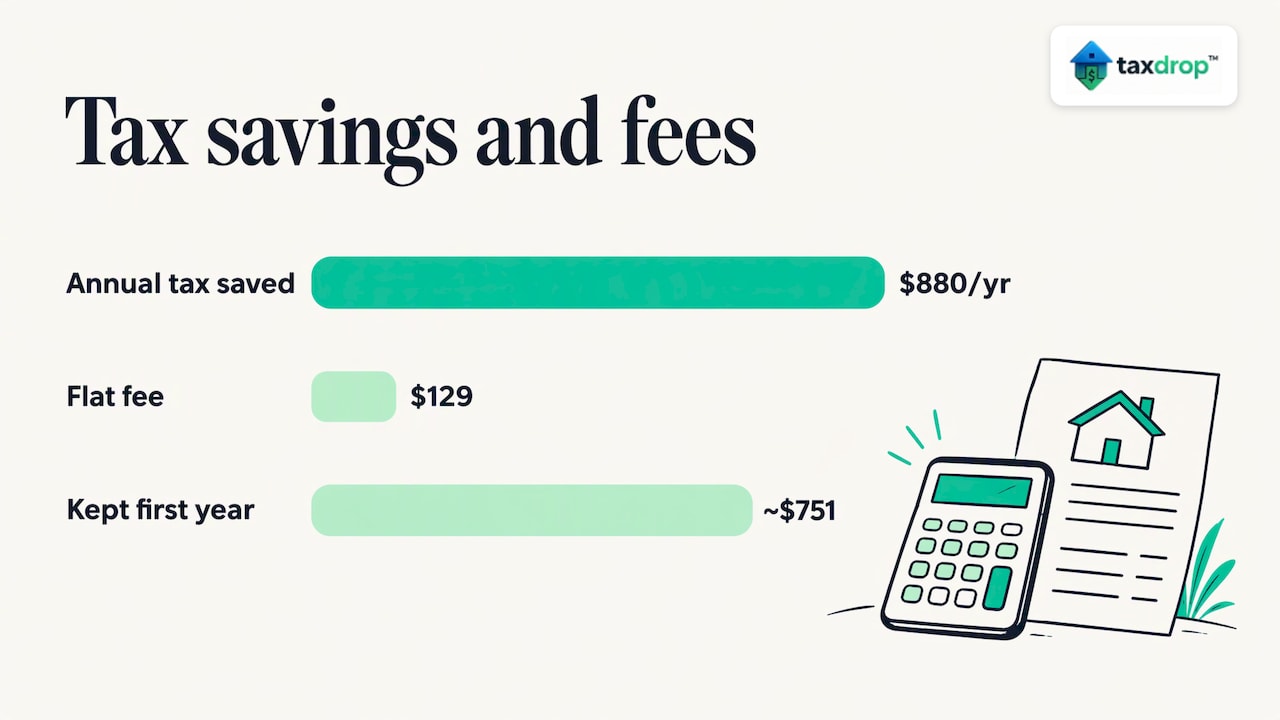
- Estimated tax saved: $40,000 × 0.022 = $880 per year
Now compare the fees on that $880.
With a flat fee of $129, you keep about $751 in the first year. With a contingency fee, you’d pay a percentage of the $880. If the service gets nothing, you owe nothing.
The savings can repeat. In Texas, a lower appraised value usually carries into the next year’s starting point. That’s why annual refiling matters. A reduction you don’t defend can drift back up.
One more point. Your tax rate comes from local taxing units like schools, cities and counties, not from the appraisal district. The Comptroller’s property tax page says the Comptroller’s office doesn’t set rates or collect property tax. A protest changes your value. It doesn’t change the rate.
What to check before you sign
Price is one line in a contract. These are the others I’d read.
- What the fee is based on. Is it a percentage of tax saved, or of value removed? Tax saved is the clearer number. Ask which one the contract uses.
- When the fee is due. A contingency fee should come after your bill drops, not before.
- How it renews. Does the service refile every year automatically? Can you cancel? A refile you didn’t know about can surprise you.
- Who attends the hearing. The hearing is held by your county’s appraisal review board, or ARB, a panel of local citizens that settles value disputes. Confirm who shows up if it goes that far.
- Agent authority. You appoint a representative with Form 50-162, the state’s Appointment of Agent for Property Tax Matters. Tarrant County requires it at check-in for accounts that need assigned authorization.
- Which properties it covers. Flat fees are per property. Five rentals means five fees.
Our Pricing & Fees help page answers the common questions on how we bill.
What a service prepares for you
A protest wins on evidence. The Comptroller’s model hearing procedures say an owner who only says the value is too high isn’t likely to prevail. For market value, the best evidence is a signed, dated closing statement or fee appraisal for your sale, or recent comparable sales closest to January 1.
The Comptroller’s protest guide also lists other evidence you can bring:
- photos of your property and the comparables
- repair receipts or estimates
- listings and closing statements
- deeds, surveys and engineering reports
This is the document preparation you’re paying for. Our evidence packages are built by licensed consultants, with AI-driven market data analysis behind them. The service pulls the comparable sales, checks them against your home and builds the package so you don’t spend a weekend on it.
There’s also a rule worth knowing about timing. Evidence has to be exchanged at or before the hearing, on paper or a portable electronic device that isn’t a smartphone, according to the Comptroller’s 2026 ARB training manual. If you handle your own hearing, plan for that.
Protest mistakes that cost money
I see the same few mistakes. Most are cheap to avoid.
Saying the district is wrong without proof. The Comptroller is blunt here: the ARB decides on market value. It can’t weigh your personal finances, and emotional arguments carry no weight. “My taxes are too high” is a rate complaint. The ARB only hears value.
Missing the deadline. The usual deadline is May 15 or 30 days after the district mails your notice, whichever is later, per Tax Code Section 41.44. Late protests can be heard for good cause before the ARB approves the records. Good cause isn’t defined in the code, and Kendall County’s 2026 procedures say it must be weighed carefully. Don’t count on it. See our deadline guide.
Missing the hearing. Tarrant County’s 2024 hearing procedures say missed hearings are dismissed for failure to appear. Put it on a calendar.
Skipping a protest because your value didn’t rise. This is where I disagree with common advice. Plenty of people say to protest only when the number jumps. I’d protest every year. Your value can be flat and still be above what the market supports. A flat notice isn’t proof it’s right.
Hiring on price alone. The cheapest option isn’t always the best fit. A flat fee can win for one property. A contingency fee can win when you don’t want to carry any risk. Pick the model that matches your goal.
How to track your protest
Once you file, the dates come fast. The ARB must give you at least 15 days’ notice of the hearing. At least 14 days before, the district mails the assistance pamphlet and the hearing procedures, per the Comptroller’s protest page. Counties over 120,000 people offer an electronic reminder if you ask in writing and give an email or phone number. Denton and Tarrant are in that group.
You can also ask for an informal conference with the district before the hearing, as described in the Comptroller’s Texas Property Tax Basics. Many cases settle there.
The calendar, in short: ARB hearings run from May 15 to July 20. Tax bills go out from October 1. Penalties and interest start February 1. The same Comptroller document has the full schedule.
With TaxDrop, you get a customer dashboard that tracks your progress and savings, and we track deadlines for you. You don’t have to watch the mailbox. For timing questions, see how long a protest takes in Texas.
Where TaxDrop fits
If you own a home, a rental or land in Texas, you can start with the plan that fits.
TaxDrop One is $129 per year per property. It gives you an evidence package built by licensed consultants. Our full-service protest adds agent filing, negotiation, hearing attendance and automatic annual refiling. You pay only if the reduction happens. Every case gets licensed agent review.
We file for residential, commercial and agricultural property. See TaxDrop pricing.

If you’re still weighing providers, our comparison of Texas protest companies lays out the criteria.
Our view on pricing
I’d pick a price model by asking one question: who carries the risk? With a flat fee, you do. With a contingency fee, we do.
That’s why we built full-service as no savings, no fee. Your bill has to drop before we earn anything. It keeps us focused on the one result you care about.
For owners who want to keep control, TaxDrop One gives you an evidence package built by licensed consultants for one flat annual price. Either way, I’d skip any contract that hides how it renews. You should know what you’re paying, when, and for what.
the author
FAQ
How much does a Texas protest service cost?
It depends on the model. At TaxDrop, the flat plan TaxDrop One is $129 per year per property. Full-service protests are contingency, so you pay a percentage of the savings only if your bill goes down. Our pricing page lists the current plans.
Do I need a protest consultant at all?
No. You can file yourself with any written notice that names the owner and property and shows you disagree with the value, per the Comptroller. The work is in the evidence and the hearing. A consultant takes that over, so you don’t gather comparables or attend.
When is the deadline to file?
Usually May 15, or 30 days after the district mails your notice if that’s later. Check the notice itself, since the clock runs from the mailing date. Our Deadlines & Timing help page covers it.
Can someone else file and attend for me?
Yes. You appoint an agent with Form 50-162. You can also appear by phone, videoconference or written affidavit, per the Comptroller. Some counties, like Jefferson, require a written request at least 10 days ahead for phone or Zoom hearings.
Sources
- Texas Comptroller, Property Tax Assistance
- Texas Comptroller, Appraisal Protests and Appeals
- Model Hearing Procedures for Appraisal Review Boards, February 2025
- Appraisal Review Board New Member Training Manual, 2026
- Texas Tax Code, Section 41.44
- Kendall County 2026 ARB Hearing Procedures
- Tarrant Appraisal Review Board Hearing Procedures
- Texas Property Tax Basics, January 2026
Recommended
Paying Too Much in Property Taxes?
Let our licensed property tax experts assess your tax bill for potential savings. 92% of Texas protests we closed in 2026 got a reduction. It takes less than 3 minutes to enroll.
⏰
🏠
💵
No Savings No Fee
FAQs

Ryder Meehan
Ryder Meehan is the Co-Founder of TaxDrop and a Licensed Property Tax Protest Consultant