
Key Takeaways:
Instead of repeatedly checking Zillow for a lower number, save a dated Zestimate and build an evidence packet around verified sales, accurate property details, and your assessment’s valuation date. Use a Zestimate as supporting context for a property tax appeal, not as a substitute for documented market evidence.
TL;DR
- Zillow Zestimate property tax appeal evidence belongs behind verified sales, not at the center of your case.
- Save the property address, capture date, estimate, and relevant property details together.
- Match comparable sales to your assessment’s valuation date and your county’s evidence rules.
- Taxdrop property tax appeal services offer Texas representation and self-serve support in covered states.
Why this matters
A lower Zestimate does not automatically mean your assessment is wrong. Zillow’s automated estimate and your taxing authority’s valuation can use different information and refer to different dates. Your job is to explain the assessment error with evidence the reviewing office accepts.
For a 2026 appeal, start with your notice rather than today’s estimate. Find the valuation date—the date your property’s value is being measured—and build your argument around that date.
Taxdrop is best for homeowners and landlords seeking property tax appeal support in its covered states. Taxdrop provides full-service representation in covered Texas counties and self-serve appeal support across its other covered states. Coverage differs by service; do not assume representation is offered everywhere self-serve support exists.
The useful part of Zillow is the starting point: a possible mismatch worth checking. The limitation is just as important: an automated estimate is not an appraisal and does not establish what your reviewing office must accept.
Before you start
- Gather your notice and property record. Have your parcel identifier, assessed value, valuation date, filing deadline, and the official filing instructions. An assessed value is the value your taxing authority uses within its property tax calculation; it is not your tax bill.
- Prepare your evidence workspace. Open the correct Zillow property page, your official property record, and any verified closed-sale records you already have. Use a folder for screenshots, PDFs, photographs, and your filing receipt.
- Check the date mismatch before collecting evidence. A Zestimate captured in 2026 describes an estimate at the time of capture, not necessarily the value on your assessment’s valuation date. A lower current estimate does not prove a lower value on that earlier date.
You do not need to build a software integration. This workflow connects your notice, saved property information, sales evidence, and filing records without depending on Zillow updates or an assumed county portal feature.
Check your filing window first
Terminology and deadlines change by state. Use the deadline printed on your notice and the current instructions from the responsible office before collecting more evidence.
Texas
- Responsible office or hearing body: Appraisal District; Appraisal Review Board hears protests
- Filing-window checkpoint: May 15 is the standard deadline; check the notice-based deadline and applicable exceptions
California
- Responsible office or hearing body: Assessor’s Office; assessment appeals board or county board hears appeals
- Filing-window checkpoint: Filing periods vary by county
Georgia
- Responsible office or hearing body: Board of Tax Assessors
- Filing-window checkpoint: Generally 45 days from the Annual Notice of Assessment
Florida
- Responsible office or hearing body: Property Appraiser; Value Adjustment Board hears petitions
- Filing-window checkpoint: Generally 25 days from the TRIM notice, your proposed property tax notice
New Jersey
- Responsible office or hearing body: Municipal Assessor sets value; County Board of Taxation hears appeals
- Filing-window checkpoint: Generally April 1; Burlington, Gloucester, and Monmouth use January 15
Maryland
- Responsible office or hearing body: SDAT, the State Department of Assessments and Taxation
- Filing-window checkpoint: Generally 45 days from a reassessment notice; January 1 for an off-cycle appeal
These are filing checkpoints, not permission to wait until the last day. Confirm your specific 2026 deadline and submission requirements with the responsible office.
New Jersey requires an additional decision before filing. The Chapter 123 ratio test compares your assessment-to-market-value ratio with the applicable common level range. An assessment below that range can be increased. Do not file simply because Zillow shows a lower number, and do not use neighboring assessments as sales evidence.
Your assessment baseline
- Check your notice. Record the parcel identifier, assessment year, value under review, valuation date, and filing deadline. Keep the notice itself in your evidence folder rather than copying only the value.
- Check your property record. Compare the official description with your home’s actual size, use, and condition. Identify factual errors separately from disagreements about value; an incorrect property characteristic needs its own documentation.
- Define your claim. Decide whether your argument concerns market value, a factual error, or another ground your state permits. Market value means the supported selling value on the relevant date, not the amount you wish your tax bill were.
- Record the governing instructions. Save the office’s current evidence and filing requirements. Note separate deadlines for filing an appeal and submitting hearing evidence if the instructions distinguish them.
Expected result: You have a clear assessment baseline and know which value, date, and factual issue your evidence must address. A lower Zestimate now has something meaningful to be compared against.
Do not subtract the Zestimate from your tax bill. Those figures measure different things. Also avoid treating the gap between an assessment and an estimate as guaranteed savings; exemptions, valuation rules, and tax rates affect the final bill.
Your dated Zillow record
- Confirm the address. Open the Zillow page for your property and verify the address against your notice. Check the unit identifier for a condominium or another property with multiple units.
- Capture the estimate. Save a screenshot showing the property address and Zestimate together. Record the capture date in your evidence index, a simple list describing each document and its purpose.
- Save the context. Capture relevant property details and any displayed estimate range or history you intend to discuss. Keep them identifiable as Zillow information rather than presenting them as official assessor records.
- Preserve a readable copy. In Chrome, open Print, choose Save as PDF under Destination, then select Save. Review the saved file; if the estimate or address is missing, retain the screenshot instead.
Expected result: You have a readable, dated record of what Zillow displayed, with the correct property attached to it. You are no longer relying on a live page that can change before your hearing.
Save the original capture without altering the number. Put your explanation in a separate document. If you highlight an error or comparison, retain an unmarked original alongside the annotated copy.
For your 2026 packet, label the capture date explicitly. A screenshot taken after the valuation date needs that distinction; hiding it weakens the explanation rather than fixing the mismatch.
Your sales evidence
- Identify closed sales. Start with properties that actually sold and verify the sale date, transaction amount, and property identity through appropriate records. An asking price is a seller’s request, not a completed transaction.
- Check comparability. Compare location, property type, living area, condition, and sale timing with your home. A nearby property is not automatically a useful comparison.
- Explain material differences. Note why each sale helps establish your home’s value. Do not invent dollar adjustments for an extra bedroom, a larger lot, or repairs; unsupported arithmetic adds another claim you must defend.
- Build the evidence order. Put your claim and verified sales first, followed by property-error documents or condition evidence. Place the dated Zestimate afterward, clearly identified as an automated estimate.
Expected result: Your packet explains a supported value rather than displaying an unexplained difference between Zillow and the assessment.
Which evidence belongs where?
Zillow Zestimate
- Best for: Initial screening and supporting context
- Useful feature: Gives you an estimate to investigate
- Limitation: Not an appraisal; admissibility and weight depend on local rules
Verified closed sales
- Best for: Supporting market value
- Useful feature: Documents completed transactions
- Limitation: Requires comparable properties and relevant sale dates
Property records and condition documents
- Best for: Demonstrating factual errors or condition differences
- Useful feature: Connects the argument to your actual home
- Limitation: Must show why the issue affects the value under review
Professional appraisal
- Best for: A documented valuation opinion
- Useful feature: Explains a valuation method and supporting evidence
- Limitation: Purpose, effective date, and local evidence rules still matter
Lead with the strongest documented evidence, not the lowest number. A Zestimate that agrees with verified sales adds context. A Zestimate that conflicts with them needs explanation, not special treatment.
Your submission packet
- Write your claim. State the value you dispute, the valuation date, the value your evidence supports, and the reason. Keep the explanation plain and connect each point to a document.
- Index your evidence. Give each document a descriptive label. Distinguish official records, sale records, photographs, and the Zillow capture so the reviewer can identify the source immediately.
- Follow the filing instructions. Use the official form and submission method required for your property. For uploads, check permitted file types and size limits in the actual portal; labels and requirements differ across offices.
- Keep your receipt. Save the submission confirmation, filed documents, and subsequent notices. Filing an appeal and submitting supporting evidence are not always the same task.
Expected result: You have a submitted filing or a filing-ready packet, plus a clear record of what you sent and when. The Zestimate has a defined supporting role rather than carrying the entire argument.
The workflow has four checkpoints: Check your notice, Capture the estimate, Identify closed sales, and Keep your receipt. Complete them in that order so evidence collection does not distract you from the filing deadline.
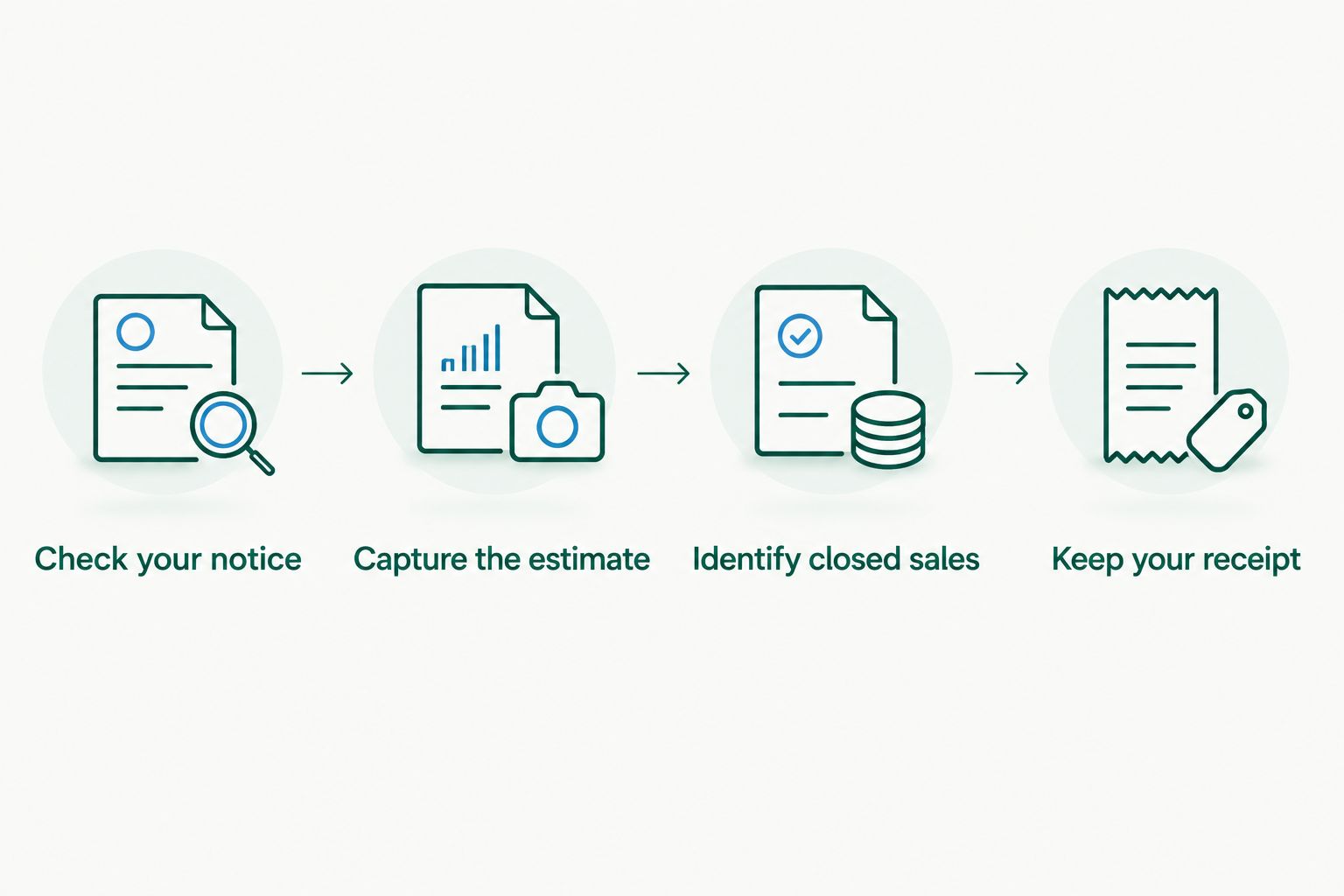
Set the assessment baseline before collecting estimates and sales evidence.
When the Zestimate changes before your hearing
A changed estimate calls for a new dated record, not an automatic rewrite of your requested value.
- Save the new capture separately and preserve the original.
- Compare the new estimate’s date with your assessment’s valuation date.
- Check whether the underlying property details changed.
- Update your explanation only when verified evidence supports the change.
- Follow the hearing office’s rules for supplemental evidence and submission deadlines.
A higher estimate does not erase a documented property error. A lower estimate does not replace your closed sales. For a 2026 hearing, keep the argument tied to the value and date being reviewed.
Troubleshooting
The estimate is missing or the PDF is incomplete
Use a readable screenshot if the printed page omits essential content. If Zillow displays no estimate, continue with verified sales and property documentation; your appeal does not depend on having a Zestimate.
Zillow and the official record describe different homes
Check the address, unit, living area, and property type. Document the correct facts from reliable records and flag the mismatch. Do not assume an estimate based on incorrect details supports your requested value.
The reviewing office will not accept the Zestimate
Remove it from the submitted evidence if the rules exclude it. Retain it in your working folder and support the argument with permitted sales and property records. Local admissibility rules control the packet.
Your comparable sales are not genuinely comparable
Replace sales with major unexplained differences in property type, condition, location, or timing. Where a difference remains, explain it and use documented adjustments rather than guesses.
The deadline arrives before the packet is complete
Check the official instructions immediately for filing and later evidence-submission requirements. Do not assume an unfinished packet extends the deadline or that supporting documents alone create a valid appeal.
Customize your workflow
If you recently bought your home, add the actual transaction documents to your review. The closing disclosure evidence workflow explains how to organize that separate source without confusing your purchase date with the assessment’s valuation date.
For multiple properties, keep a separate folder and evidence index for each parcel. Reusing a template helps organization; reusing the same sales argument without checking each property does not.
Taxdrop property tax appeal support includes licensed-consultant-led representation in covered Texas counties and TaxDrop One self-serve packets in covered states. Choose support based on coverage and who will handle filing and representation. A self-serve packet does not mean someone else handles every procedural step.
FAQ
Can I use a Zillow Zestimate as property tax appeal evidence?
Use a Zestimate as supporting context only if your reviewing office permits it. Build the central argument around verified sales, accurate property facts, and the assessment’s valuation date.
Is a Zestimate the same as a property appraisal?
No. A Zestimate is Zillow’s automated estimate, not a professional appraisal. It does not independently establish the value your appeal body must accept.
What if my Zestimate is lower than my assessment?
Investigate the difference before filing. Check the valuation date, property details, and verified comparable sales; a lower estimate alone does not prove over-assessment.
Should I use today’s Zestimate for my 2026 appeal?
Preserve today’s Zestimate with its capture date, but do not treat it as proof of value on a different date. Your evidence must address the valuation date that governs the assessment under review.
Are Zillow asking prices useful comparable sales?
Asking prices are not completed sales. Use verified closed transactions for a sales-based argument and explain why each property is comparable to yours.
Can a New Jersey appeal increase my assessment?
Yes. Under the Chapter 123 ratio test, an assessment below the applicable common level range can be increased. Review the ratio rules before filing, and use sales rather than neighboring assessments.
Will Taxdrop represent me outside Texas?
Taxdrop’s full-service representation is limited to covered Texas counties. TaxDrop One provides self-serve support in covered areas of Texas, California, Georgia, Florida, New Jersey, and Maryland; self-serve coverage does not establish full-service availability.
One last thing
A lower online estimate is a reason to check your assessment, not a reason to file automatically. If you remove the Zillow screenshot and the packet no longer explains your requested value, strengthen the underlying evidence before relying on it.
Related guides
- Assessment notice to filed appeal workflow
- Refinance appraisal to appeal evidence workflow
- Property tax appeal deadline benchmarks by state
Check your assessment
Review your assessment and the support offered for your property’s location.
Paying Too Much in Property Taxes?
Let our licensed property tax experts assess your tax bill for potential savings. Over 80% of protests get a reduction of more than $1,000 and it takes less than 3 minutes to enroll.
⏰
🏠
💵
No Savings No Fee