

Key Takeaways:
Typical annual savings from a successful property tax appeal are 10–15% of your property tax bill, a useful planning benchmark for 2026 rather than a guaranteed result. Your take-home savings are lower after service fees and any filing charges, and a reduction in your assessment does not always translate directly into a smaller bill. The amount you can actually save depends on the value you can support, your taxable value, and your state’s rules.
TL;DR
- How much can you save appealing property taxes? Typical annual savings are 10–15%, not a guaranteed outcome.
- TaxDrop property tax appeals suit homeowners and landlords who want help checking whether their assessment supports a challenge.
- Assessment reductions and tax savings are different amounts; compare your lower bill with the fees before choosing help.
- New Jersey appeals can increase your assessment, so check the Chapter 123 ratio test before filing.
How much can you actually save by appealing property taxes?
Use 10–15% annual savings as a starting benchmark, then calculate your property’s result from the taxable value reduction. Do not apply that percentage to your home’s market value. It describes a reduction in the tax bill, not a reduction in the price of your home.
The basic calculation is:
Annual tax savings = reduction in taxable value × applicable property tax rate.
A separate calculation tells you what you keep:
Net savings = annual tax savings − service fees − filing charges.
For Texas owners, the property tax appeal cost guide explains the cost side of that decision. Compare those costs with the expected bill reduction, not just the assessment reduction.
Example: a $1,250 annual tax reduction
A $50,000 reduction in taxable value at a 2.5% tax rate produces $1,250 in annual tax savings. This is an arithmetic example, not a promised result or a customer case study.
The distinction matters. A $50,000 reduction in the value used to calculate your taxes is not $50,000 back in your pocket. The tax rate converts that value reduction into a smaller bill.
This example assumes the full reduction reaches taxable value and the applicable rate stays the same. Exemptions, assessment caps, and other rules can change that relationship. Your 2026 notice and tax calculation are the documents that establish the starting point.
Why this matters
Your assessment is the value your taxing authority assigns to your property. Your taxable value is the amount used to calculate taxes after applicable adjustments. Your bill is the amount you owe.
Those figures are connected, but they are not interchangeable. An appeal challenges the assessment under your state’s rules; it does not let you choose a lower tax rate.
The useful question is whether correcting your assessment would lower your taxable value enough to justify the effort and cost. A large-looking assessment reduction can disappoint if another rule already limits the value being taxed.
For your 2026 decision, start with the notice, not a percentage advertised elsewhere. Find the value being challenged, identify the value being taxed, and check how a successful challenge would affect both.
How to estimate the savings on your property
You do not need a guaranteed outcome to make a sensible decision. You need a supported value, a clear tax calculation, and a complete picture of the costs.
- Read your notice. Identify your assessment, the tax year, and the filing instructions. Check property details such as size, condition, and classification against your records.
- Check taxable value. Find the value used to calculate your bill after exemptions or assessment limits. Do not assume it matches the headline value on your notice.
- Gather evidence. Use relevant closed sales, public records, and documentation of property errors or condition. Match the evidence to the valuation date that applies to your assessment.
- Calculate savings. Work out how the supported assessment would change taxable value, then apply the relevant tax rate. Separate the gross bill reduction from what you keep after costs.
- Compare costs. Review service fees, filing charges, and the work you would handle yourself. Decide whether the evidence supports filing before committing to an approach.
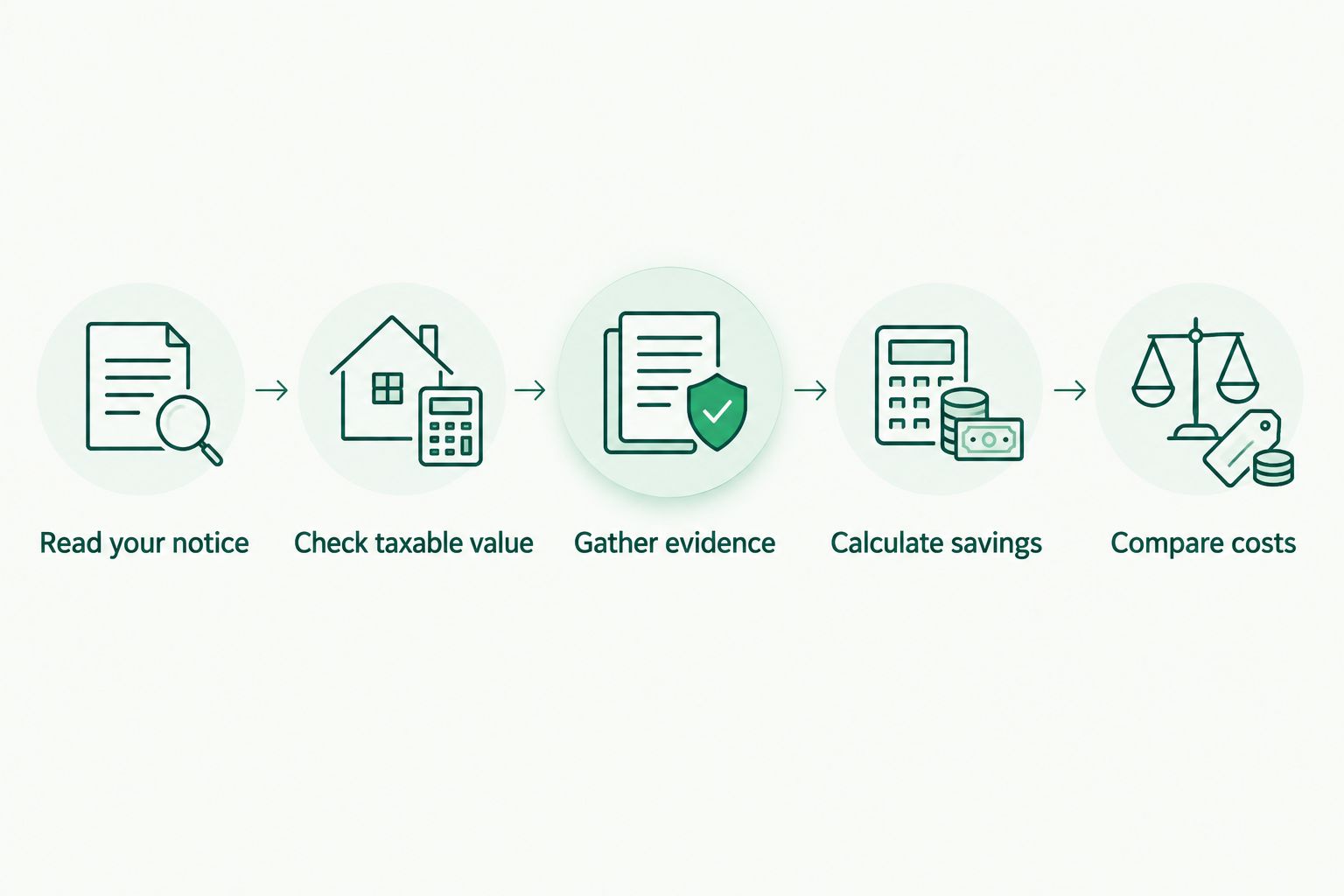
Calculate the bill reduction before deciding how much help to buy.
Keep the estimate tied to the same tax year throughout. Comparing a current assessment with sales from the wrong valuation period can lead you to the wrong conclusion, even when those sales accurately describe today’s market.
A lower asking price for a nearby home is not the same as a completed sale. Your strongest argument connects evidence to your property and explains why the assigned value needs correcting.
Why property tax appeal savings vary
The 10–15% benchmark does not tell you which properties have a strong case. These factors explain why two owners can receive very different results:
- The size of the valuation error. A supported gap between the assessment and the correct value creates the basis for a reduction. A high bill alone does not establish that gap.
- The applicable tax rate. The same taxable value reduction produces different tax savings at different rates. Use the rate relevant to your property rather than a statewide shorthand.
- Exemptions and assessment limits. An exemption removes qualifying value from taxation; a cap limits an increase under applicable rules. Either can affect whether an assessment reduction lowers the bill.
- The quality of your evidence. Relevant closed sales and documented property errors support a value argument. Evidence that does not match your property or valuation date needs explanation.
- Your state’s legal test. States do not all judge assessments the same way. A comparison accepted in one state can be the wrong argument in another.
- Fees and filing charges. Gross savings describe the bill reduction. Net savings describe the amount left after the costs of obtaining it.
Choose the argument your state recognizes, not the argument that sounds most persuasive. Comparable assessments support certain equity arguments in Texas and Georgia. They are not a substitute for sales evidence in New Jersey.
Should you file yourself or get help?
The best approach depends on your evidence, your willingness to handle the process, and the service coverage available for your property. Paying for help does not create a valuation error where none exists.
Handle the filing yourself
- Best for: Owners comfortable preparing evidence and following filing instructions
- Benefit: You control the submission and do not hire a service
- Limitation: You handle the research, deadlines, and presentation
TaxDrop One
- Best for: Owners who want a self-serve appeal packet
- Benefit: Free instant analysis first, followed by a self-serve option
- Limitation: You remain responsible for handling the appeal; county coverage varies
TaxDrop Pro
- Best for: Texas owners who want licensed-consultant-led representation
- Benefit: No fee unless the service reduces your assessment
- Limitation: Full-service coverage is limited to 17 Texas counties
TaxDrop property tax appeals are best for homeowners and landlords who want help assessing their case before choosing a filing approach. Check your property’s eligibility before assuming either service is available.
The self-serve option covers 43 Texas counties, 6 California counties, and 4 Georgia counties, plus statewide coverage in Florida, New Jersey, and Maryland. Full-service representation is Texas only.
The no-reduction-no-fee promise applies to full-service representation. Do not treat a self-serve packet as the same arrangement, and do not confuse a fee based on an assessment reduction with a fee based on tax dollars saved.
For your 2026 comparison, ask which amount determines the fee and which work you must complete yourself. Those answers matter more than a headline success rate.
Check your assessment
Get a savings estimate in under 2 minutes, then check the option available for your property.
Does a successful challenge always lower your bill?
A successful assessment challenge does not automatically produce the same percentage reduction in your tax bill. The result depends on how the revised assessment changes taxable value.
Texas illustrates the distinction. The 10% homestead cap limits annual increases in qualifying assessed value, and your Notice of Appraised Value shows both market value and capped value. A reduction in market value does not necessarily move the capped value used in your tax calculation.
Check both figures before treating an assessment reduction as spendable savings. Ask for the expected effect on the bill, not only the expected change to the notice.
The same discipline applies to exemptions. Confirm that qualifying relief is reflected in your records, but keep exemption questions separate from the evidence supporting a lower assessment.
Does an 80–90% success rate mean you will save money?
An 80–90% informal success rate in Texas is not an 80–90% promise for your property. Informal success refers to the Texas process, not every state, every hearing, or a guaranteed savings amount.
A success rate also does not describe the size of the reduction. A small adjustment and a substantial adjustment can both count as successful outcomes while leaving owners with different net savings.
Judge your case by the evidence and the expected bill impact. Do not use a Texas informal success benchmark to predict a California appeal or a New Jersey hearing.
Can a New Jersey appeal make your taxes higher?
A New Jersey appeal can increase your assessment. The County Board of Taxation hears these appeals and applies the Chapter 123 ratio test, which compares your assessment-to-market-value ratio with the permitted common level range.
If the ratio falls below that range, the board is required by statute to increase the assessment. A belief that your home’s market value has fallen is not enough to establish that filing helps you.
New Jersey also charges a non-refundable filing fee. Use sales evidence, not comparable assessments, and check the ratio before deciding to file.
For 2026, the general filing deadline is April 1, but Burlington, Gloucester, and Monmouth use January 15. Verify the instructions for your municipality and tax year rather than relying on a generic deadline.
FAQ
How much can you save appealing property taxes in 2026?
Typical annual savings are 10–15% of the property tax bill, not a guaranteed result. Your actual savings depend on the supported assessment reduction, taxable value, tax rate, and costs.
Is an assessment reduction the same as tax savings?
No, an assessment reduction changes a property value used in the tax calculation; tax savings are the resulting reduction in your bill. A $50,000 taxable value reduction at a 2.5% rate produces $1,250 in annual tax savings before costs.
Is it worth appealing if my home value dropped?
A lower home value supports filing only when relevant evidence shows your assessment needs correcting under your state's rules. Use the applicable valuation date and calculate the effect on taxable value before deciding.
Can I save money by handling the appeal myself?
Handling the appeal yourself avoids hiring a service, but you remain responsible for the evidence, deadlines, and presentation. Filing charges and state-specific risks still need checking.
Does TaxDrop provide full-service representation outside Texas?
No, full-service representation is available only in 17 Texas counties. The self-serve option has separate coverage in Texas, California, Georgia, Florida, New Jersey, and Maryland.
Can a New Jersey property tax appeal raise my assessment?
Yes, a New Jersey appeal can raise your assessment under the Chapter 123 ratio test. Check the common level range before filing, and use sales evidence rather than comparable assessments.
Will an appeal reduction lower my mortgage payment immediately?
An assessment reduction does not automatically change your mortgage payment immediately. If you pay taxes through escrow, the lender-held account used to pay property expenses, check how your servicer will account for the revised bill.
One last thing
The biggest-looking reduction is not always the best financial result. Compare changes to your actual tax bill after fees, not just changes to the assessment on your notice.
Keep your original notice, the final decision, and the revised tax calculation together. That gives you a way to confirm whether the assessment correction reached the bill and to distinguish estimated savings from the amount you actually keep.
Check your assessment.
Related guides
Paying Too Much in Property Taxes?
Let our licensed property tax experts assess your tax bill for potential savings. Over 80% of protests get a reduction of more than $1,000 and it takes less than 3 minutes to enroll.
⏰
🏠
💵
No Savings No Fee