
Fulton County Property Tax Appeal: Deadline, Process, and the 299(c) Freeze
Win a Fulton appeal and the county can't raise your assessed value for two more years. Fulton's General Fund millage hasn't moved from 8.87 mills in five years, so if your bill keeps climbing, the assessed value is doing it. Here's how to file — free — by July 31.

Key Takeaways:
- July 31, 2026 — Fulton County appeal deadline
- No fee — BOE hearing is free
- Two grounds — fair market value AND uniformity/equity
- 8.87 mills — Fulton County General Fund (5th consecutive year)
- 299(c) freeze — win a reduction, lock the value for 3 years
- PT-311A — file online at fultonassessor.org
Fulton County issued 2026 Annual Notices of Assessment in June, with a deadline of July 31, 2026 for most properties. If that date has already passed when you read this, mark your calendar for next June — the process resets annually and the county mails notices roughly the same week each year.
This guide covers the 2026 filing mechanics, the evidence that wins at the Board of Equalization, and the 299(c) three-year freeze that makes a successful appeal worth more than it looks in year one.
| Key takeaways |
|---|
| Key takeaways |
| July 31, 2026 is the appeal deadline for most Fulton County properties — 45 days from the June notice date per O.C.G.A. § 48-5-311. The date on your notice controls. |
| No filing fee for a Board of Equalization appeal. Arbitration adds costs; hearing officer proceedings may as well. |
| Two grounds: fair market value and uniformity (equity). Only Georgia and Texas allow the equity argument. |
| Win a reduction and the 299(c) freeze locks your assessed value for three years. |
| County General Fund millage: 8.87 mills (unchanged since 2022). Atlanta Public Schools adds ~20.50 mills for APS-zone properties. |
Fulton County at a glance
| 2026 appeal deadline | July 31, 2026 (most properties) — 45 days from notice date |
| Filing fee | None for BOE appeal |
| Appeal form | PT-311A, filed with the Fulton County Board of Tax Assessors |
| 2025 county General Fund millage | 8.87 mills (5th consecutive year) |
| Median home value | $431,200 (U.S. Census Bureau, ACS 2019–2023) |
| Population | 1,068,507 — largest county in Georgia |
| Online filing | fultonassessor.org — preferred method; upload documents and receive filing ID |
How Georgia property tax assessments work
Georgia assesses property at 40% of fair market value as of January 1 each year. That 40% figure is called the assessed value. Your tax bill multiplies assessed value (after exemptions) by the combined millage rate from the county, school district and city.
The Board of Tax Assessors (BTA) sets the value. The Board of Equalization (BOE) — a separate, independent panel of three citizens — hears your appeal if the BTA does not resolve it.
In Fulton County, 40% of a $431,200 median home is $172,480 assessed value. Apply the county General Fund rate of 8.87 mills and the county portion alone is $1,530. Add Atlanta Public Schools (~20.50 mills for APS-zone) and the city of Atlanta rate (~9.04 mills) and the total effective millage on a City of Atlanta property runs around 38.41 mills — $6,623 on that same median home before exemptions. The standard homestead exemption, plus Atlanta’s own exemption, cuts it meaningfully. The point: a $20,000 reduction in assessed value at a 38-mill rate is worth $760 a year. The 299(c) freeze stretches that over three years.

The 299(c) three-year freeze: why one appeal covers three tax years
Under O.C.G.A. § 48-5-299(c), when your appeal results in an actual reduction in assessed value, the county cannot raise that value during the next two years. The appeal year plus two more = three years of protection. That is what turns a single appeal win into three years of lower bills.
The “actual reduction” requirement matters. Under HB 581 (2024), a “no change” outcome no longer triggers the freeze. If you appeal, come with evidence that supports a lower number, not just an argument that the current value is debatable.
The two grounds for appeal in Fulton County
1. Value — fair market value as of January 1
The standard case: your property is worth less than the assessor’s number. You need three to five closed sales of similar properties, adjusted for size, age, condition and location, that support a lower value as of January 1. Pull them from the county records at fultonassessor.org or from a licensed appraiser. The BOE gives both sides 10–15 minutes. Short, clean, evidence-first.
2. Uniformity — your assessment is disproportionate
Georgia also allows an equity / uniformity appeal under O.C.G.A. § 48-5-299(c) — the argument that your property is assessed disproportionately high compared to similar properties. You do not have to prove fair market value is wrong. You only need to show your assessed value per square foot is higher than comparable parcels. Present comparable assessments (not sales) from the county records. This is a Georgia-specific argument; it does not exist in Florida, California or New Jersey. If you bring it, check the uniformity box on your PT-311A and choose the BOE route (not arbitration).
How to file in Fulton County
Step 1 — Request an informal review (optional but free)
Call the Fulton County Board of Assessors at 404-612-6440. Record errors — wrong square footage, wrong property class, nonexistent improvements — get fixed here fastest. The informal conversation does not extend the 45-day deadline.
Step 2 — File the PT-311A before July 31
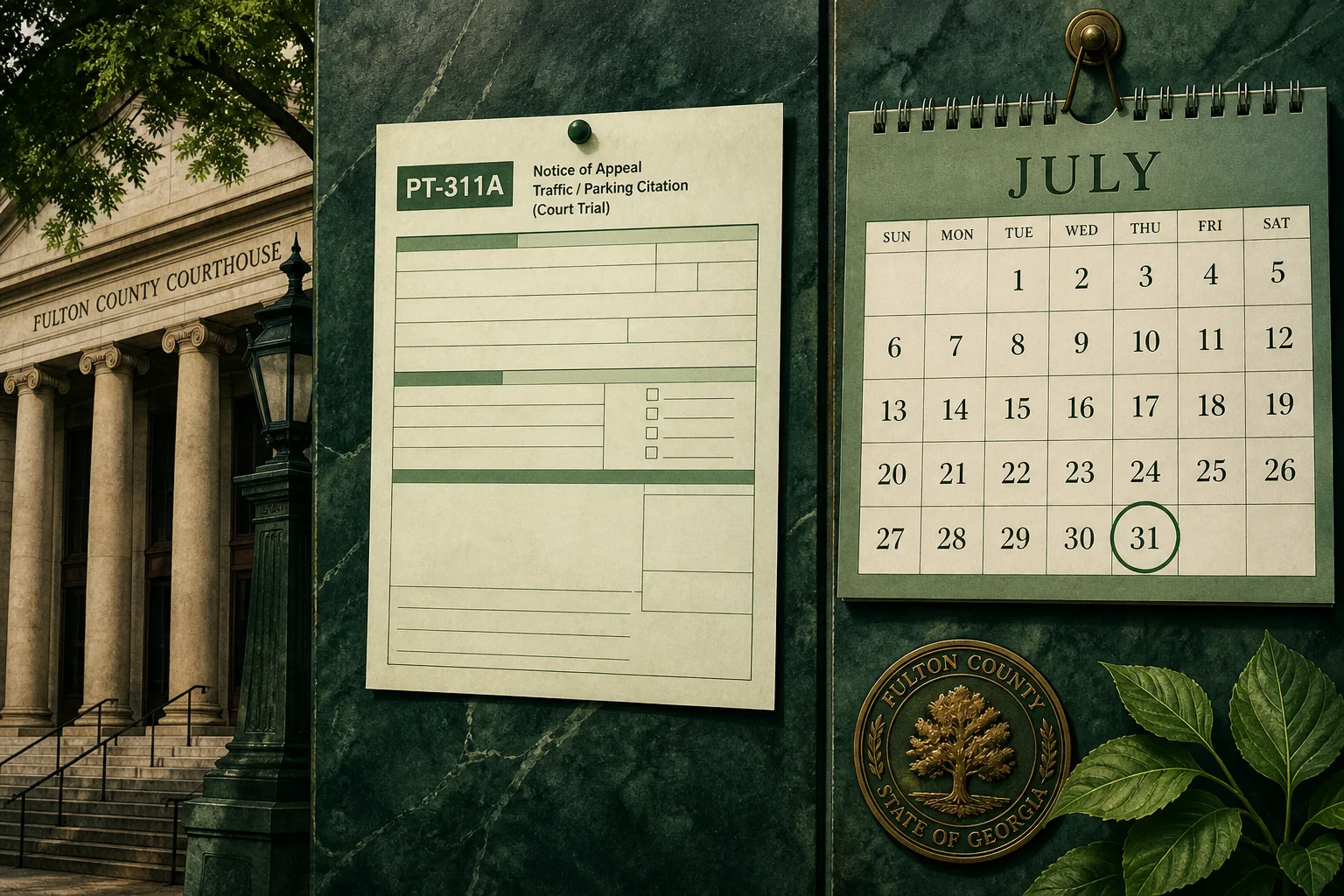
File at fultonassessor.org (online, preferred), by mail to 235 Peachtree Street NE, Suite 1200, Atlanta, GA 30303, or in person at any of Fulton’s six Board of Assessors offices. Postmarked by the deadline is acceptable for mail. No fax or email. You must choose your appeal route on the form: BOE (most common), arbitration, or hearing officer. On PT-311A, check all grounds that apply: value, uniformity, taxability.
Step 3 — The Board of Assessors review
A staff appraiser reviews your appeal and may offer an amended value. If you accept, the appeal ends and the 299(c) freeze begins if the value was reduced. If you reject, your case is forwarded to the BOE.
Step 4 — Board of Equalization hearing
A three-citizen panel, appointed by the grand jury. You present your evidence (comps, photos, condition documentation). The county appraiser presents theirs. Each side gets 10–15 minutes. The board issues a written decision within 10 days, delivered by certified or registered mail.
Step 5 — Pay your tax bill while the appeal is pending
Georgia law requires you to pay the undisputed portion of your tax bill while an appeal is pending. Miss it and you risk penalties. The county issues a temporary bill based on the prior year’s assessment or 85% of the current assessment while the appeal is open.
What will not work here
- The wrong date. Georgia values property as of January 1. Sales after that date and damage after that date are next-year issues.
- Millage rates. The BOE hears value and uniformity. It does not set tax rates. Budget-hearing complaints go to the Board of Commissioners.
- “My bill went up too much.” A higher bill can mean a higher assessed value, a higher millage, a lost exemption, or all three. Identify the cause before deciding whether to appeal.
- Filing after the deadline. Georgia law does not extend the 45-day window. One day late means waiting until next year.
Who should appeal in Fulton County
- Anyone whose January 1 value looks higher than what the property would have sold for that day. The standard case.
- Owners who bought the property in the last two years. Your closing price is close to unanswerable evidence of fair market value.
- Owners whose assessed value per square foot is above the neighborhood median. Pull comparable assessments from the county records. If yours is higher, you have a uniformity case.
- Landlords and commercial owners. No homestead cap protection means every dollar of overassessment costs you. The equity argument is particularly strong on income-producing property where the assessor’s mass-appraisal model struggles with vacancy or condition.
If you would rather not build the comparable-sales analysis yourself, TaxDrop One runs your Fulton County property against public records and MLS-sourced sales, identifies whether you have a case, and delivers a filled PT-311A with the evidence packet for $129 per property per tax year. A licensed appraiser reviews every Georgia case before it goes out.
More on the county: Fulton County property tax appeals. Georgia statewide: Georgia property tax appeals.
Keep Reading
- Gwinnett County Property Tax Appeal: Deadline, Process, and the 299(c) Freeze
- Cobb County Property Tax Appeal: Deadline, Process, and the 299(c) Freeze
- DeKalb County Property Tax Appeal: Deadline, Process, and the 299(c) Freeze
- How to Find Comps for Your Property Tax Appeal
- Property Tax Strategies for Rental Property Investors
Paying Too Much in Property Taxes?
Let our licensed property tax experts assess your tax bill for potential savings. Over 80% of protests get a reduction of more than $1,000 and it takes less than 3 minutes to enroll.
⏰
🏠
💵
No Savings No Fee
FAQs
When is the Fulton County property tax appeal deadline?
July 31, 2026 for most properties — 45 days from the June notice date under O.C.G.A. § 48-5-311. The date printed on your notice controls. File online at fultonassessor.org by that date.
How much does it cost to file a Fulton County appeal?
Nothing for a Board of Equalization appeal. Arbitration and hearing officer proceedings may carry additional costs. The BOE route is the standard path for residential appeals.
What are the two grounds for appeal in Georgia?
Fair market value — arguing the county's assessed value exceeds what the property would sell for on January 1. And uniformity/equity under O.C.G.A. § 48-5-299(c) — arguing your assessment is disproportionately high compared to similar properties. You can bring both on the same PT-311A.
What is the 299(c) three-year freeze?
If your appeal results in an actual reduction in assessed value, the county cannot raise that value for the next two years. The appeal year plus two more equals three years of protection. Since HB 581 (2024), the freeze requires an actual reduction — a no-change outcome does not trigger it.
Can I use comparable sales from Zillow?
The BOE prefers county-sourced sales or MLS data. Zillow estimates are not sales. Bring three to five closed comparable sales, adjusted for size, age, condition and location, from the Fulton County records or an appraisal.
Do I have to pay my taxes while the appeal is pending?
Yes. Georgia requires payment of the undisputed portion. Fulton issues a temporary bill. Pay it to preserve your appeal rights.

Ryder Meehan
Ryder Meehan is the Co-Founder of TaxDrop and a Licensed Property Tax Protest Consultant