

Key Takeaways:
Accidental landlords’ property tax appeal is a request to correct an overstated assessment—the value used to calculate your property taxes—with the aim of keeping more rental income. If you rented out a former home after moving, inheriting it, or struggling to sell, start by checking its value, exemption status, and filing deadline before challenging your 2026 assessment.
TL;DR
- A property tax appeal for accidental landlords starts with your assessment, rental status, and state deadline.
- TaxDrop One suits accidental landlords who want a self-serve appeal packet; full-service representation is Texas-only.
- Rental expenses alone do not establish that your assessed value is wrong.
- New Jersey appeals can increase assessments; check the Chapter 123 ratio before filing.
Why property tax appeals matter for accidental landlords
Your property tax bill becomes a rental expense even if you never planned to run a rental business. An overstated assessment adds to that expense, but a larger bill does not automatically mean your property is overvalued. Check the value and the exemptions separately.
TaxDrop One is best for accidental landlords who want a self-serve property tax appeal packet rather than full-service representation. You can start with the free instant analysis through TaxDrop and then decide whether your evidence supports filing.
A former primary residence brings a particular problem: your records can still reflect how you used the home before tenants moved in. A mailing-address error can hide a notice, while an outdated owner-occupancy exemption can create a separate tax issue. Neither disappears because you challenge the value.
Your 2026 goal is a supportable assessment, not simply a smaller number. Keep the ownership, exemption, and valuation questions separate so you address the right problem with the right office.
How to review and challenge your rental assessment
Check your ownership and exemption records
Start with your property record and assessment notice. Compare the owner name, mailing address, property description, and exemption entries with the home’s current use. Do this yourself before paying for help.
A homestead exemption is tax relief tied to qualifying primary-residence ownership and occupancy. Renting out your former home can affect eligibility, but the answer depends on your state’s rules and your circumstances. Do not assume every exemption ends immediately or that every existing exemption remains valid.
Also check factual errors. An incorrect living area, an extra bathroom, or a finished-space entry that does not match the property can affect its recorded value. Request the office’s correction procedure, and ask whether you must also file an appeal to preserve your rights.
Keep a separate folder for exemption correspondence. A valuation decision does not automatically resolve your occupancy status.
- Confirm the property identifier on your notice matches your rental.
- Update the mailing address used for assessment notices.
- Compare recorded living area and features with reliable documents.
- Ask the assessing office about your current exemption eligibility.
- Save the lease start date and occupancy-change records.
Confirm your deadline and the correct office
Find the deadline on your 2026 notice and verify the filing instructions with the responsible office. Do not use the date your tenant forwarded the envelope as the start of the filing window unless the applicable rules say so.
The terminology matters. Texas uses a protest; the other states below use an appeal or petition. Filing instructions also differ from the office that originally values your home.
Texas
- Notice and responsible office: Notice of Appraised Value; Appraisal District, also called a CAD
- Deadline checkpoint: May 15 is the standard deadline; check notice-based extensions
California
- Notice and responsible office: Assessment Notice; Assessor’s Office values the property
- Deadline checkpoint: Appeal deadlines vary by county; verify the filing body and instructions
Georgia
- Notice and responsible office: Annual Notice of Assessment; Board of Tax Assessors
- Deadline checkpoint: Approximately 45 days from the notice
Florida
- Notice and responsible office: TRIM notice; Property Appraiser values the property, Value Adjustment Board hears petitions
- Deadline checkpoint: Approximately 25 days from the TRIM notice
New Jersey
- Notice and responsible office: Municipal Assessor sets value; County Board of Taxation hears the appeal
- Deadline checkpoint: April 1 generally; January 15 in Burlington, Gloucester, and Monmouth
Maryland
- Notice and responsible office: Reassessment notice; SDAT or Supervisor of Assessments
- Deadline checkpoint: Approximately 45 days for reassessment appeals; January 1 for off-cycle petitions
A rental property in another state still follows that state’s process, not the rules where you now live. Calendar the evidence deadline and hearing date separately from the initial filing deadline.
- Record the notice date and the stated filing deadline.
- Verify the submission method and required attachments.
- Confirm which office receives your filing.
- Calendar evidence exchanges and hearing dates when provided.
- Keep the notice and envelope together.
Build evidence that matches your property
Start with public records and county assessor records. Identify comparable sales—closed transactions involving similar properties—and explain why they match your rental’s location, size, condition, and relevant valuation date. Asking prices are not completed sales.
For a former home, your own records can help establish condition. Dated photographs, inspection findings, and repair estimates give the reviewer something specific to evaluate. Connect each item to the property’s value; a list of bills alone does not establish overassessment.
Lost rent, a difficult tenant, and your mortgage payment describe your finances. They do not, by themselves, prove that the assessed value is wrong. If the local process accepts an income-based valuation, meaning a value calculation using rental income and expenses, follow its required method rather than subtracting expenses from the assessment.
TaxDrop One provides the faster self-serve path through an appeal packet. You still need to verify the property details and understand what the local office requires.
- Gather relevant closed-sale records, not just active listings.
- Explain meaningful differences between each sale and your rental.
- Photograph condition issues and record when the images were taken.
- Include inspection findings or repair estimates where relevant.
- Separate valuation evidence from ordinary rental bookkeeping.
Test whether filing helps before you submit
Write down the value you believe the evidence supports. Then compare it with the value under review, remembering that market value and taxable value can differ because of exemptions, caps, or assessment rules.
A lower assessment is not the same as an equal-sized tax saving. Your actual bill depends on the taxable value and applicable tax rates. Do not treat an assessment reduction as money already saved or expect your lender to change an escrow payment immediately.
New Jersey needs an additional check. Chapter 123 is the assessment-to-market-value ratio test used to evaluate whether an assessment falls within the permitted common level range. Below that range, the County Board of Taxation is required to increase the assessment. Filing is not a one-way route to a lower value.
New Jersey comparable assessments are inadmissible; use sales evidence. Unequal-appraisal arguments—claims that similar properties are assessed more favorably—have a statutory basis in Texas and Georgia, not California, Florida, New Jersey, or Maryland.
- Identify the value and valuation date you are challenging.
- Estimate tax effects separately from the assessment change.
- Use only arguments recognized by the relevant state process.
- Check New Jersey’s Chapter 123 ratio before filing.
- Reconsider filing if the evidence supports the existing assessment.
Choose the right level of help
The manual route starts with the official forms, instructions, and your own evidence. It gives you control over the argument but leaves preparation, filing, and hearing responsibilities with you. New Jersey also has a non-refundable filing charge, so self-preparation does not mean every filing is free.
TaxDrop offers two different service levels. TaxDrop One is self-serve: $129 per property, per tax year, with free instant analysis first. Full-service Pro charges 1% of the assessment reduction won, with no fee unless the assessment is reduced. That percentage applies to the reduction in assessed value, not the tax dollars saved.
For 2026, full-service coverage is Texas only, across 17 counties. TaxDrop One covers 43 Texas counties, 6 California counties, 4 Georgia counties, and statewide in Florida, New Jersey, and Maryland. Confirm coverage for your property before choosing a service.
Manual filing
- Best for: Owners comfortable preparing evidence and following local instructions
- Fee basis: Your own preparation; applicable filing charges remain separate
- Main benefit: Direct control over the submission
- Key limitation: You manage preparation, deadlines, and the hearing
TaxDrop One
- Best for: Accidental landlords who want a self-serve appeal packet
- Fee basis: $129 per property, per tax year; free instant analysis first
- Main benefit: A packet instead of starting preparation from scratch
- Key limitation: Self-serve is not full-service representation
TaxDrop Pro
- Best for: Owners of covered Texas properties who want consultant-led representation
- Fee basis: 1% of the assessment reduction won; no fee without a reduction
- Main benefit: Licensed-consultant-led handling
- Key limitation: Texas-only coverage in 17 counties
Choose based on responsibility, not just the fee. A packet and representation solve different problems: one supports your submission; the other changes who handles the case.
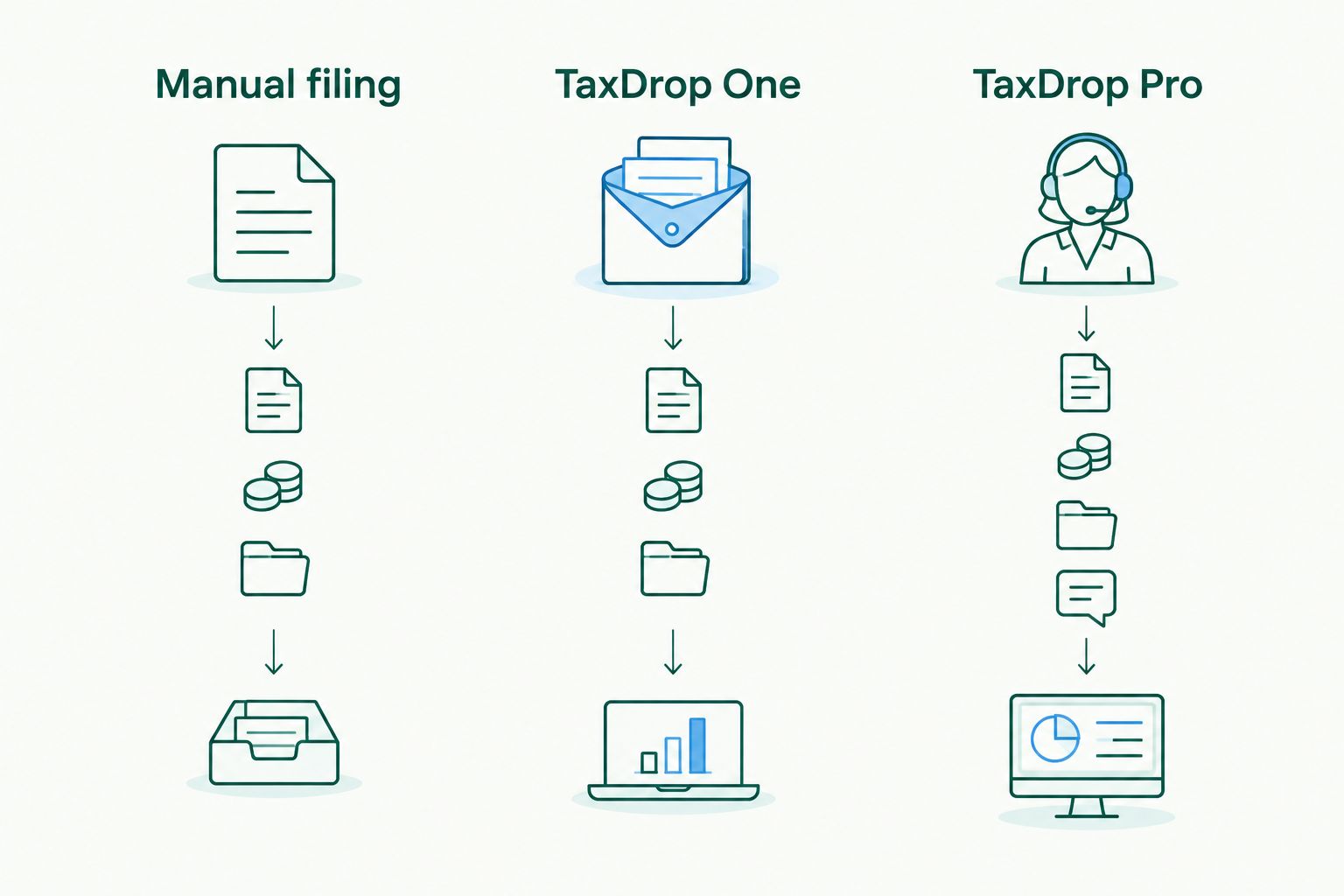
Choose the service level by who prepares and handles your case.
Before committing, ask what remains your responsibility. Evidence review, signatures, filing, and hearing attendance should be clear before the deadline approaches.
- Confirm coverage for the specific property.
- Separate self-serve preparation from representation.
- Check what you must sign, submit, or attend.
- Compare the fee basis with the estimated tax benefit.
- Keep government filing charges separate from service fees.
File, track the decision, and check the bill
Submit through the approved channel and keep proof that the office received your filing. A saved draft is not a filed case. If the process requires a signature, authorization, or supporting document, confirm it is included.
After submission, monitor the address and communication channel listed on your filing. An accidental landlord living elsewhere needs a reliable way to receive evidence requests and hearing notices. Do not rely on tenants to manage official mail.
Once a decision arrives, compare the written result with the updated property record and tax bill. If your lender collects property taxes through escrow—a mortgage account used to pay taxes and insurance—send the final documentation and ask about its review process. The appeal-to-lower-escrow workflow explains that separate follow-through.
Keep your 2026 decision with the supporting evidence. It provides a record of what changed, but it does not automatically establish the correct value for a later tax year.
- Save the submitted forms and receipt or confirmation.
- Track case status and requests for additional evidence.
- Prepare a short explanation of your proposed value.
- Read the written decision and any further-review deadline.
- Compare the final assessment with the tax bill.
- Send the final result to your lender when relevant.
Common mistakes accidental landlords make
Treating a rent shortfall as valuation evidence
Your rental can lose money without being over-assessed. A vacancy, mortgage payment, or unexpected repair bill needs a clear connection to the accepted valuation method. Lead with evidence about the property’s value, not your need for relief.
Keeping the old homeowner setup unchanged
A former residence needs a fresh review of its mailing address, occupancy records, and exemptions. Update those records separately from your appeal. Otherwise, you risk missing notices or leaving an eligibility issue unresolved while focusing on value.
Hiring for a service level that is unavailable
A self-serve packet does not mean someone represents you at a hearing. Full-service coverage does not extend outside Texas. Check the actual responsibilities and geographic coverage before assuming you can hand over the entire case.
Filing in New Jersey because the bill rose
A higher bill alone is not a reason to file. New Jersey’s ratio test can produce an assessment increase, and the filing charge is non-refundable. Review sales evidence and Chapter 123 before deciding that an appeal helps.
Waiting for the mortgage payment to correct itself
An assessment decision, a tax bill, and an escrow review are separate events. Keep the final decision and follow up with both the taxing office and lender as appropriate. A successful value challenge is unfinished from your perspective until you check the billing records.
FAQ
Can I appeal property taxes after turning my home into a rental?
Yes, rental use does not by itself prevent an owner from challenging an assessment. Check your state’s filing rules and review any primary-residence exemption separately.
What is the best property tax appeal approach for accidental landlords?
The best approach starts with checking your assessment, exemption status, deadline, and valuation evidence. Choose manual filing, a self-serve packet, or representation based on the responsibilities you can handle and the service coverage available.
Will renting out my former home remove my homestead exemption?
Rental use can change homestead eligibility, but the answer depends on your state’s rules and your circumstances. Ask the assessing office to review the exemption rather than assuming the valuation appeal resolves it.
Does lower rental income prove my assessment is too high?
No, lower rental income alone does not prove an assessment is too high. Use accepted valuation evidence, and follow the local method if an income-based valuation is permitted.
Is TaxDrop One the same as full-service representation?
No, TaxDrop One is a self-serve appeal packet, while Pro provides licensed-consultant-led representation. Pro is available only in 17 Texas counties; TaxDrop One has separate coverage across the six served states.
Can a New Jersey property tax appeal raise my assessment?
Yes, a New Jersey appeal can raise your assessment under the Chapter 123 ratio test. The County Board of Taxation must increase an assessment below the applicable common level range, so check the ratio before filing.
Will a successful appeal immediately lower my mortgage payment?
No, an assessment reduction does not immediately change your mortgage payment. Verify the tax billing result and ask your lender to review the escrow account using the final documentation.
One last thing
Check the exemption before you argue the value. For a former home, a smaller assessment and correct exemption treatment are different tasks. Completing only one leaves the other unresolved.
Put your 2026 notice, rental start date, and current property record together. That simple review tells you which questions to ask before you file.
Related guides
- Is appealing a rental property assessment worth it?
- Can you appeal property taxes every year?
- Property tax appeal deadlines by state
Check your assessment
Start with free instant analysis, then choose the service level that fits your property.
Paying Too Much in Property Taxes?
Let our licensed property tax experts assess your tax bill for potential savings. Over 80% of protests get a reduction of more than $1,000 and it takes less than 3 minutes to enroll.
⏰
🏠
💵
No Savings No Fee