
Multifamily Tax Protest Service in Texas: Save on Apartments

Key Takeaways:
A multifamily tax protest service files your Texas apartment protest, builds the income evidence, and argues your value down with the appraisal district. With TaxDrop, you pay only if your tax bill drops. I’m Ryder Meehan, Founder and Licensed Property Tax Consultant at TaxDrop. I’ve been a landlord since 2012, with rentals in Dallas and Grayson counties. I’ve sat on both sides of this: the owner who gets the notice and the consultant who answers it.
This guide shows how an apartment protest works, what evidence moves the number, and when hiring help makes sense.
TL;DR
- A protest is a written request to lower your appraised value. You file it with the appraisal district, and the Appraisal Review Board (ARB) hears it if you can’t settle first.
- The usual deadline is May 15 or 30 days after the district mails your notice, whichever is later.
- For apartments, income and expense records carry the most weight: rent rolls, operating statements, occupancy and concessions.
- Tax rates and budgets don’t count as evidence. Only value does.
- TaxDrop works on a no savings, no fee basis. TaxDrop One is $129 per year per property.
Table of Contents
- What a multifamily protest service actually does
- Why apartments are different from houses
- How to tell if your apartment value is too high
- A worked example
- Deadlines and filing rules
- Informal conference first, then the ARB
- Who can file for you
- What a service costs and how fees work
- Where TaxDrop fits
- Perspective from the TaxDrop team
- FAQ
- Sources
What a multifamily protest service actually does
Your appraisal district sets a value for your property every year. Your tax bill is that value times the tax rates of every taxing unit on your property, such as the county, city, school district and others. A protest challenges the value.
The Texas Comptroller says the official path has a few steps. You file a written notice by the deadline. You can ask for an informal conference. If that fails, you present evidence to the ARB, a panel that hears disputes between owners and the district.
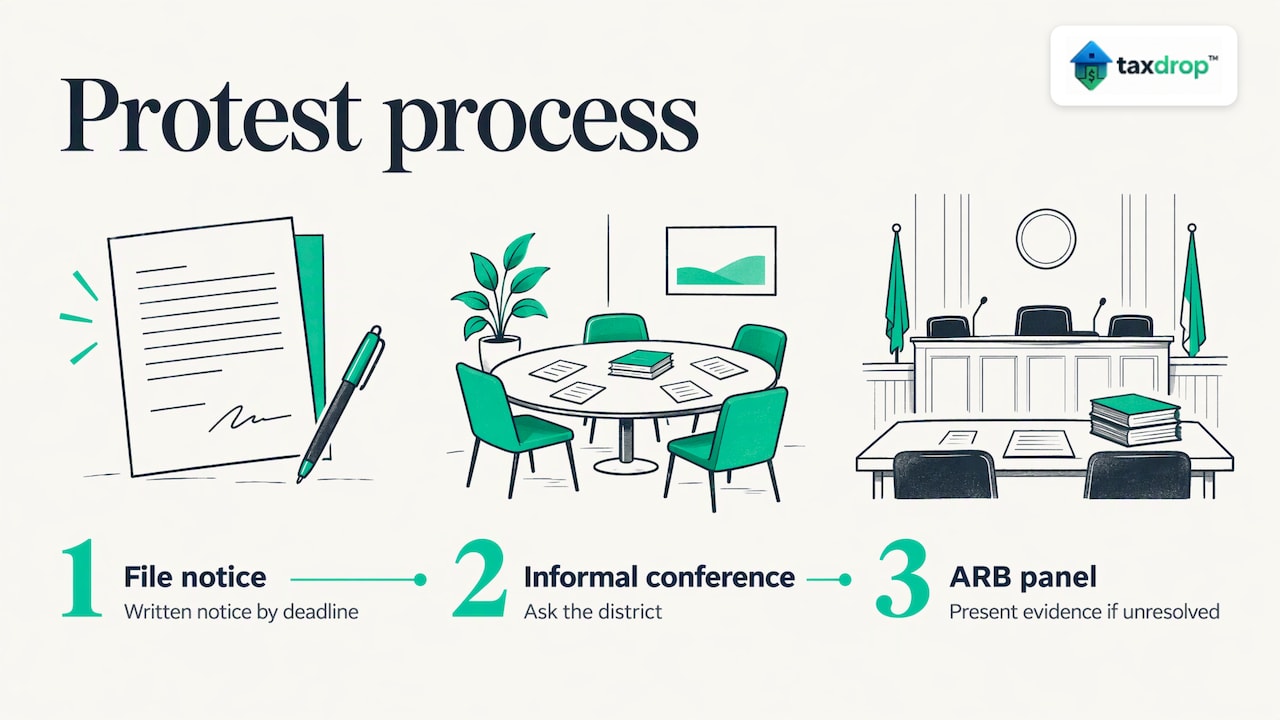
A protest service does that work for you. It reads the notice, pulls the district’s numbers, builds the case, files on time, and shows up. For an apartment building, that case is mostly numbers. Someone has to turn your rent roll and expenses into a value the district will respect.
That’s the job. Here’s how to do it well, whoever does it.
Why apartments are different from houses
A house protest leans on recent sales of similar homes. An apartment building is valued more like a business. What matters is how much income it produces after expenses.
That changes what you bring. The Dallas Central Appraisal District lists the evidence it expects on multifamily and commercial properties:
- Rent rolls and rent summaries
- Income and expense statements, typically three years
- Lease rates and concessions
- Occupancy history
- Comparable sales
- A complete independent appraisal report
The El Paso Central Appraisal District packet for 2025 asks for much the same on commercial property. It adds land leases, gross sales revenue, construction or repair costs, photographs and a sale contract or closing statement.
Two districts, one pattern. Show the real money the building makes.
If you own a small complex, a duplex or a mixed-use building, the same logic holds. We have pages for apartment complexes and mixed-use properties that explain how we treat each.
How to tell if your apartment value is too high
Start with the notice of appraised value. Then ask three questions.
- Does the value match what the building earns? Take your last year of net operating income, which is rent collected minus operating costs. Compare it to the value the district assigned. If the district’s value implies a return far below what buyers in your area accept, you have a case.
- Did the district assume full occupancy? Vacancy, concessions and bad debt lower real income. Districts don’t always see them unless you show them.
- Are similar buildings valued lower? Texas allows protests on market value and on unequal appraisal, which means your property is valued higher than comparable ones. The Texas Real Estate Research Center advises checking both grounds when they apply. It also advises requesting the district’s own evidence before the hearing.
Condition counts too. Deferred repairs, a failing roof or unit damage lower value. The same guide says to document them with photos and repair estimates, not just claims.
What doesn’t work
Don’t protest because your tax rate went up. Don’t protest because the budget is too big or because you can’t afford the bill. The Texas Real Estate Research Center notes that those arguments don’t show the value is wrong. Districts appraise value. Taxing units set rates.
I see owners lose hearings on this every year. Anger about the bill is fair. It’s just not evidence.
A worked example
Here’s an illustration with round numbers. The tax rate is an assumption for the math, not a published figure. Your combined rate will differ.
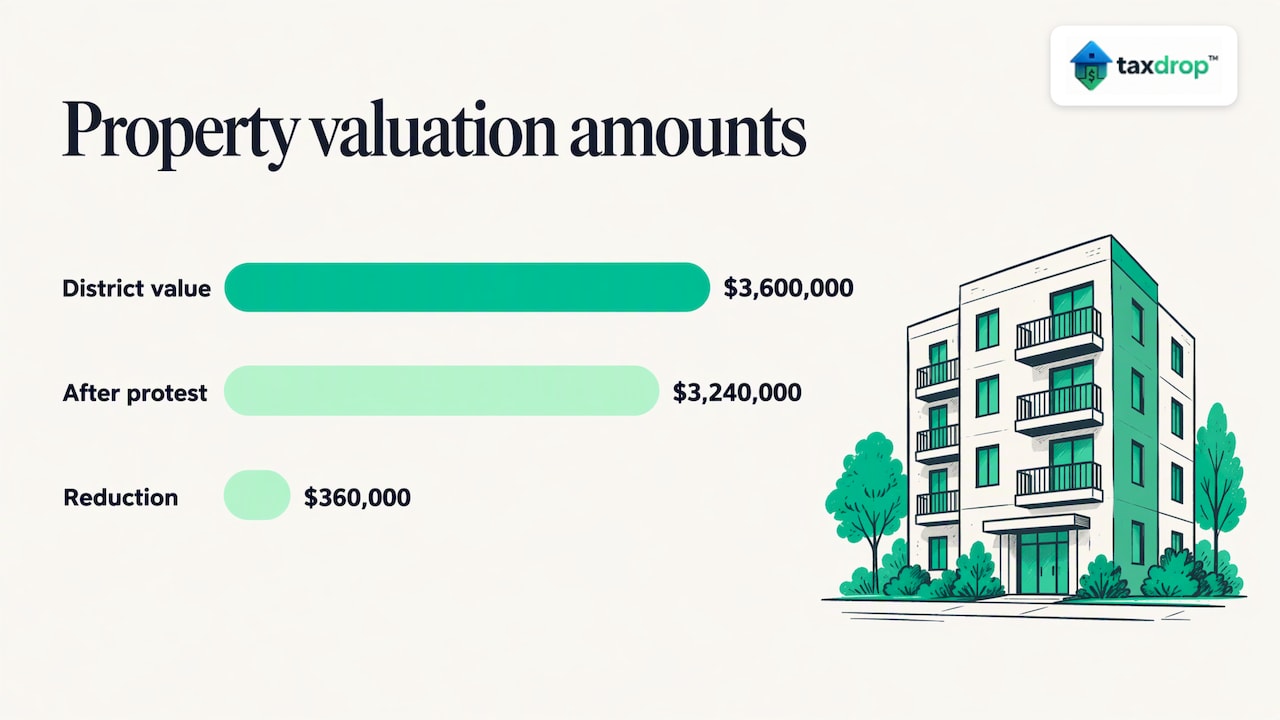
Say you own a 24-unit building in Tarrant County. The district values it at $3,600,000. Your records show vacancy and concessions the district never counted. Your evidence supports a value of $3,240,000.
| Item | Amount |
|---|---|
| District value | $3,600,000 |
| Value after protest | $3,240,000 |
| Reduction | $360,000 |
| Assumed combined tax rate | 2.3% |
| Estimated tax saved | $8,280 |
That’s $8,280 in year one. A lower value also becomes the starting point for next year’s notice. The saving can repeat if you protest again.
Now compare it to the fee. A contingency fee takes a percentage of the savings. If there are no savings, you owe nothing with us. A flat annual fee is a fixed cost whether you save or not. Either way, you weigh the fee against a number like that $8,280.
Deadlines and filing rules
The Comptroller says the usual deadline is May 15 or 30 days after the district mails the notice, whichever is later. A late protest may be heard for good cause. The El Paso district’s 2026 procedures say the late protest has to come in before the ARB approves the appraisal records, and the ARB decides whether the cause is good.
I wouldn’t count on good cause. Treat May 15 as the date. Our deadline guide walks through the timing.
The filing itself is easy. A valid notice doesn’t need the official form. It needs to identify the property and the owner and say, in writing, that you disagree. The Comptroller’s recommended form is 50-132, Notice of Protest.
What comes next matters more:
- The district schedules your hearing. Dallas CAD says it gives at least 15 days’ notice.
- You can appear in person, by phone or videoconference, or send a written affidavit, which is a sworn written statement.
- Both you and the district can present evidence.
Paper notices and deadlines pile up when you manage several buildings. A tracking habit helps. For a model of how to keep written notices organized, see this guide on responding to HOA letters in Texas.
Informal conference first, then the ARB
Most owners skip straight to the hearing in their heads. I wouldn’t.
The Texas Real Estate Research Center recommends exploring an informal conference before a formal hearing. I agree. It’s a meeting with an appraiser at the district. No panel, no formality. You hand over your rent roll and statements, and many cases settle there.
If they don’t settle, you go to the ARB with the same evidence, tidier. We explain the differences in informal review vs ARB hearing.
Here’s where I disagree with common advice. People say to wait for the notice, then scramble. For apartments, I’d gather the last three years of income and expenses in January. You’ll have a stronger case and fewer rushed mistakes in May.
I’d also skip the “bring your neighbor’s lower bill” move for a multifamily property. A different building has different income. Your own numbers beat a neighbor’s tax statement.
Who can file for you
An owner can name an agent. The Texas Tax Code, section 1.111, says you can authorize an agent in writing on the Comptroller-prescribed form. The designation takes effect for a district once it’s filed with that district. It also says tax bodies can’t force you to use an agent. Hiring help is your choice.
If you own a number of buildings, or you have no time for hearings, an agent makes sense. If you have one small building and clean books, you could file yourself. Our step-by-step protest guide shows how.
What a service costs and how fees work
Fees usually come in two shapes. Some firms charge a percentage of the tax you save, so you pay only when the bill drops. Others charge a flat fee for evidence preparation. I won’t quote a market average, because I can’t point you to an official source for one. Ask any provider for the fee in writing before you sign.
Here’s how ours works:
- Full-service protest: a contingency fee, a percentage of the tax savings. No reduction, no payment.
- TaxDrop One: a flat $129 per year per property. It’s a self-service evidence package built by licensed consultants.
- TaxDrop Pro: has no published price on our pricing page.
Full-service covers negotiation, hearing attendance and annual refiling. You also get a dashboard to track progress and savings. Our pricing and fees help center answers the common questions.
Where TaxDrop fits
We built TaxDrop for Texas owners who want the protest handled. Our AI analyzes market data. A licensed consultant reviews every case. We track deadlines and refile automatically each year.
For an apartment owner, the point is simple. You send the building’s records. We build the case and file it. You don’t pay a fee on full-service unless the bill goes down.
See our commercial property tax protests page, or read the evidence guide to see what we’ll ask you for.

Ready to start? Pick a plan on our pricing page, or talk to a Texas property tax consultant about your building.
Perspective from the TaxDrop team
We think apartment owners shouldn’t pay for a protest that doesn’t work. That’s why our full-service protests are no savings, no fee.
Apartments are won on the numbers. A rent roll, an operating statement and honest occupancy data say more than any argument. Our licensed consultants review every case, and our AI pulls market data so the evidence is current.
We also think the protest shouldn’t end in May. A lower value helps only if someone defends it next year. That’s why we refile automatically and show progress on a dashboard.
If you want to do the work, TaxDrop One gives you an evidence package for $129 per year per property. If you’d rather hand it off, our full-service protest does the negotiating and attends the hearing.
the author
FAQ
Can I protest an apartment building’s value every year?
Yes. Texas lets owners protest each year when they disagree with the district’s value. Each year brings a new notice and a new deadline. Our full-service protest refiles automatically, so you don’t have to remember.
What records should I gather first?
Start with your rent roll and three years of income and expense statements. Add occupancy history, lease rates and concessions. Photos and repair estimates help if the building has condition problems. Dallas CAD lists these items in its protest guide.
Does a protest work if my taxes went up because of the tax rate?
Not by itself. Protests challenge appraised value, not rates. If the district’s value is too high, you can protest that. A rate increase is a separate matter for the taxing units that set it.
Do I pay anything if the protest fails?
On full-service protests with TaxDrop, no. We charge a percentage of the tax savings, and without a reduction, you owe no fee. TaxDrop One is a flat annual fee of $129 per property for the evidence package.
Sources
- Appraisal Protests and Appeals, Texas Comptroller
- It’s Property Tax Season, Here’s Your Guide to Protest Your Appraisal, Texas Real Estate Research Center
- The Protest Process, Dallas Central Appraisal District
- Taxpayer Information, El Paso Central Appraisal District, 2025
- Protest and Appeals Procedures 2026, El Paso Central Appraisal District
- Texas Tax Code, section 1.111, Texas Statutes
Recommended
Paying Too Much in Property Taxes?
Let our licensed property tax experts assess your tax bill for potential savings. 92% of Texas protests we closed in 2026 got a reduction. It takes less than 3 minutes to enroll.
⏰
🏠
💵
No Savings No Fee
FAQs

Ryder Meehan
Ryder Meehan is the Co-Founder of TaxDrop and a Licensed Property Tax Protest Consultant