
Property Tax Protest Review: What to Check Before You Hire Help

Key Takeaways:
A good property tax protest comes down to three things: filing on time, bringing real market evidence, and showing up prepared. Expert guidance pays off when you don’t have the time or the data to do those three well. I’m Ryder Meehan, Founder and Licensed Property Tax Consultant at TaxDrop. I’ve been a landlord since 2012, with rentals in Dallas and Grayson counties, so I’ve paid these bills and protested them myself.
This review covers how a Texas protest works, what the state says wins one, and how to judge fees and results claims. It also covers where we fit in. If you’d rather hand it off, our residential property tax protests carry a “no savings, no fee” guarantee.
TL;DR
- You can protest if you disagree with the appraisal district’s value. Filing is due by May 15 or 30 days after your notice was delivered, whichever is later.
- The district usually carries the burden of proof in a value protest. You still need evidence, because “my value is too high” doesn’t win.
- Ability to pay, and the size of your tax bill, aren’t grounds for a protest. Market value and equal treatment are.
- Doing it yourself costs $0 and your time. A registered consultant builds the evidence and attends the hearing for a fee tied to savings.
- Judge any service on its fee structure, its registration, and what happens if you save nothing.
Table of Contents
- What a protest actually is
- Deadlines and the paperwork
- How the process runs
- What wins a protest: evidence
- Who carries the burden of proof
- Doing it yourself versus using a service
- How to review a protest service
- Where I disagree with common advice
- What I’d do, and what I’d skip
- Ready to hand it off?
- FAQ
- Sources
What a protest actually is
Your county appraisal district (the local office that sets the value of your property) mails you a notice of appraised value each spring. If you disagree with that value, you can protest to the Appraisal Review Board, or ARB. The ARB is a group of local citizens who hear disputes between owners and the district.
The Texas Comptroller says you may protest if you disagree with the district’s value or any of its actions concerning your property. That includes denied exemptions, which are tax breaks like the homestead exemption.
The district sets value. It doesn’t set your tax rate. Cities, counties and school districts do that. So a protest can lower your value, but it can’t lower the rate.
Deadlines and the paperwork
The rule sits in Texas Tax Code Section 41.44. Your written notice of protest is due by May 15 or the 30th day after your notice was delivered, whichever is later. The Comptroller’s Property Tax Basics guide adds that a deadline falling on a weekend or holiday moves to the next business day.
Late filing is possible for good cause. The statute also gives extra time to Gulf of Mexico offshore workers and to active-duty military stationed outside the U.S. Don’t plan around those exceptions, though.
Districts also vary on how they take filings. Dallas CAD’s 2026 process says it won’t take fax or e-mail protests. Online filing opened April 15 that year, and mailed protests needed a postmark by May 15. Check your own district’s page each year. Our deadline guide tracks the pattern.
The form is Form 50-132, Property Owner’s Notice of Protest. You can name an agent with Form 50-162. No official form is required if your written notice names the property, the owner and your disagreement with a district decision, per the Comptroller.
How the process runs
Here’s the usual order:
- The district mails your notice. For a value increase, the Comptroller says it’s due by May 1, or April 1 for a homestead.
- You file your protest.
- The district offers an informal conference. Section 41.445 requires one if you ask.
- If you don’t settle, the ARB schedules a hearing.
- You get your order, and you can still go further if you disagree.
Dallas CAD says the ARB gives at least 15 days’ notice of the hearing. The Comptroller says most hearings must finish by July 20.
You can attend in person, by phone or video, or send an affidavit, which is a sworn written statement. Remote appearances need your evidence submitted by affidavit.
The informal step is where most protests end. I wrote a full comparison of informal review versus the ARB hearing. If you want the whole filing path with screenshots-level detail, use our step-by-step protest guide.
Denton and Tarrant counties
If you own in Denton or Tarrant County, the state rules are the same. The local office changes how you file and what the portal looks like. Tarrant Appraisal District’s protest procedures page says owners can protest concerns about value, comparable properties, or inclusion on the roll. Pull your district’s current-year instructions before you file, because portals and dates shift.
What wins a protest: evidence
This is where most self-filed protests fail.
The Comptroller states plainly that you can’t walk into a hearing and say the district is wrong. Its protest page lists evidence that counts: photos, repair estimates, sales documents, affidavits, surveys and deed records. For equal-and-uniform protests, it lists median-level appraisal calculations. It also says to stay factual and skip emotional arguments.
Two kinds of case do most of the work:
- Market value. Your home would sell for less than the district says as of January 1. Recent sales of similar homes nearby are the core evidence.
- Unequal appraisal. Similar homes are valued lower per square foot than yours. You show the comparison.
A sales comp is a recently sold home close to yours in size, age, condition and location. Our guide to reading a comparable sales report shows how to tell a strong comp from a weak one. Jefferson CAD’s 2026 ARB procedures say the board decides on the evidence at the hearing. They also say an owner who only says the value is too high is unlikely to win.
If you want to see how sellers handle low valuations, the same logic applies in reverse. This piece on how appraisal gaps work shows why the market data behind a value matters more than opinion.
A worked example
Say your district values your home at $400,000. Your comps support $370,000. That’s a $30,000 reduction.
At a combined tax rate of 2.2% (an illustration, since your rate depends on your taxing units), the savings are $30,000 × 0.022 = $660 on that year’s bill. If your homestead exemption applies, the cap on yearly increases for homesteads can carry some of that benefit into later years. Check your district’s rules on that.
Now compare the cost. A fee of 30% of the savings would be $198. You keep $462. Doing it alone keeps all $660, but costs you the hours.

Mistakes that sink protests
A Texas Real Estate Research Center protest guide from March 2026 lists the common ones. Don’t argue about the tax bill itself. Don’t use list prices as comps, because only closed sales count. Don’t lean on your ability to pay, since your finances aren’t a legal ground for a valuation protest.
The guide also tells owners to request the district’s evidence packet before the hearing. I’d do that every time.
Who carries the burden of proof
Here’s something many owners don’t know. In most value and unequal-appraisal protests, the district, not you, has the burden of proof. The Comptroller’s 2026 ARB training manual says the standard is a preponderance of the evidence. That means “more likely than not.” If the district can’t meet it, the board must rule for you.
For property valued at $1 million or less, a valid certified appraisal can raise that bar to clear and convincing evidence. The appraisal must be done within 180 days before the hearing and delivered 14 days before it.
So your job isn’t to prove everything. It’s to give the board a better-supported number than the district has.
Doing it yourself versus using a service
Texas lets you represent yourself. The Comptroller offers free guides, including “How to Present Your Case at an ARB Hearing.” Plenty of owners file online, get an offer at the informal stage, and take it.
That’s a fair route if you have a few free evenings and a clear read on comps. Where it gets hard:
- Finding good comps takes data access and judgment.
- Hearings fall in a tight window, May through July.
- You’d need to repeat the work every year.
- Landlords and investors may have several properties to cover.
This is what a service does. A registered consultant builds the evidence packet, handles the informal conference, and presents at the hearing if it gets that far. Compensated consulting in Texas generally requires registration under Occupations Code Chapter 1152. Applicants without a broker, salesperson or appraiser license need 40 classroom hours and an exam. TDLR’s registration form lists a $50 total registration cost.
That’s a low bar, so registration alone doesn’t tell you how good someone is. It does tell you they’re legally allowed to act for you.
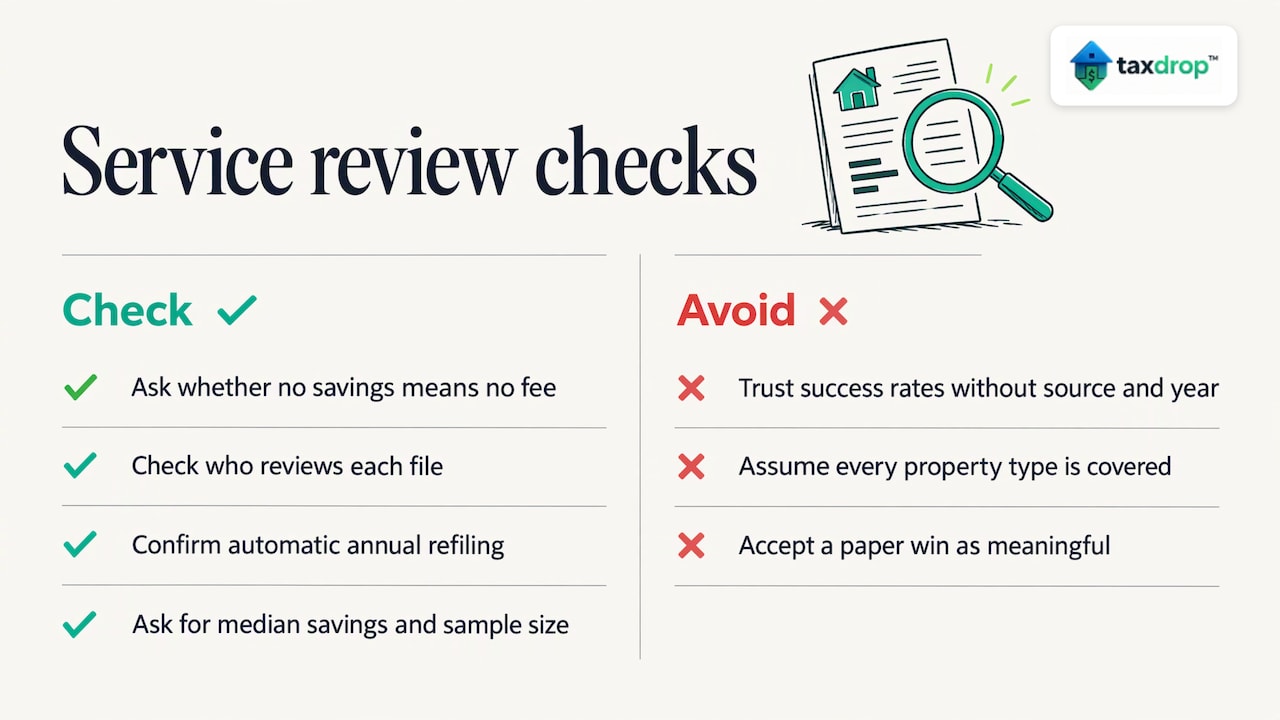
How to review a protest service
Use these checks on any firm, including us.
Fee structure. Ask what it costs if you save nothing. Our full-service protests are “no savings, no fee.” You pay only when your tax bill goes down. We also offer a self-service evidence package built by licensed consultants. TaxDrop One is listed at $129 per year per property.
Who does the work. Our consultants review every case. Ask any firm whether a licensed person reviews your file or just software does.
Annual refiling. A protest is a yearly job. Our full-service option includes automatic refiling, so you don’t lose a year by forgetting.
Visibility. You should be able to see where your case stands and what you saved. We give you a dashboard for that.
Results claims. Any figure needs a named source and a year. Be careful with success rates quoted on company blogs. They rarely say what counts as a “win.” A $5 reduction is a win on paper. I’d ask for the median savings and the number of properties behind it.
Scope. Make sure the service covers your property type. We handle residential, commercial and agricultural protests.
Where I disagree with common advice
You’ll hear “take the district’s informal offer fast, it’s easy money.” I’d slow down.
The first offer is a starting point. I’ve seen owners accept a small cut when their comps supported a bigger one. Before you say yes, compare the offer to your own comps. If the gap is a few hundred dollars of tax, taking the offer is fine. If it’s larger, keep going.
The other common line is “always protest.” I wouldn’t say always. The Comptroller’s Property Tax Basics asks owners to weigh the reasons, the evidence and whether the savings justify the time and expense. On a small value gap, the numbers can be thin. I’d skip it if your comps clearly support the district’s value.
What I’d do, and what I’d skip
I’d protest every year my value rose faster than nearby sales. I’d pull comps closest to January 1. I’d ask for the district’s evidence before any hearing.
I’d skip arguing about tax rates. I’d skip hardship stories. And I’d skip filing at the last minute, since portals get slow near May 15.
For a single homestead where I had time, I might file it myself. For my rentals, I hand them off. Our primary home guide covers homestead details.
Our view
We built TaxDrop for owners who know they should protest and don’t have the hours. A protest is mostly evidence work, and evidence work repeats every year. Our approach pairs AI-driven market data analysis with review by a licensed consultant on every case.
We’d rather you pay nothing when we find nothing. That’s why full-service protests run on a contingency fee. You see progress and savings in your dashboard, and we refile for you each year.
If you own in Denton, Tarrant, Dallas or Grayson county, the rules are the same. The work is knowing your district’s data and filing on time.
the author
Ready to hand it off?
If you want a licensed consultant on your protest, start with our pricing page. Full-service protests run on a “no savings, no fee” basis. Self-service evidence packages carry a flat annual fee per property, and TaxDrop One is listed at $129 per year per property.

We handle deadline tracking, document preparation, negotiation and hearing attendance. You can also read about our Texas property tax consultants.
FAQ
Should I protest my property taxes every year?
Protest when your value rose faster than comparable sales, or when you see an error like wrong square footage. Weigh the likely tax savings against your time. If you hire a service that refiles each year, the yearly work is handled for you.
Can I protest because my tax bill is too high?
No. The district sets value, and local taxing units set rates. A protest has to rest on value, equal treatment or a district action like a denied exemption. Your ability to pay isn’t a legal ground, according to the Texas Real Estate Research Center.
What if I miss the May 15 deadline?
You may still have until 30 days after your notice was delivered if that date is later. Section 41.44 also allows late protests for good cause, plus special rules for offshore workers and deployed military. Don’t count on it. File early.
Do I have to attend the hearing?
No. You can appear in person, by phone or video, or by affidavit under Section 41.45. Remote appearances require your evidence to be submitted by affidavit. If you hire us, we attend for you.
Sources
- Texas Comptroller: protests
- Texas Property Tax Basics, January 2026
- Texas Tax Code, Chapter 41
- Dallas CAD protest process, 2026
- Tarrant Appraisal District protest procedures
- Jefferson CAD ARB hearing procedures, 2026
- Comptroller ARB training manual, 2026
- Texas Occupations Code, Chapter 1152
- TDLR property tax consultant registration form
- Texas Real Estate Research Center protest guide, March 2026
Recommended
Paying Too Much in Property Taxes?
Let our licensed property tax experts assess your tax bill for potential savings. 92% of Texas protests we closed in 2026 got a reduction. It takes less than 3 minutes to enroll.
⏰
🏠
💵
No Savings No Fee
FAQs

Ryder Meehan
Ryder Meehan is the Co-Founder of TaxDrop and a Licensed Property Tax Protest Consultant